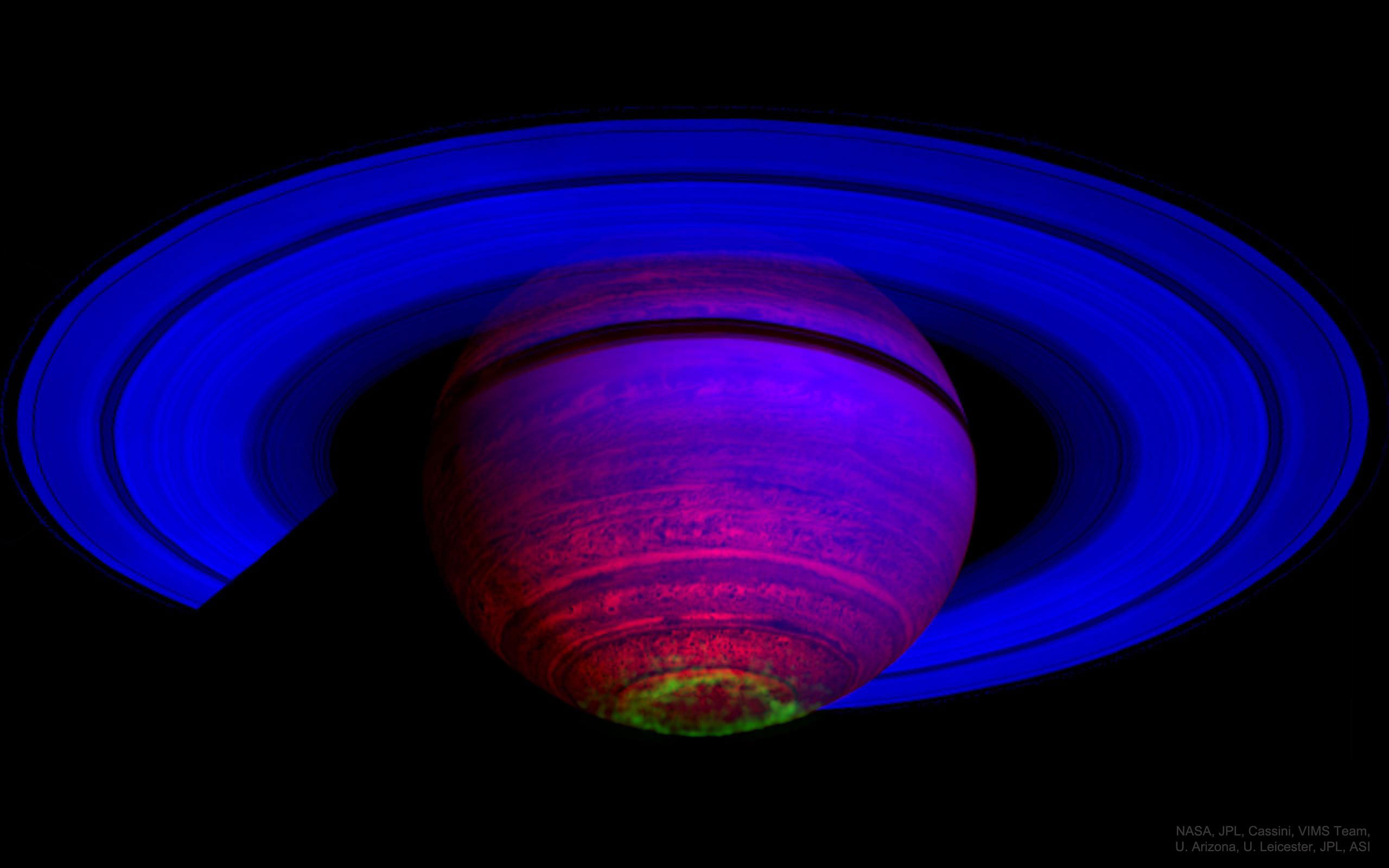
What drives auroras on Saturn? To help find out, scientists have sorted through hundreds of infrared images of Saturn taken by the Cassini spacecraft for other purposes, trying to find enough aurora images to correlate changes and make movies. Once made, some movies clearly show that Saturnian auroras can change not only with the angle of the Sun, but also as the planet rotates. Furthermore, some auroral changes appear related to waves in Saturn's magnetosphere likely caused by Saturn's moons. Pictured here, a false-colored image taken in 2007 shows Saturn in three bands of infrared light. The rings reflect relatively blue sunlight, while the planet itself glows in comparatively low energy red. A band of southern aurora in visible in green. In has recently been found that auroras heat Saturn's upper atmosphere. Understanding Saturn's auroras is a path toward a better understanding of Earth's auroras.
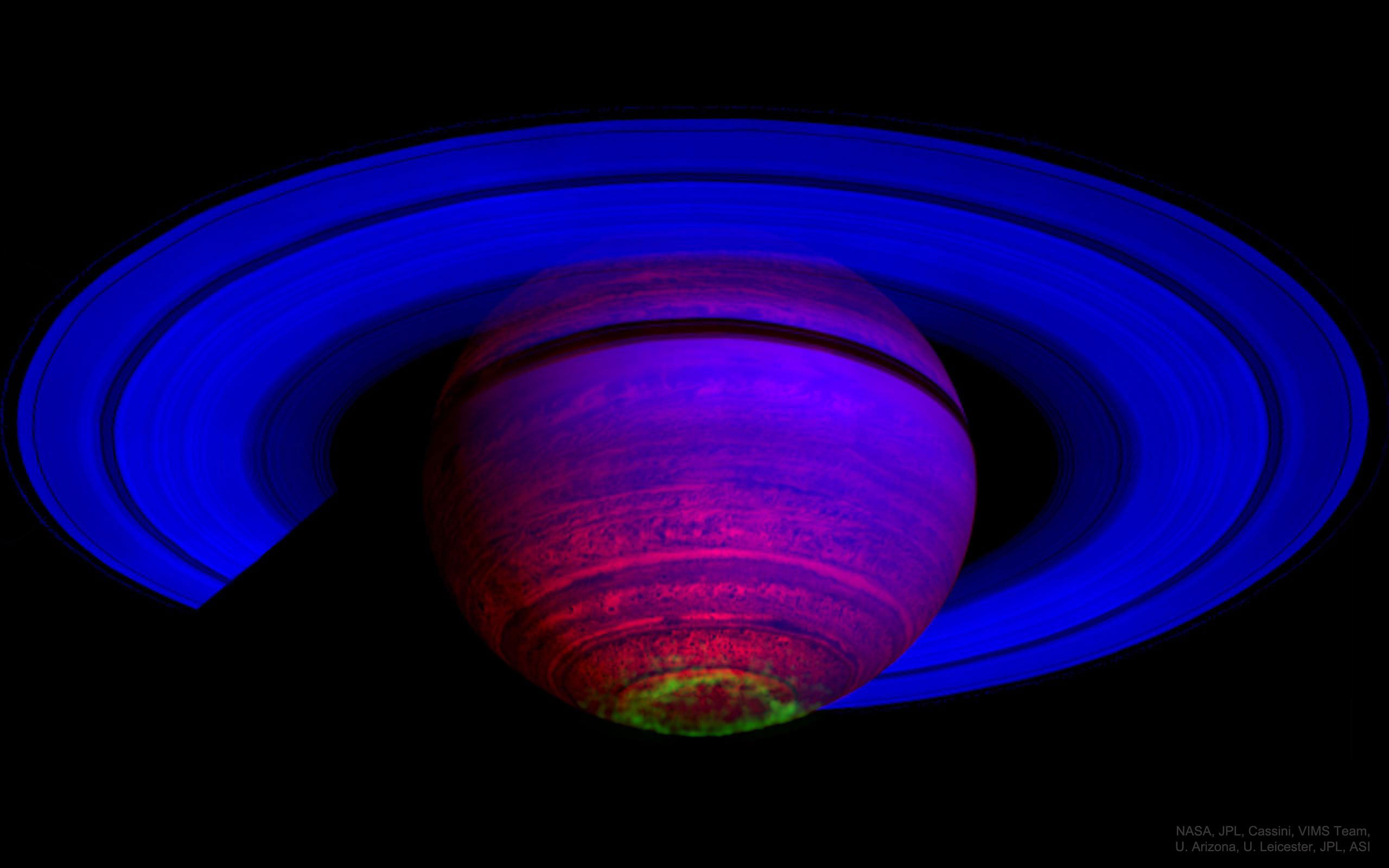
¿Qué impulsa las auroras en Saturno? Para ayudar a descubrirlo, los científicos han revisado cientos de imágenes en infrarrojo de Saturno tomadas por la nave espacial Cassini con otros propósitos, intentando encontrar suficientes imágenes de auroras para correlacionar cambios y crear películas. Una vez realizadas, algunas películas muestran claramente que las auroras de Saturno pueden cambiar no solo con el ángulo del Sol, sino también a medida que el planeta rota. Además, algunos cambios aurorales parecen estar relacionados con ondas en el magnetosfera de Saturno, probablemente causadas por las lunas de Saturno. En la imagen mostrada, una imagen en falso color tomada en 2007 muestra a Saturno en tres bandas de luz infrarroja. Los anillos reflejan luz solar relativamente azul, mientras que el planeta mismo emite luz roja de energía comparativamente baja. Una banda de aurora en el hemisferio sur es visible en color verde. Se ha descubierto recientemente que las auroras calientan la atmósfera superior de Saturno. Comprender las auroras de Saturno es un camino hacia una mejor comprensión de las auroras terrestres.