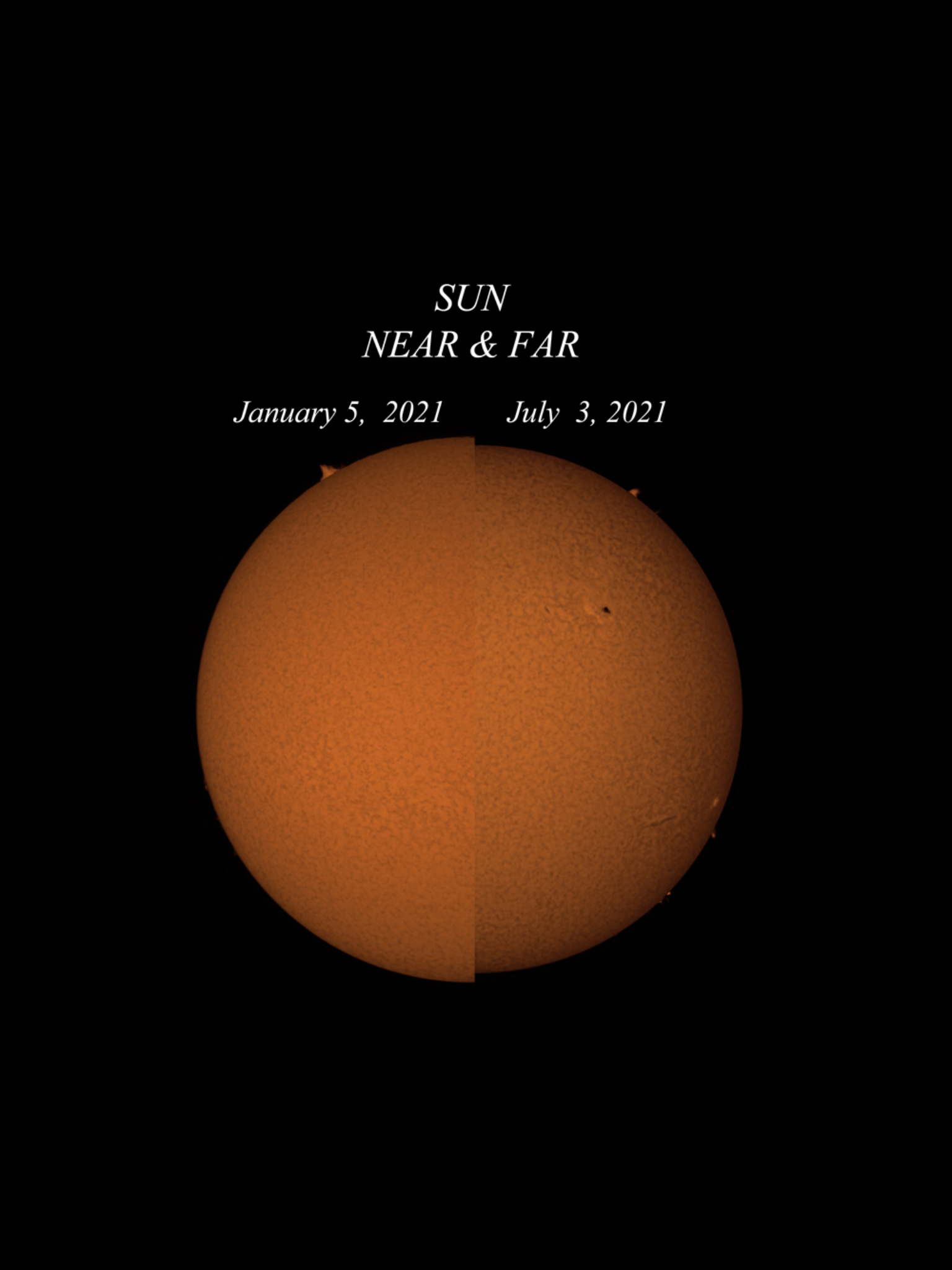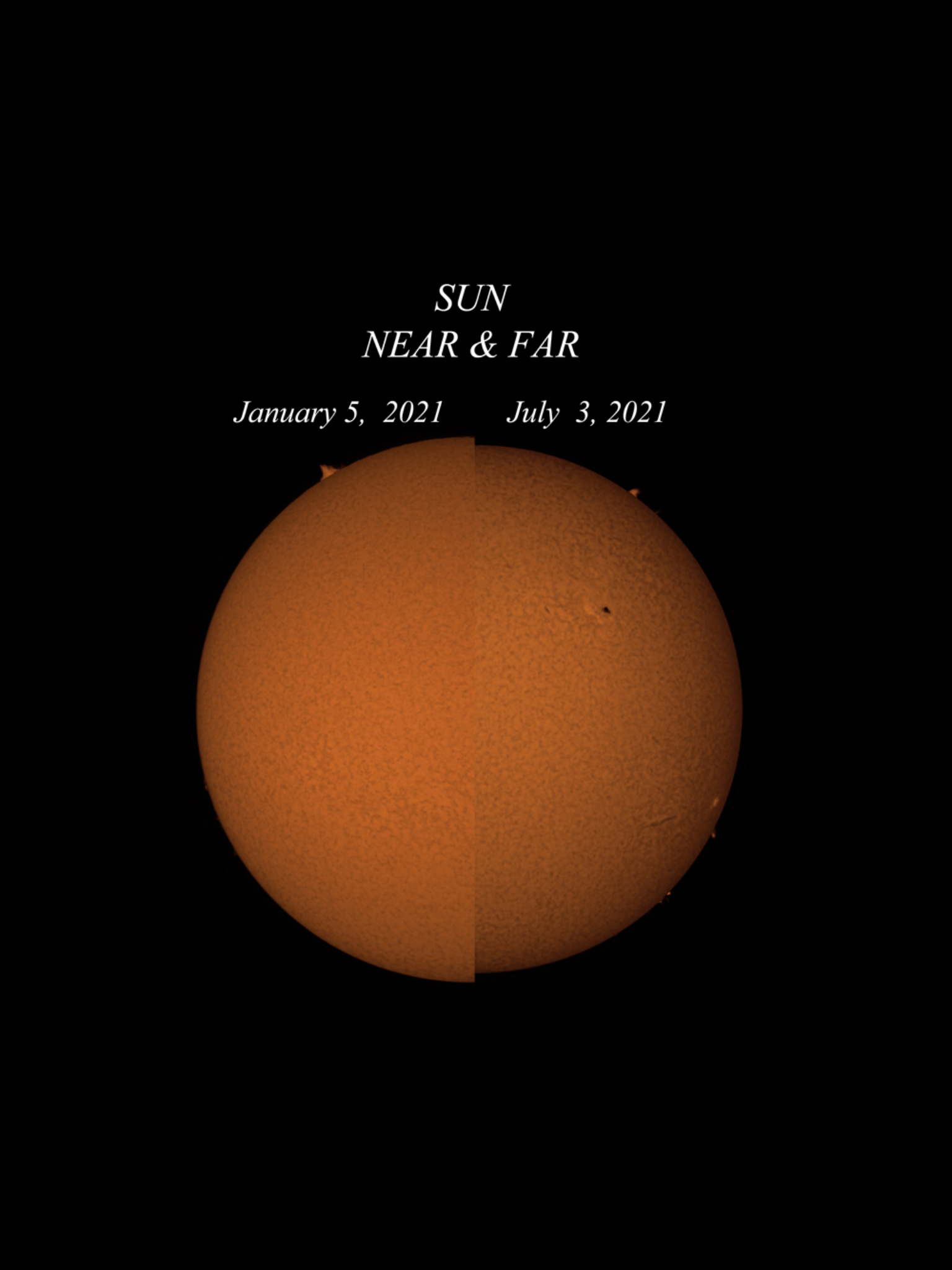
Aphelion for 2021 occurred on July 5th. That's the point in Earth's elliptical orbit when it is farthest from the Sun. Of course, the distance from the Sun doesn't determine the seasons. Those are governed by the tilt of Earth's axis of rotation, so July is still summer in the north and winter in the southern hemisphere. But it does mean that on July 5 the Sun was at its smallest apparent size when viewed from planet Earth. This composite neatly compares two pictures of the Sun, both taken with the same telescope and camera. The left half was captured close to the date of the 2021 perihelion (January 2), the closest point in Earth's orbit. The right was recorded just before the aphelion in 2021. Otherwise difficult to notice, the change in the Sun's apparent diameter between perihelion and aphelion amounts to a little over 3 percent.
El afelio de 2021 ocurrió el 5 de julio. Ese es el punto en la órbita elíptica de la Tierra cuando está más alejada del Sol. Por supuesto, la distancia al Sol no determina las estaciones. Estas están gobernadas por la inclinación del eje de rotación de la Tierra, por lo que julio sigue siendo verano en el hemisferio norte e invierno en el hemisferio sur. Pero eso sí significa que el 5 de julio el Sol tenía su menor tamaño aparente cuando se observa desde la Tierra. Esta composición compara claramente dos imágenes del Sol, ambas tomadas con el mismo telescopio y cámara. La mitad izquierda fue capturada cerca de la fecha del perihelio de 2021 (2 de enero), el punto más cercano en la órbita terrestre. La derecha fue registrada justo antes del afelio de 2021. Difícil de notar de otro modo, el cambio en el diámetro aparente del Sol entre el perihelio y el afelio asciende a un poco más del 3 por ciento.