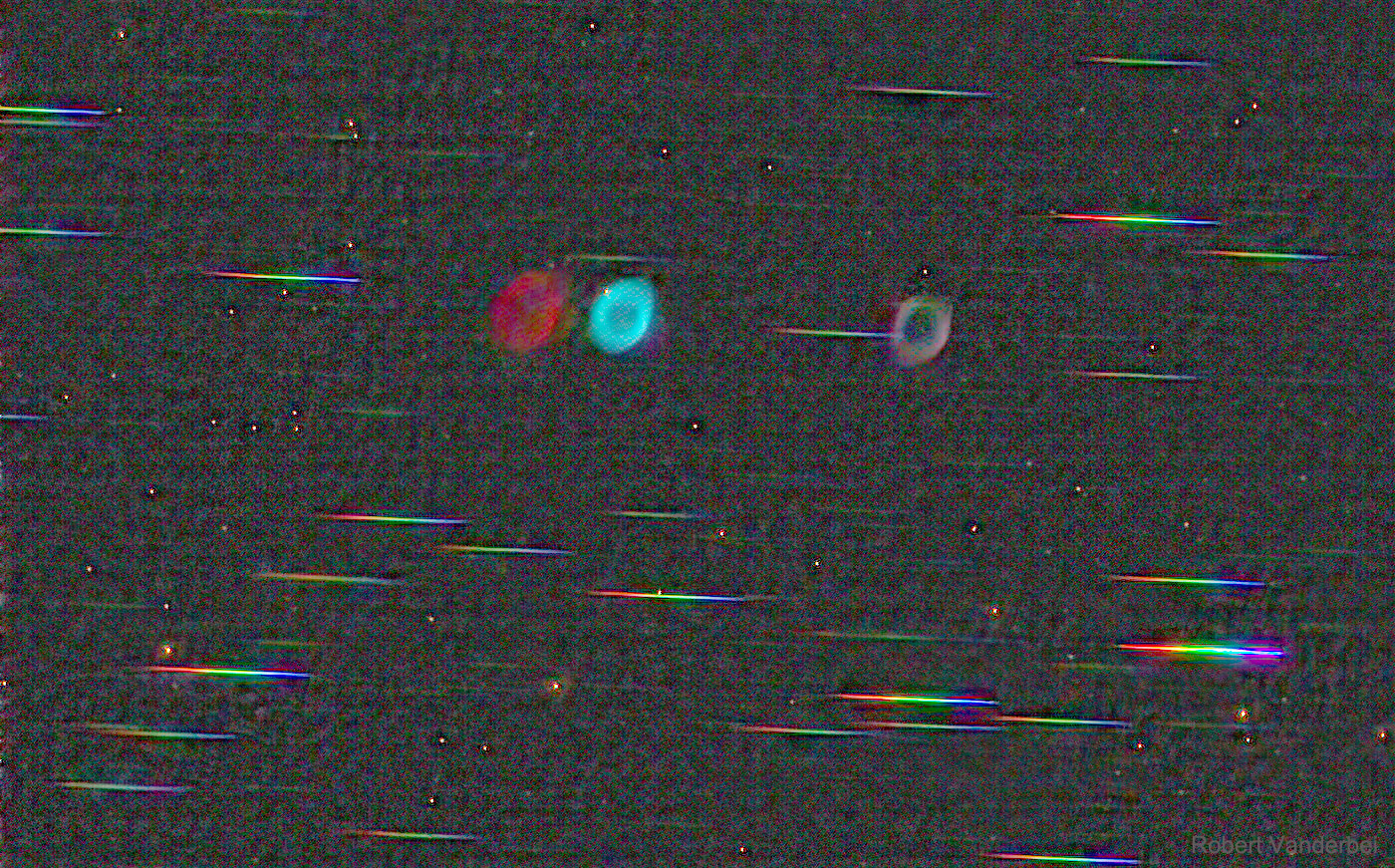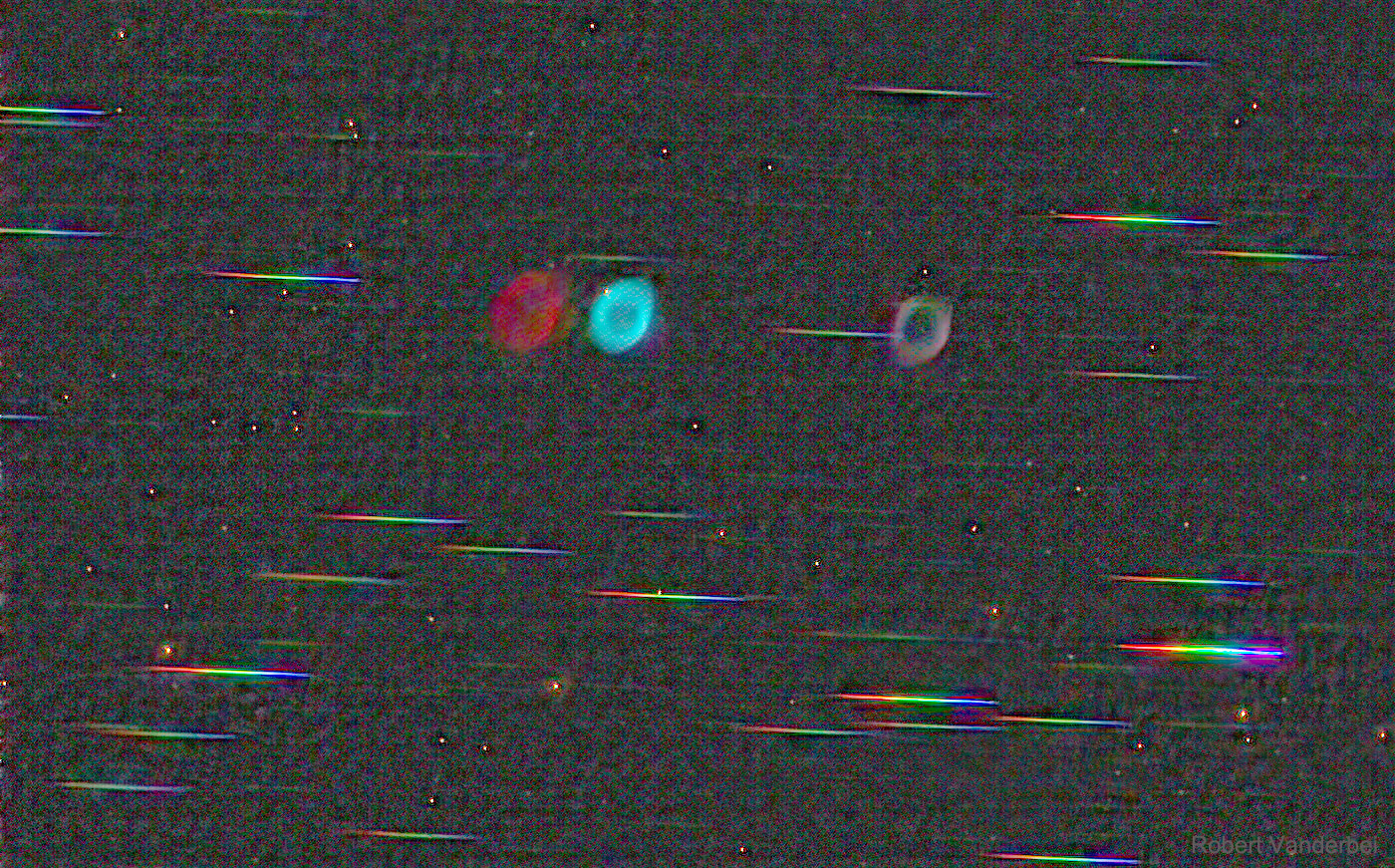
What if you could see, separately, all the colors of the Ring? And of the surrounding stars? There's technology for that. The featured image shows the Ring Nebula (M57) and nearby stars through such technology: in this case, a prism-like diffraction grating. The Ring Nebula is seen only a few times because it emits light, primarily, in only a few colors. The two brightest emitted colors are hydrogen (red) and oxygen (blue), appearing as nearly overlapping images to the left of the image center. The image just to the right of center is the color-combined icon normally seen. Stars, on the other hand, emit most of their light in colors all across the visible spectrum. These colors, combined, make a nearly continuous streak -- which is why stars appear accompanied by multicolored bars. Breaking object light up into colors is scientifically useful because it can reveal the elements that compose that object, how fast that object is moving, and how distant that object is.
¿Qué pasaría si pudieras ver, por separado, todos los colores del Anillo? ¿Y de las estrellas que lo rodean? Existe una tecnología para hacerlo. La imagen destacada muestra la Nebulosa Anillo (M57) y las estrellas cercanas mediante tal tecnología: en este caso, una rejilla de difracción similar a un prisma. La Nebulosa Anillo solo se ve en contadas ocasiones porque emite luz, principalmente, en muy pocos colores. Los dos colores más brillantes emitidos son el hidrógeno (rojo) y el oxígeno (azul), apareciendo como imágenes casi superpuestas a la izquierda del centro de la imagen. La imagen justo a la derecha del centro es el icono combinado de colores que normalmente se ve. Por otro lado, las estrellas emiten la mayor parte de su luz en colores a lo largo de todo el espectro visible. Estos colores, combinados, forman una raya casi continua — por eso las estrellas aparecen acompañadas por barras multicolores. Separar la luz de un objeto en colores es útil científicamente, ya que puede revelar los elementos que componen ese objeto, qué tan rápido se mueve ese objeto y qué tan lejos está ese objeto.