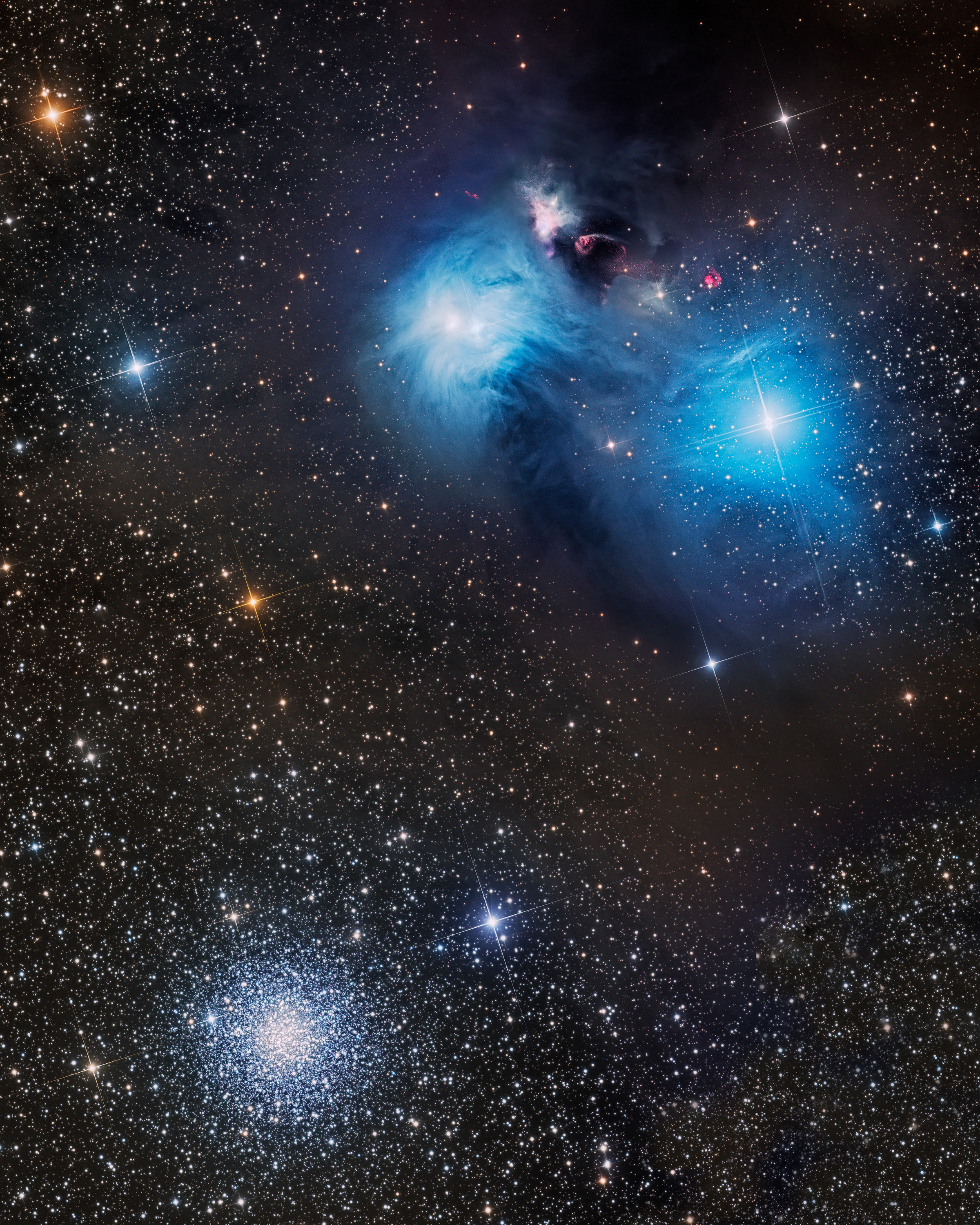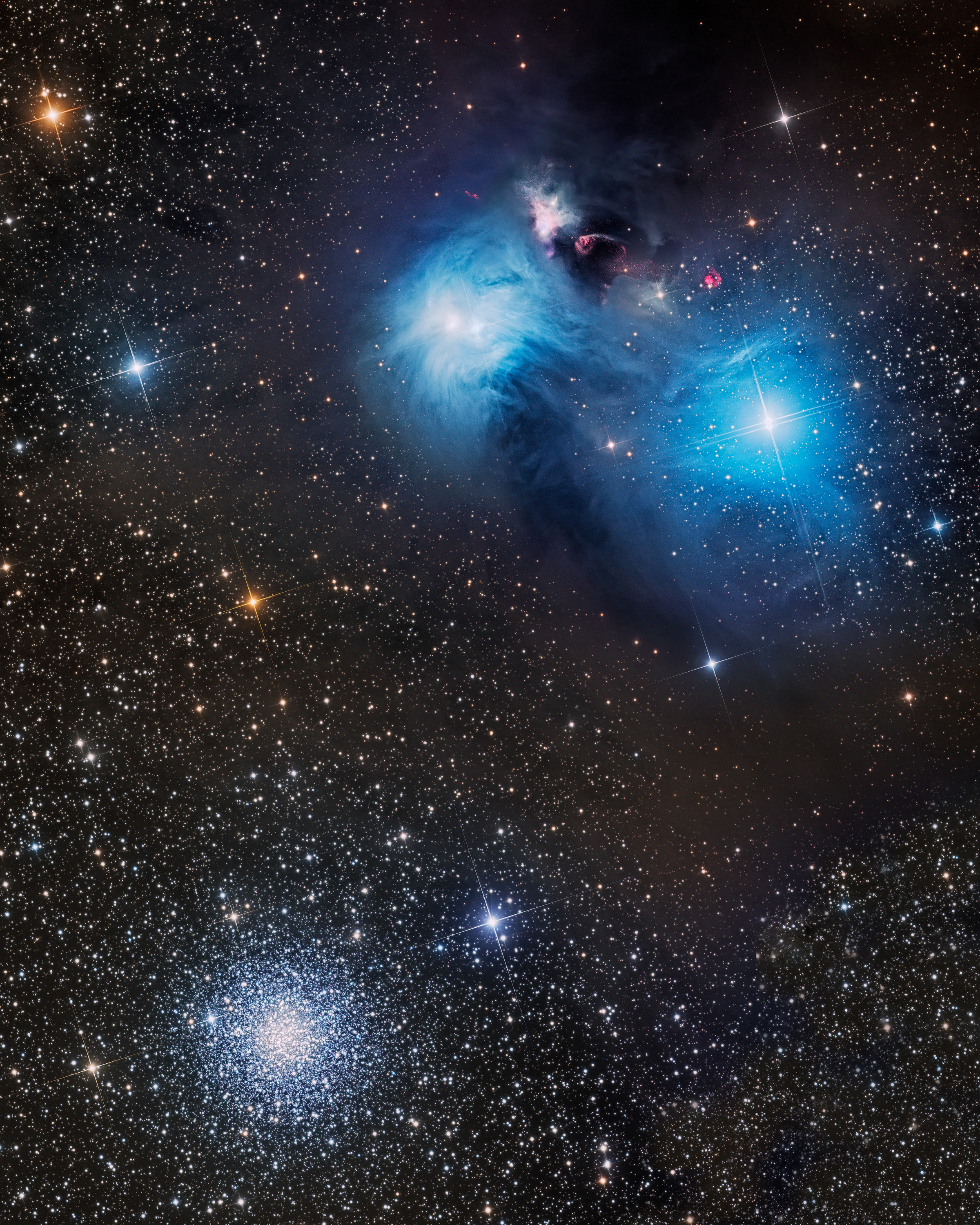
Cosmic dust clouds cross a rich field of stars in this telescopic vista near the northern boundary of Corona Australis, the Southern Crown. Less than 500 light-years away the dust clouds effectively block light from more distant background stars in the Milky Way. Top to bottom the frame spans about 2 degrees or over 15 light-years at the clouds' estimated distance. At top right is a group of lovely reflection nebulae cataloged as NGC 6726, 6727, 6729, and IC 4812. A characteristic blue color is produced as light from hot stars is reflected by the cosmic dust. The dust also obscures from view stars in the region still in the process of formation. Just above the bluish reflection nebulae a smaller NGC 6729 surrounds young variable star R Coronae Australis. To its right are telltale reddish arcs and loops identified as Herbig Haro objects associated with energetic newborn stars. Magnificent globular star cluster NGC 6723 is at bottom left in the frame. Though NGC 6723 appears to be part of the group, its ancient stars actually lie nearly 30,000 light-years away, far beyond the young stars of the Corona Australis dust clouds.
Crédito: NASA, CGRO SSC Nubes de polvo cósmico cruzan un campo rico en estrellas en esta vista telescópica cerca del límite norte de Corona Australis, la Corona del Sur. A menos de 500 años luz de distancia, las nubes de polvo bloquean eficazmente la luz de estrellas de fondo más distantes de la Vía Láctea. De arriba a abajo, el marco abarca aproximadamente 2 grados, o más de 15 años luz a la distancia estimada de las nubes. En la parte superior derecha se encuentra un grupo de hermosas nebulosas de reflexión catalogadas como NGC 6726, 6727, 6729 y IC 4812. Un característico color azul se produce cuando la luz de estrellas calientes es reflejada por el polvo cósmico. El polvo también oculta estrellas en la región que aún están en proceso de formación. Justo encima de las nebulosas de reflexión azuladas se encuentra una nebulosa más pequeña, NGC 6729, que rodea a la joven estrella variable R Coronae Australis. A su derecha se encuentran arcos y bucles rojizos identificados como objetos Herbig-Haro asociados con estrellas recién nacidas energéticas. El magnífico cúmulo globular de estrellas NGC 6723 se encuentra en la parte inferior izquierda del marco. Aunque NGC 6723 parece formar parte del grupo, sus estrellas antiguas en realidad se encuentran a casi 30 000 años luz de distancia, mucho más allá de las estrellas jóvenes de las nubes de polvo de Corona Australis.