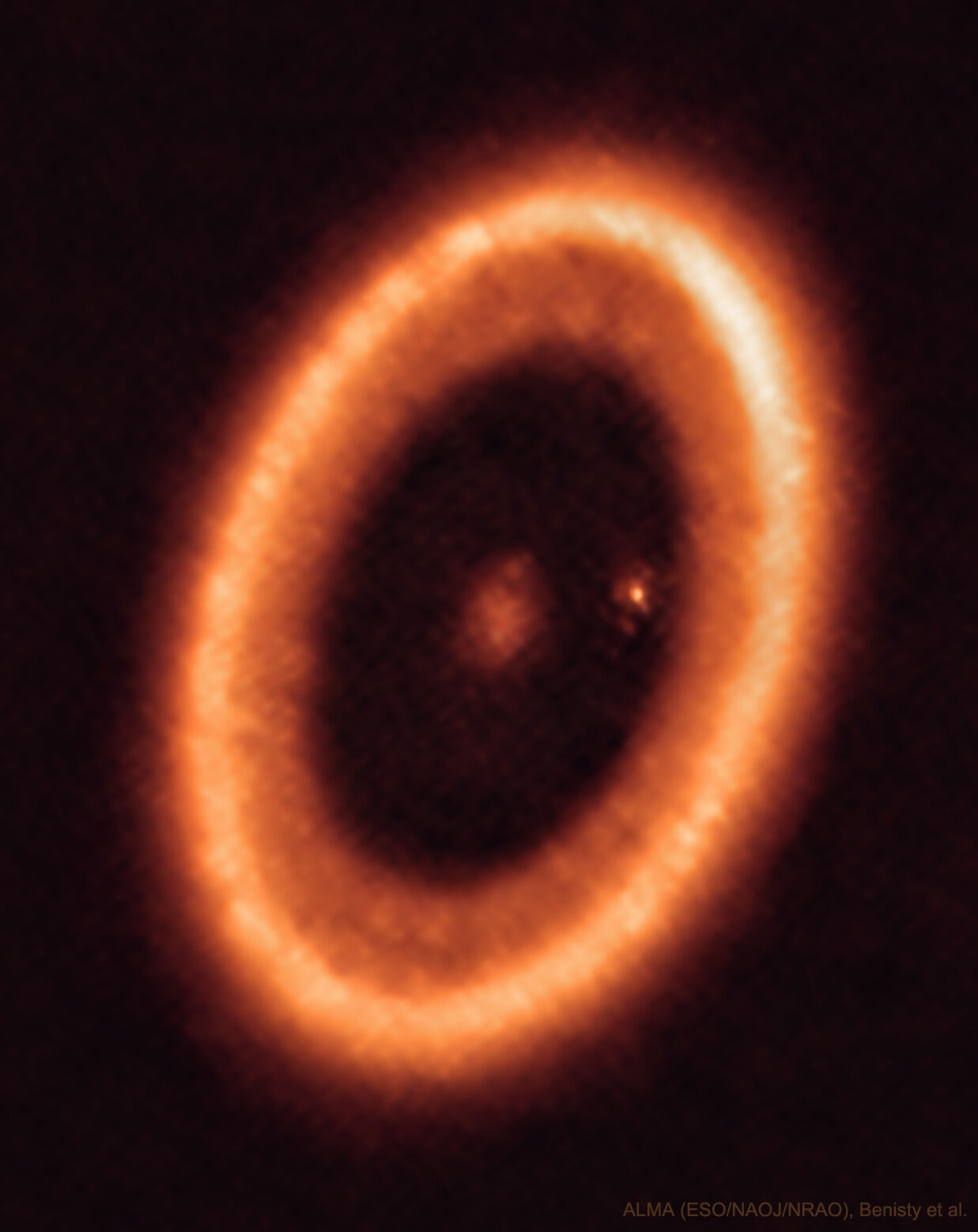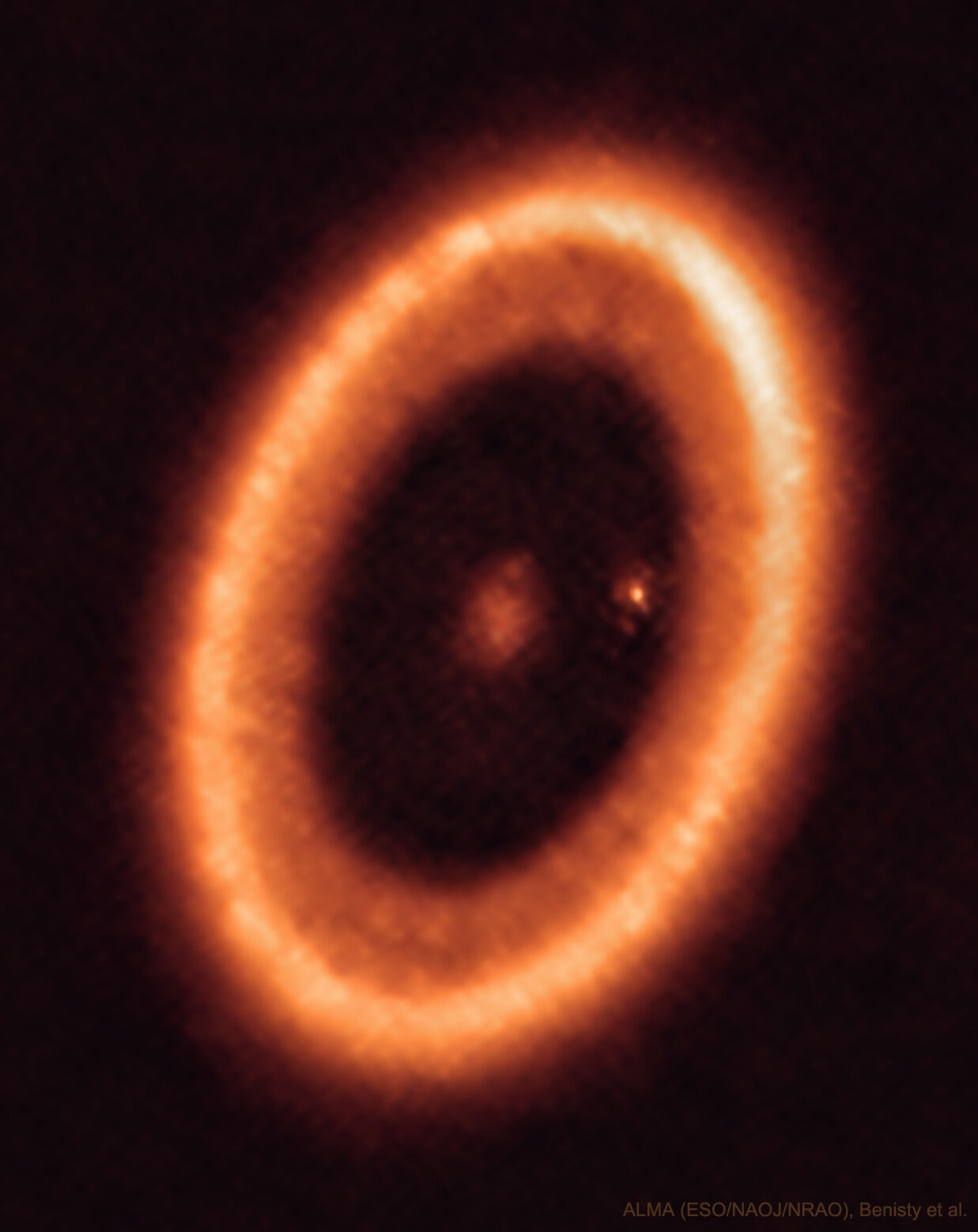
It's not the big disk that's attracting the most attention. Although the big planet-forming disk around the star PDS 70 is clearly imaged and itself quite interesting. It's also not the planet on the right, just inside the big disk, that’s being talked about the most. Although the planet PDS 70c is a newly formed and, interestingly, similar in size and mass to Jupiter. It's the fuzzy patch around the planet PDS 70c that's causing the commotion. That fuzzy patch is thought to be itself a dusty disk that is now forming into moons -- and that has never been seen before. The featured image was taken by the Atacama Large Millimeter Array (ALMA) of 66 radio telescopes in the high Atacama Desert of northern Chile. Based on ALMA data, astronomers infer that the moon-forming exoplanetary disk has a radius similar to our Earth's orbit, and may one day form three or so Luna-sized moons -- not very different from our Jupiter's four.
No es el gran disco el que está atrayendo la mayor atención. Aunque el disco de formación planetaria alrededor de la estrella PDS 70 está claramente capturado en la imagen y es en sí mismo bastante interesante. Tampoco es el planeta a la derecha, justo dentro del gran disco, el que está generando el mayor debate. Aunque el planeta PDS 70c es un planeta recién formado y, curiosamente, similar en tamaño y masa a Júpiter. Es la mancha borrosa alrededor del planeta PDS 70c la que está causando el revuelo. Esa mancha borrosa se cree que es un disco polvoriento que ahora está formando lunas — y que nunca se había observado antes. La imagen destacada fue tomada por el Atacama Large Millimeter Array (ALMA), un conjunto de 66 telescopios de radio en el alto desierto de Atacama en el norte de Chile. Basándose en datos de ALMA, los astrónomos infieren que el disco planetario que forma lunas tiene un radio similar al de la órbita de la Tierra, y podría formar tres o más lunas del tamaño de la Luna — no muy diferentes de las cuatro lunas de Júpiter en nuestro sistema solar.