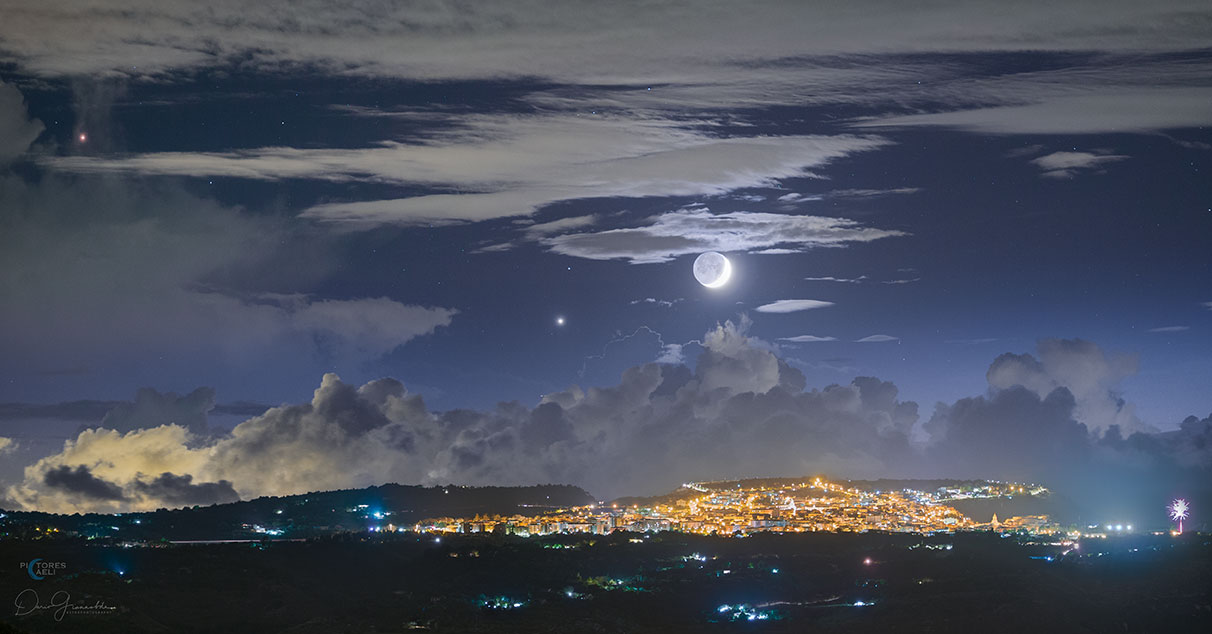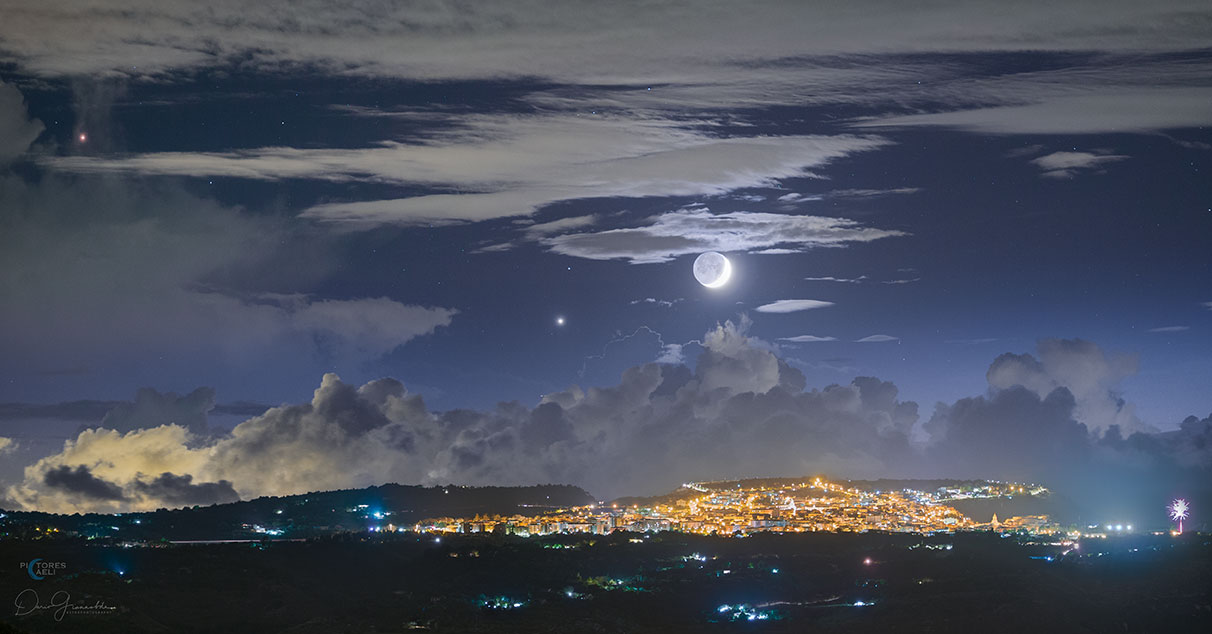
Why can we see the entire face of this Moon? When the Moon is in a crescent phase, only part of it appears directly illuminated by the Sun. The answer is earthshine, also known as earthlight and the da Vinci glow. The reason is that the rest of the Earth-facing Moon is slightly illuminated by sunlight first reflected from the Earth. Since the Earth appears near full phase from the Moon -- when the Moon appears as a slight crescent from the Earth -- earthshine is then near its brightest. Featured here in combined, consecutively-taken, HDR images taken earlier this month, a rising earthshine Moon was captured passing slowly near the planet Venus, the brightest spot near the image center. Just above Venus is the star Dschubba (catalogued as Delta Scorpii), while the red star on the far left is Antares. The celestial show is visible through scenic cloud decks. In the foreground are the lights from Palazzolo Acreide, a city with ancient historical roots in Sicily, Italy.
¿Por qué podemos ver toda la cara de esta Luna? Cuando la Luna está en fase creciente, solo una parte de ella aparece directamente iluminada por el Sol. La respuesta es el brillo terrestre, también conocido como luz terrestre y el resplandor de Da Vinci. La razón es que el resto de la cara de la Luna que mira hacia la Tierra está ligeramente iluminado por la luz solar que primero se refleja en la Tierra. Dado que la Tierra aparece casi en fase llena desde la Luna — cuando la Luna aparece como un delgado creciente desde la Tierra — el brillo terrestre es entonces casi su más brillante. En las imágenes HDR combinadas y tomadas consecutivamente que se muestran aquí, tomadas hace unos días, se capturó una Luna con brillo terrestre ascendente que se movía lentamente cerca del planeta Venus, el punto más brillante cerca del centro de la imagen. Justo encima de Venus se encuentra la estrella Dschubba (catalogada como Delta Scorpii), mientras que la estrella rojiza en el extremo izquierdo es Antares. El espectáculo celeste es visible a través de bancos de nubes escénicos. En primer plano se ven las luces de Palazzolo Acreide, una ciudad con raíces históricas antiguas en Sicilia, Italia.