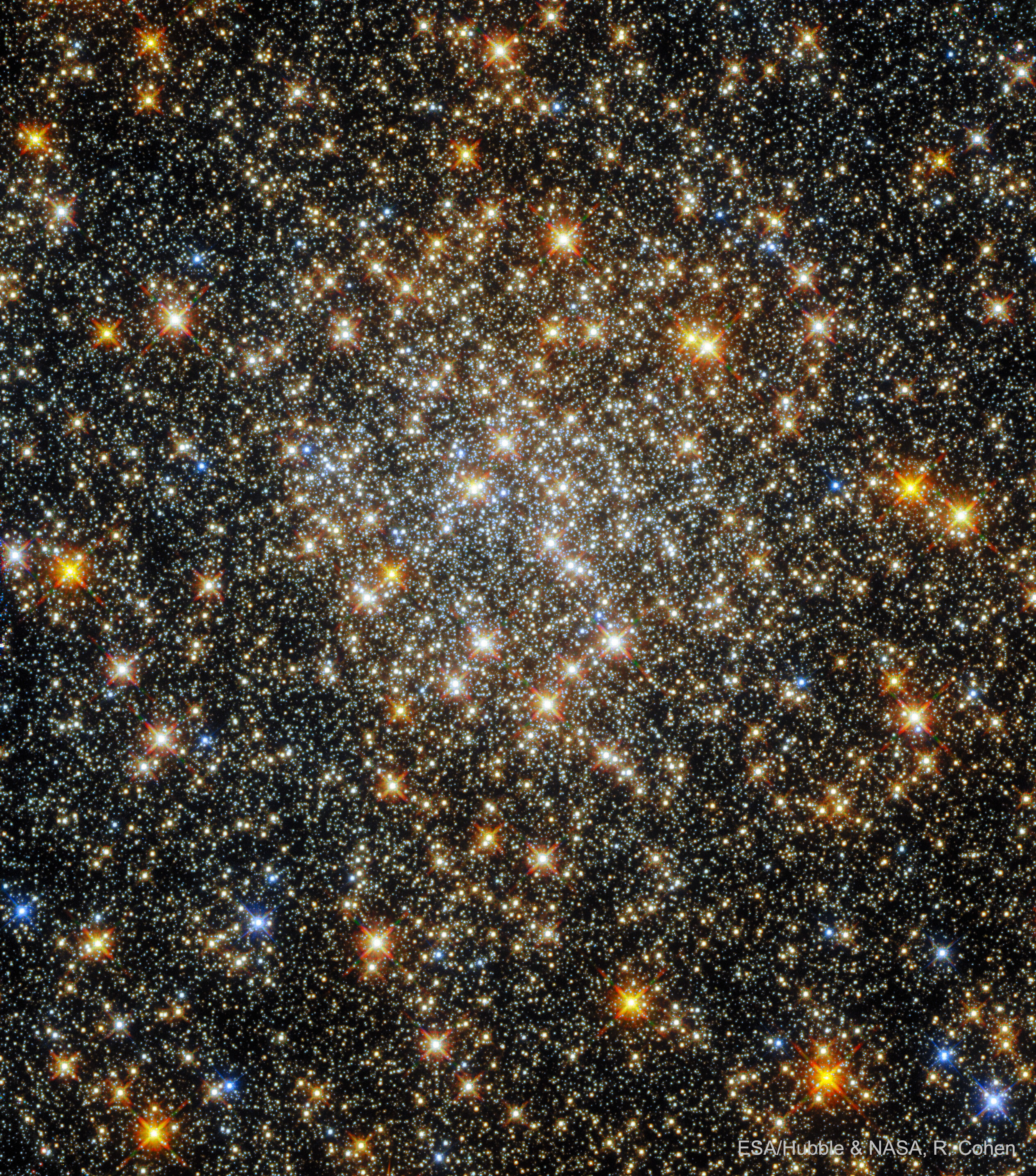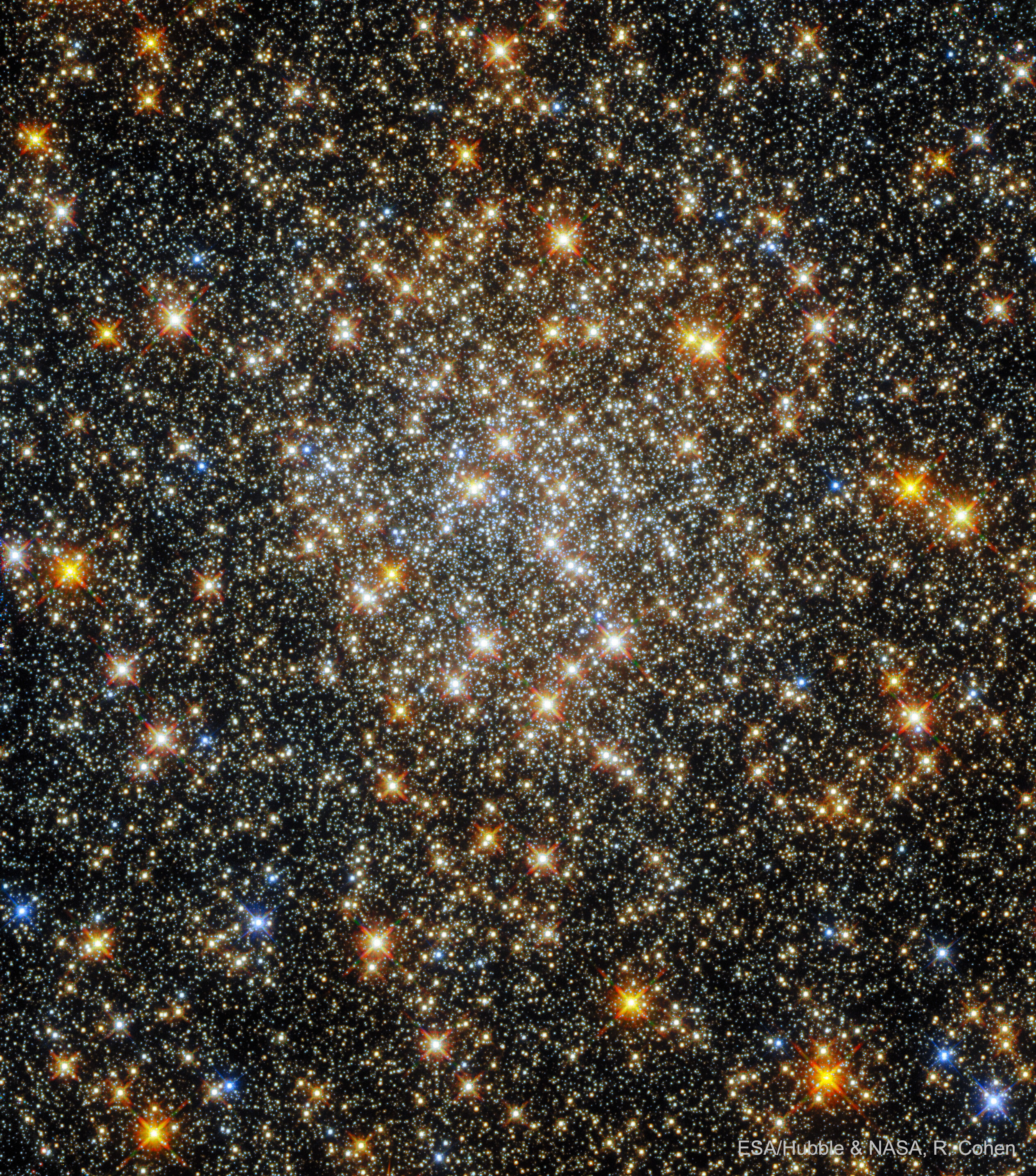
Where did this big ball of stars come from? Palomar 6 is one of about 200 globular clusters of stars that survive in our Milky Way Galaxy. These spherical star-balls are older than our Sun as well as older than most stars that orbit in our galaxy's disk. Palomar 6 itself is estimated to be about 12.5 billion years old, so old that it is close to -- and so constrains -- the age of the entire universe. Containing about 500,000 stars, Palomar 6 lies about 25,000 light years away, but not very far from our galaxy's center. At that distance, this sharp image from the Hubble Space Telescope spans about 15 light-years. After much study including images from Hubble, a leading origin hypothesis is that Palomar 6 was created -- and survives today -- in the central bulge of stars that surround the Milky Way's center, not in the distant galactic halo where most other globular clusters are now found.
¿De dónde provino esta gran bola de estrellas? Palomar 6 es uno de los aproximadamente 200 cúmulos globulares de estrellas que sobreviven en nuestra Galaxia Vía Láctea. Estas esferas de estrellas son más antiguas que nuestro Sol, así como más antiguas que la mayoría de las estrellas que orbitan en el disco de nuestra galaxia. Palomar 6 en sí mismo se estima que tenga aproximadamente 12.5 mil millones de años, tan antiguo que se acerca — y por tanto limita — la edad del universo entero. Contiene alrededor de 500,000 estrellas, y se encuentra a unos 25,000 años luz de distancia, pero no muy lejos del centro de nuestra galaxia. A esa distancia, esta imagen nítida del Telescopio Espacial Hubble abarca aproximadamente 15 años luz. Después de muchos estudios, incluyendo imágenes de Hubble, una hipótesis principal sobre su origen es que Palomar 6 fue creado — y sobrevive hoy — en el bulbo central de estrellas que rodea el centro de la Vía Láctea, no en el halo galáctico distante donde se encuentran ahora la mayoría de los otros cúmulos globulares.