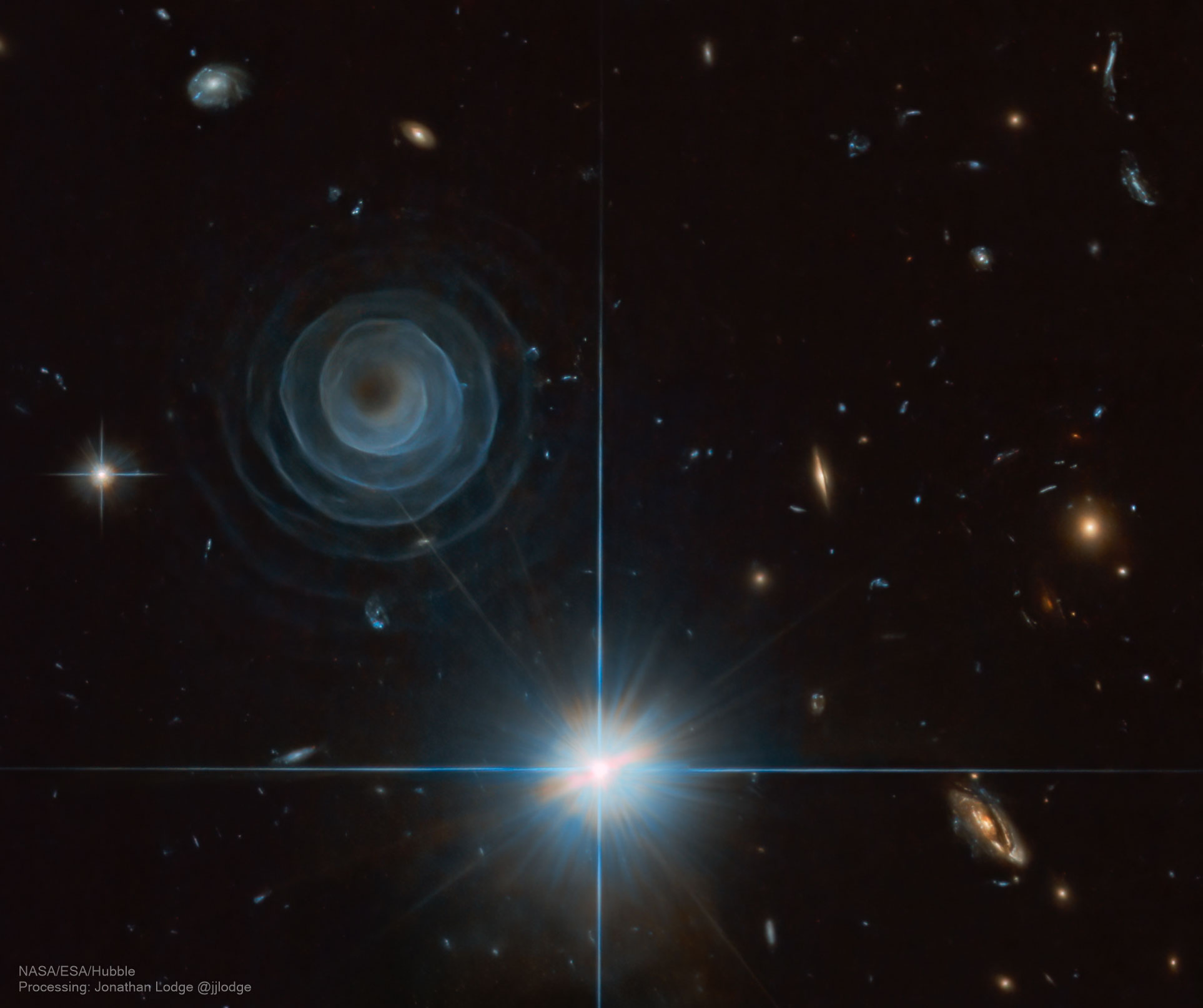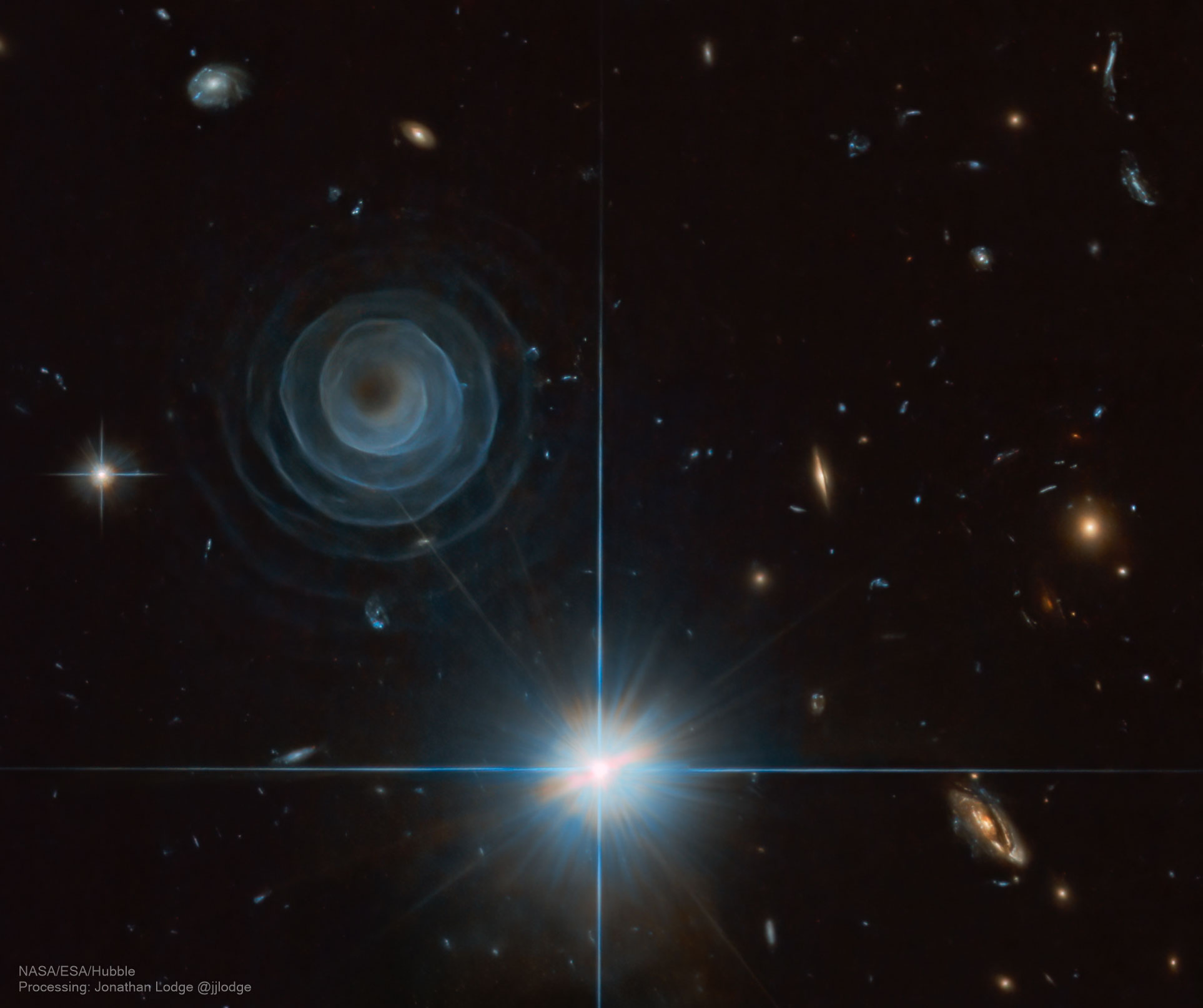
What created the strange spiral structure on the upper left? No one is sure, although it is likely related to a star in a binary star system entering the planetary nebula phase, when its outer atmosphere is ejected. The huge spiral spans about a third of a light year across and, winding four or five complete turns, has a regularity that is without precedent. Given the expansion rate of the spiral gas, a new layer must appear about every 800 years, a close match to the time it takes for the two stars to orbit each other. The star system that created it is most commonly known as LL Pegasi, but also AFGL 3068 and IRAS 23166+1655. The featured image was taken in near-infrared light by the Hubble Space Telescope. Why the spiral glows is itself a mystery, with a leading hypothesis being illumination by light reflected from nearby stars.
¿Qué creó la estructura espiral extraña en la esquina superior izquierda? Nadie está seguro, aunque es probable que esté relacionado con una estrella en un sistema binario que entra en la fase de nebulosa planetaria, cuando su atmósfera exterior es expulsada. La enorme espiral abarca aproximadamente un tercio de año luz de diámetro y, enrollándose en cuatro o cinco vueltas completas, tiene una regularidad sin precedentes. Dado la tasa de expansión del gas espiral, una nueva capa debe aparecer aproximadamente cada 800 años, una coincidencia cercana al tiempo que tardan las dos estrellas en orbitar entre sí. El sistema estelar que lo creó es más comúnmente conocido como LL Pegasi, pero también como AFGL 3068 e IRAS 23166+1655. La imagen destacada fue tomada en luz infrarroja cercana por el Telescopio Espacial Hubble. Por qué la espiral brilla es en sí mismo un misterio, con la hipótesis principal siendo la iluminación por la luz reflejada de estrellas cercanas.