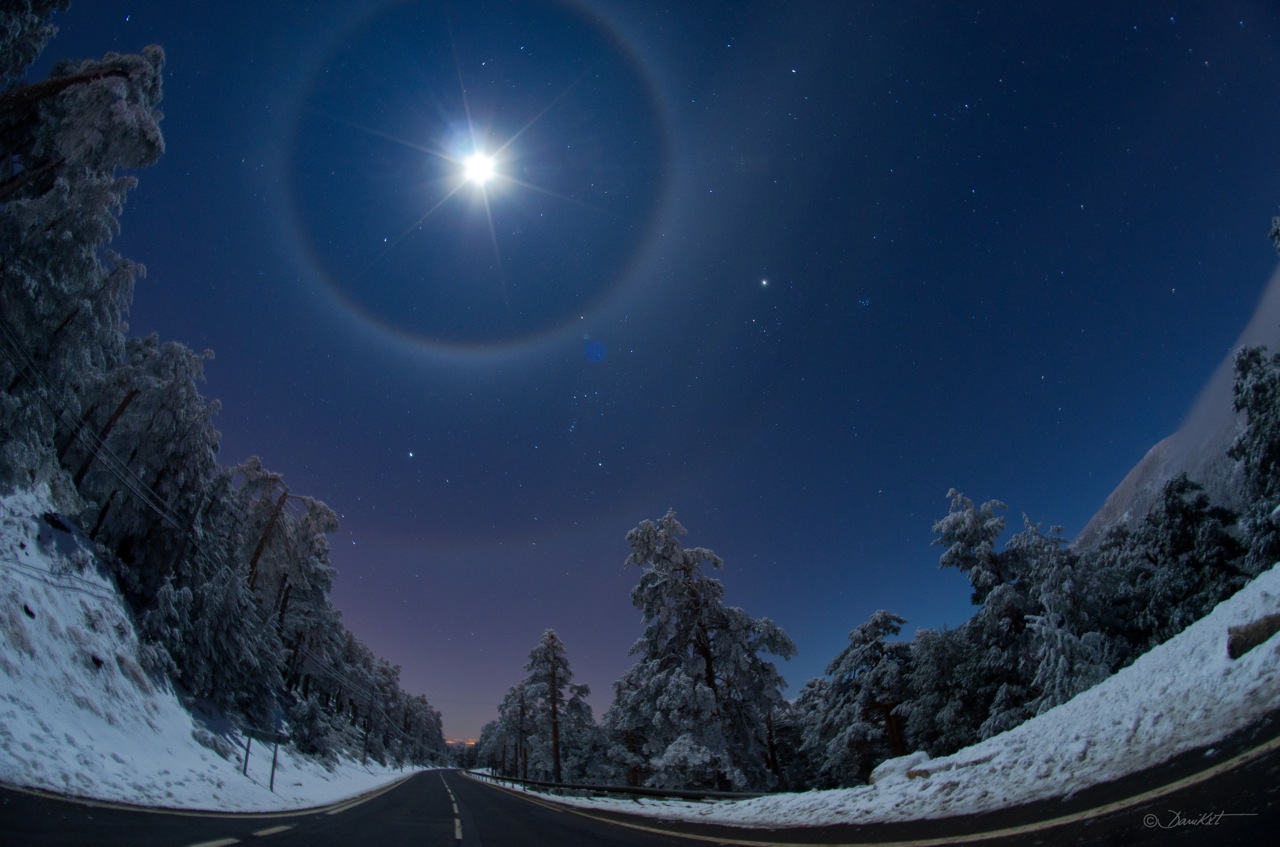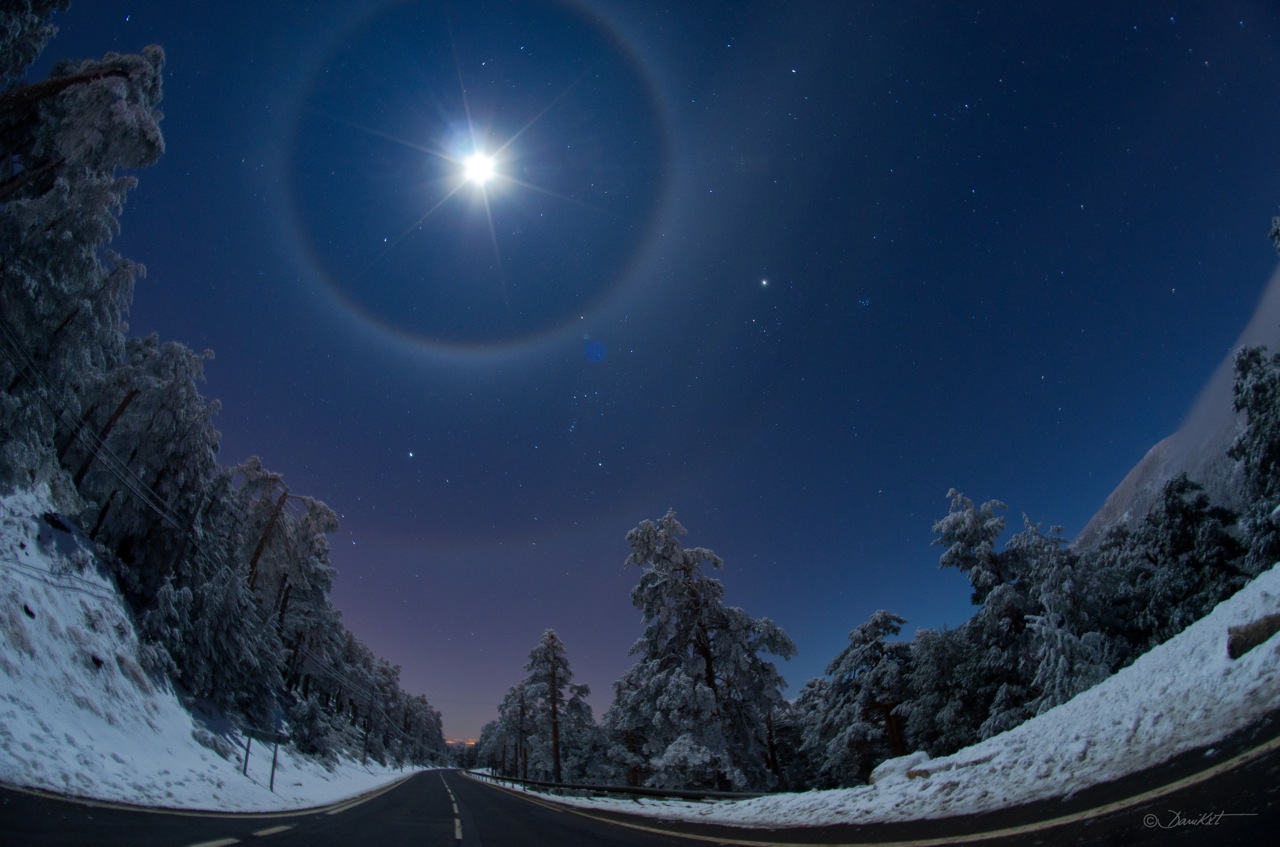
Sometimes falling ice crystals make the atmosphere into a giant lens causing arcs and halos to appear around the Sun or Moon. One Saturday night in 2012 was just such a time near Madrid, Spain, where a winter sky displayed not only a bright Moon but four rare lunar halos. The brightest object, near the top of the featured image, is the Moon. Light from the Moon refracts through tumbling hexagonal ice crystals into a somewhat rare 22-degree halo seen surrounding the Moon. Elongating the 22-degree arc horizontally is a more rare circumscribed halo caused by column ice crystals. Even more rare, some moonlight refracts through more distant tumbling ice crystals to form a (third) rainbow-like arc 46 degrees from the Moon and appearing here just above a picturesque winter landscape. Furthermore, part of a whole 46-degree circular halo is also visible, so that an extremely rare -- especially for the Moon -- quadruple halo was captured. Far in the background is a famous winter skyscape that includes Sirius, the belt of Orion, and Betelgeuse -- visible between the inner and outer arcs. Halos and arcs typically last for minutes to hours, so if you do see one there should be time to invite family, friends or neighbors to share your unusual lensed vista of the sky.
A veces, cristales de hielo en caída transforman la atmósfera en una lente gigantesca, causando que aparezcan arcos y halos alrededor del Sol o la Luna. Una noche de sábado en 2012 fue precisamente uno de esos momentos cerca de Madrid, España, donde un cielo invernal mostró no solo una Luna brillante, sino también cuatro halos lunares raros. El objeto más brillante, cerca de la parte superior de la imagen destacada, es la Luna. La luz de la Luna se refracta a través de cristales de hielo hexagonales en caída, formando un halo de 22 grados, algo relativamente raro, que se ve rodeando a la Luna. Extendiendo horizontalmente el arco de 22 grados se encuentra un halo circunscrito, aún más raro, causado por cristales de hielo en forma de columna. Incluso más raro, algo de la luz de la Luna se refracta a través de cristales de hielo más distantes en caída, formando un tercer arco, similar a un arco iris, a 46 grados de la Luna y apareciendo aquí justo encima de un paisaje invernal pintoresco. Además, parte de un halo completo de 46 grados también es visible, de modo que se capturó un halo cuádruple extremadamente raro — especialmente para la Luna. En el fondo lejano se encuentra un famoso paisaje invernal que incluye a Sirio, el cinturón de Orión y Betelgeuse — visible entre los arcos interior y exterior. Los halos y arcos suelen durar de minutos a horas, por lo que si ves uno, deberías tener tiempo suficiente para invitar a familiares, amigos o vecinos a compartir contigo esta inusual vista del cielo a través de la lente natural de la atmósfera.