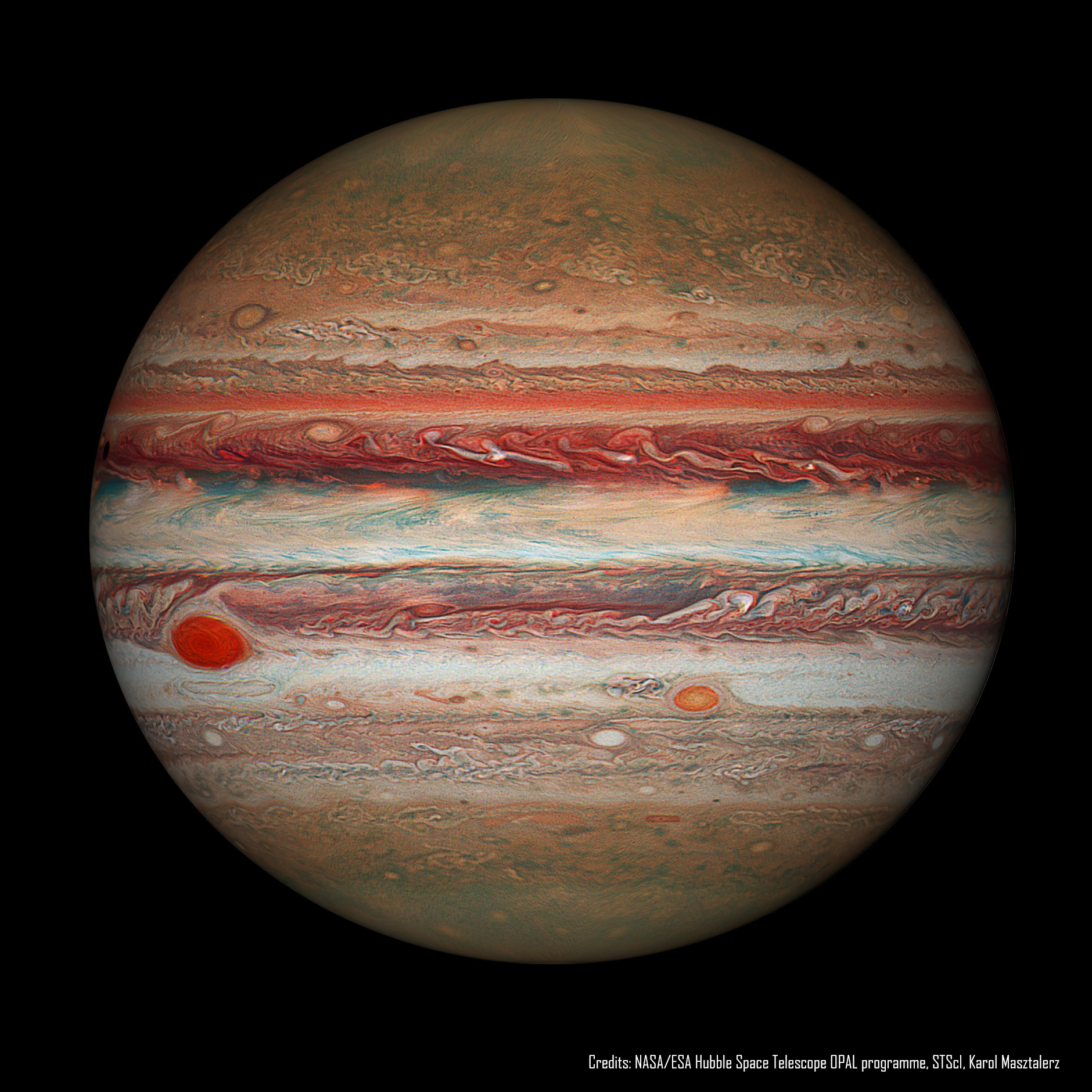
What will become of Jupiter's Great Red Spot? Gas giant Jupiter is the solar system's largest world with about 320 times the mass of planet Earth. Jupiter is home to one of the largest and longest lasting storm systems known, the Great Red Spot (GRS), visible to the left. The GRS is so large it could swallow Earth, although it has been shrinking. Comparison with historical notes indicate that the storm spans only about one third of the exposed surface area it had 150 years ago. NASA's Outer Planets Atmospheres Legacy (OPAL) program has been monitoring the storm more recently using the Hubble Space Telescope. The featured Hubble OPAL image shows Jupiter as it appeared in 2016, processed in a way that makes red hues appear quite vibrant. Modern GRS data indicate that the storm continues to constrict its surface area, but is also becoming slightly taller, vertically. No one knows the future of the GRS, including the possibility that if the shrinking trend continues, the GRS might one day even do what smaller spots on Jupiter have done -- disappear completely. Tuesday over Zoom: APOD editor to present the Best APOD Space Images of 2021
¿Qué será del Gran Red Spot de Júpiter? Júpiter, el planeta gaseoso más grande del sistema solar, tiene aproximadamente 320 veces la masa de la Tierra. Júpiter alberga uno de los sistemas de tormentas más grandes y duraderos conocidos, el Gran Red Spot (GRS), visible a la izquierda. El GRS es tan grande que podría tragarse a la Tierra, aunque ha estado disminuyendo de tamaño. Comparaciones con notas históricas indican que la tormenta ahora abarca solo aproximadamente un tercio del área superficial expuesta que tenía hace 150 años. El programa Outer Planets Atmospheres Legacy (OPAL) de la NASA ha estado monitoreando la tormenta más recientemente utilizando el telescopio espacial Hubble. La imagen destacada de OPAL de Hubble muestra a Júpiter como apareció en 2016, procesada de una manera que hace que los matices rojos aparezcan muy vibrantes. Datos modernos del GRS indican que la tormenta continúa reduciendo su área superficial, pero también se está volviendo ligeramente más alta, verticalmente. Nadie sabe el futuro del GRS, incluyendo la posibilidad de que, si la tendencia de encogimiento continúa, el GRS podría incluso un día hacer lo que han hecho las manchas más pequeñas en Júpiter: desaparecer por completo.