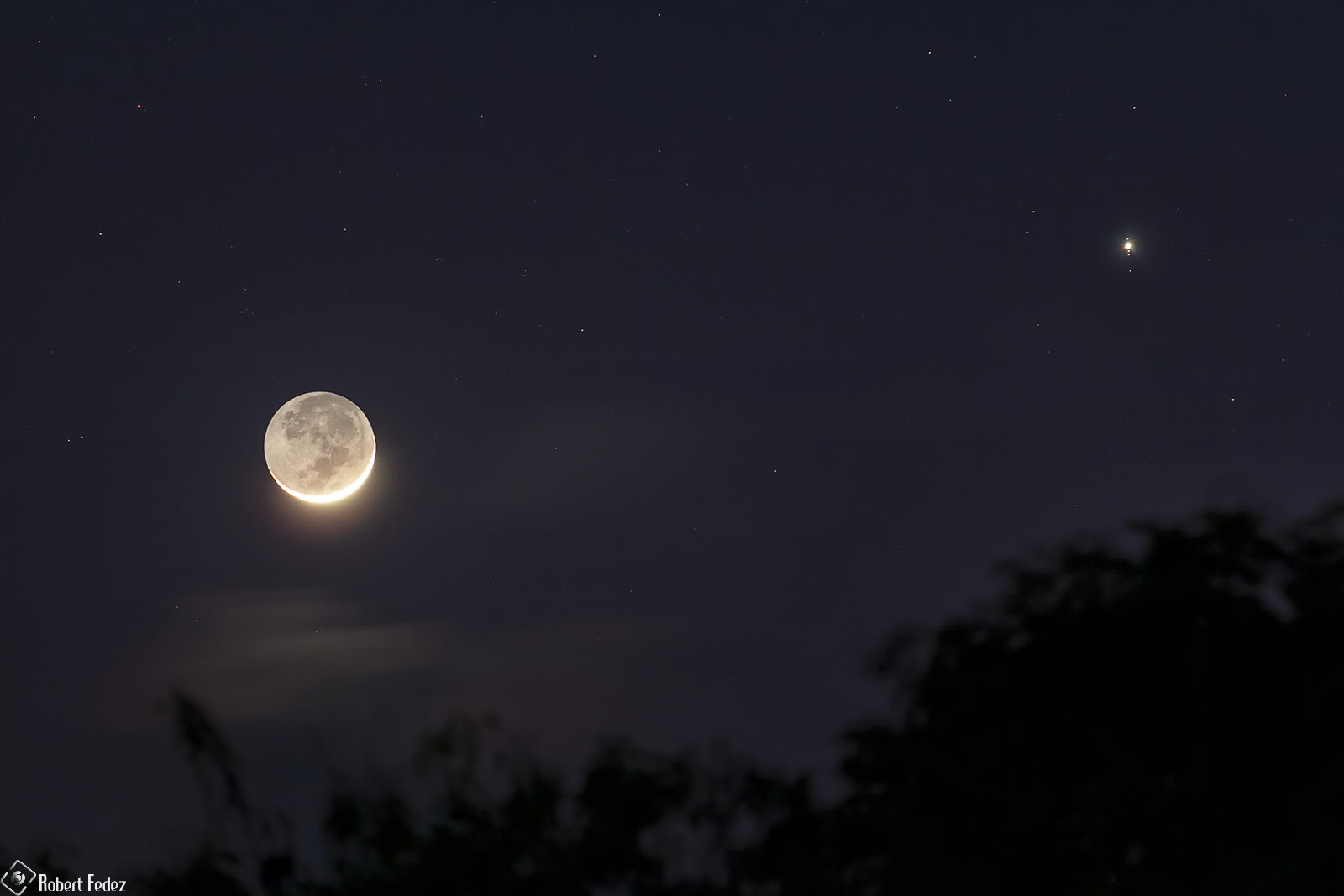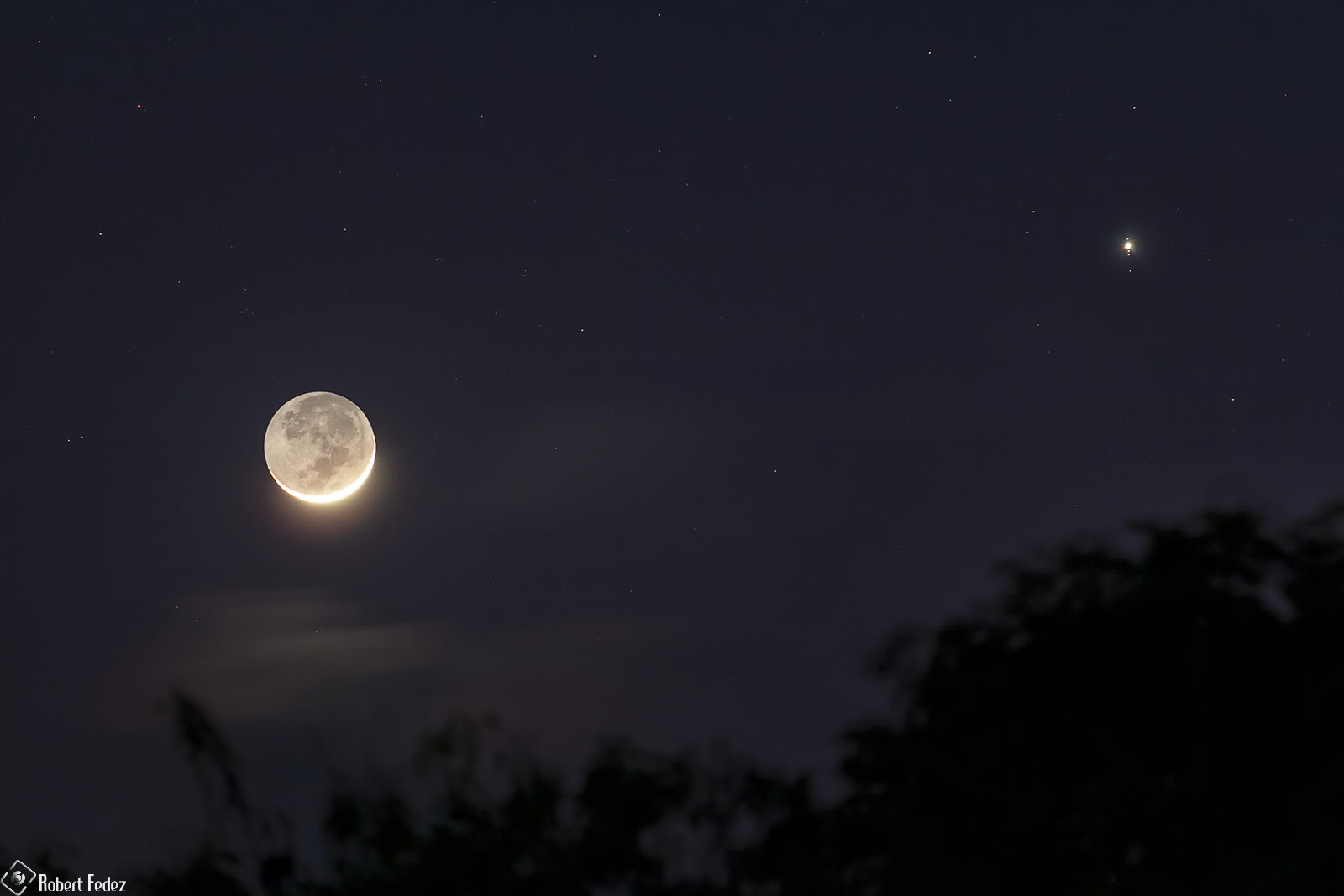
ven though Jupiter was the only planet visible in the evening sky on February 2, it shared the twilight above the western horizon with the Solar System's brightest moons. In a single exposure made just after sunset, the Solar System's ruling gas giant is at the upper right in this telephoto field-of-view from Cancun, Mexico. The snapshot also captures our fair planet's own natural satellite in its young crescent phase. The Moon's disk looms large, its familiar face illuminated mostly by earthshine. But the four points of light lined-up with Jupiter are Jupiter's own large Galilean moons. Top to bottom are Ganymede, [Jupiter], Io, Europa, and Callisto. Ganymede, Io, and Callisto are physically larger than Earth's Moon while water world Europa is only slightly smaller.
Aunque Júpiter fue el único planeta visible en el cielo nocturno el 2 de febrero, compartió el crepúsculo sobre el horizonte occidental con las lunas más brillantes del Sistema Solar. En una única exposición hecha justo después de la puesta de sol, el gigante gaseoso que domina el Sistema Solar se encuentra en la parte superior derecha en este campo de visión telefoto desde Cancún, México. La instantánea también captura nuestro propio satélite natural en su fase creciente joven. El disco de la Luna aparece grande, su cara familiar iluminada principalmente por la luz reflejada de la Tierra. Pero los cuatro puntos de luz alineados con Júpiter son las propias grandes lunas galileanas de Júpiter. De arriba hacia abajo están Ganímedes, [Júpiter], Io, Europa y Calisto. Ganímedes, Io y Calisto son físicamente más grandes que la Luna de la Tierra, mientras que el mundo acuático Europa es solo ligeramente más pequeño.