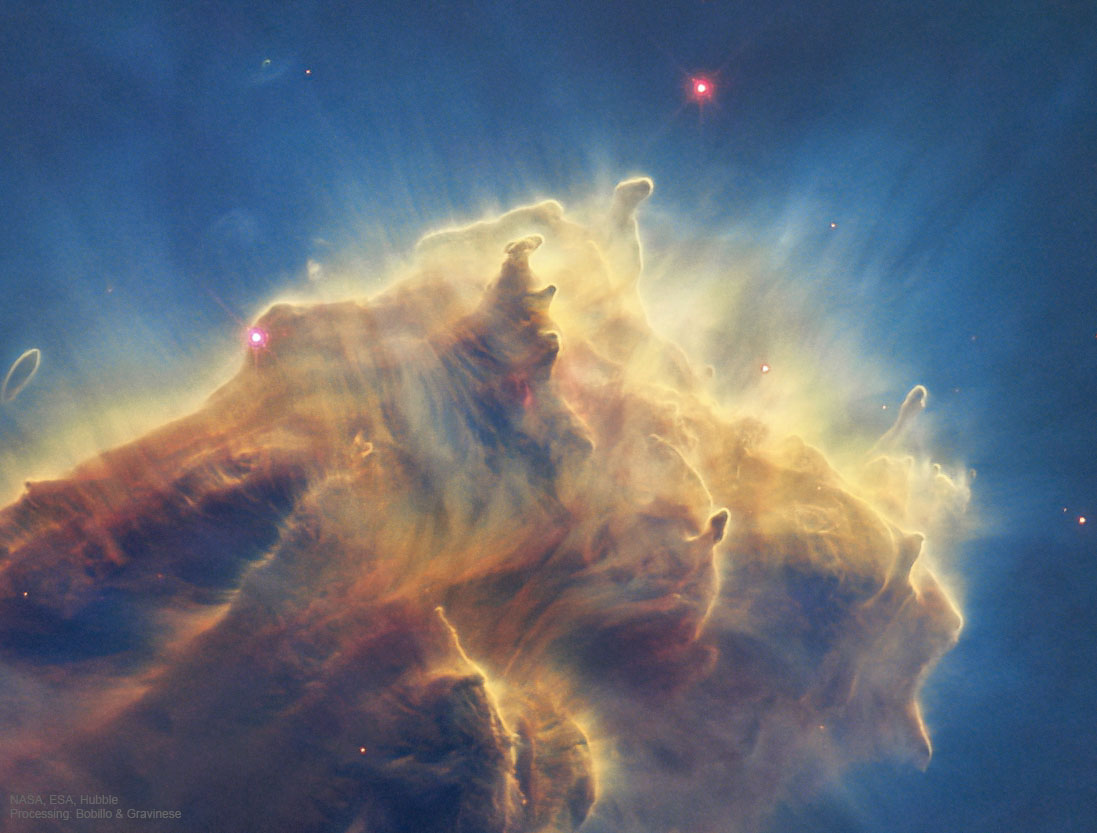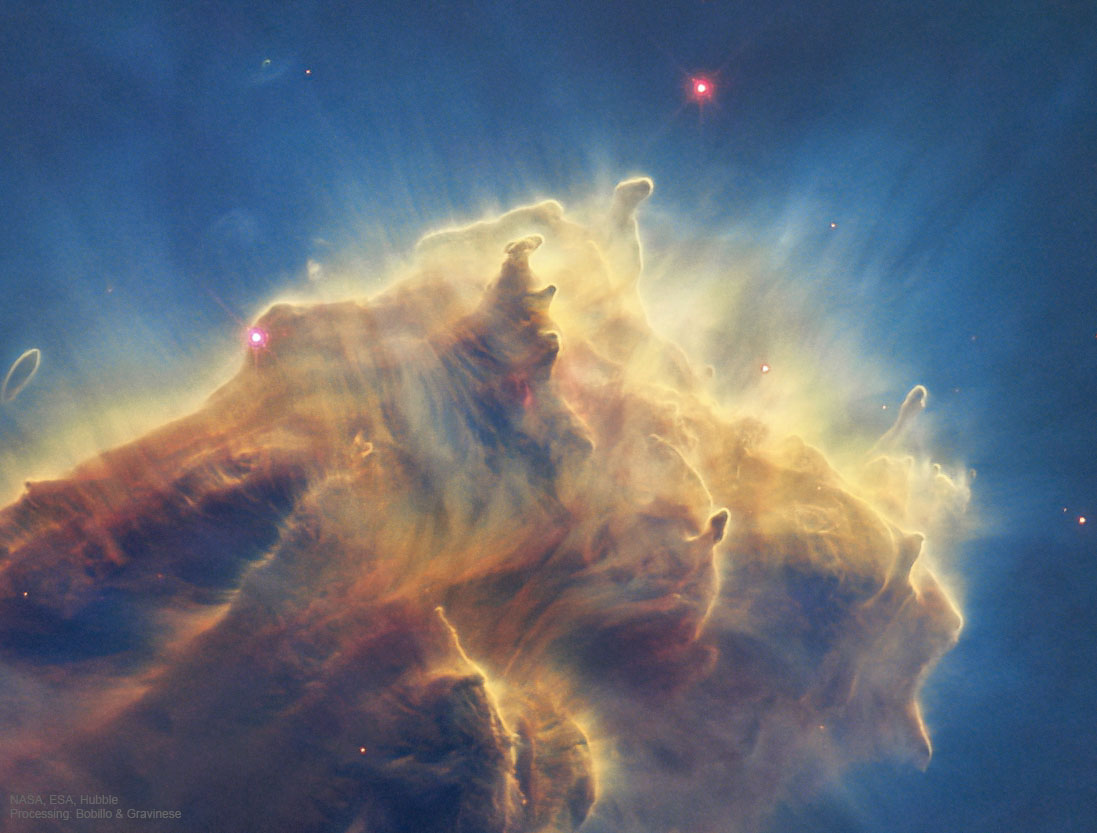
Where do stars form? One place, star forming regions known as "EGGs", are being uncovered at the end of this giant pillar of gas and dust in the Eagle Nebula (M16). Short for evaporating gaseous globules, EGGs are dense regions of mostly molecular hydrogen gas that fragment and gravitationally collapse to form stars. Light from the hottest and brightest of these new stars heats the end of the pillar and causes further evaporation of gas and dust -- revealing yet more EGGs and more young stars. This featured picture was created from exposures spanning over 30 hours with the Earth-orbiting Hubble Space Telescope in 2014, and digitally processed with modern software by experienced volunteers in Argentina. Newborn stars will gradually destroy their birth pillars over the next 100,000 years or so -- if a supernova doesn't destroy them first.
¿Dónde se forman las estrellas? Un lugar, regiones donde se forman estrellas conocidas como "EGGs", se están revelando en la punta de este pilar gigante de gas y polvo en la Nebulosa del Águila (M16). Las siglas EGGs significan globulos gaseosos evaporados, y son regiones densas compuestas principalmente por gas hidrógeno molecular que se fragmentan y colapsan gravitacionalmente para formar estrellas. La luz de las estrellas más calientes y brillantes de estas nuevas estrellas calienta la punta del pilar y causa una mayor evaporación del gas y el polvo, revelando aún más EGGs y más estrellas jóvenes. Esta imagen destacada fue creada a partir de exposiciones que abarcaron más de 30 horas con el Telescopio Espacial Hubble en órbita terrestre en 2014, y fue procesada digitalmente con software moderno por voluntarios experimentados en Argentina. Las estrellas recién nacidas destruirán gradualmente sus pilar de nacimiento durante los próximos 100 000 años o así, a menos que una supernova las destruya primero.