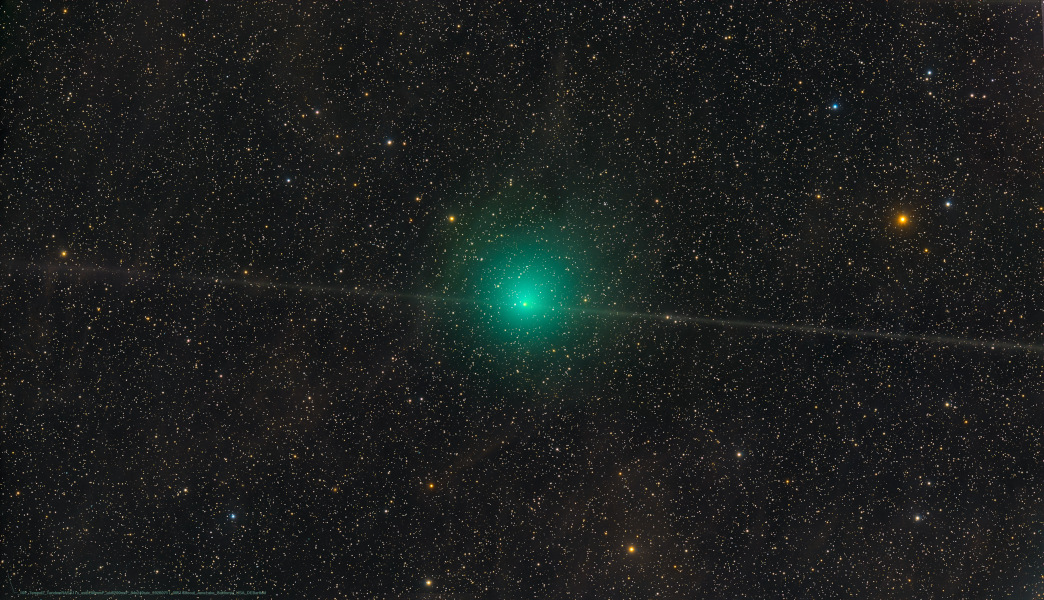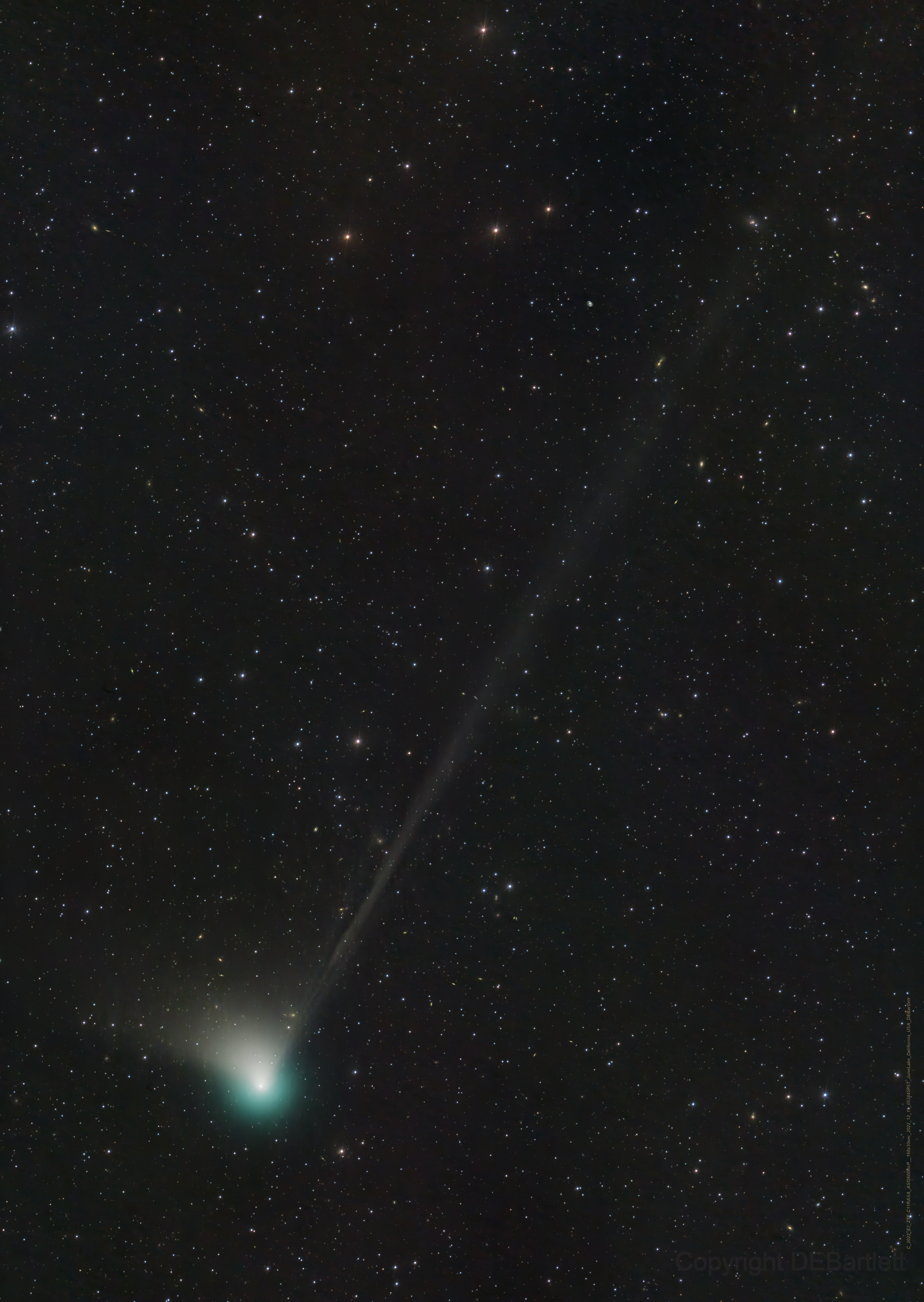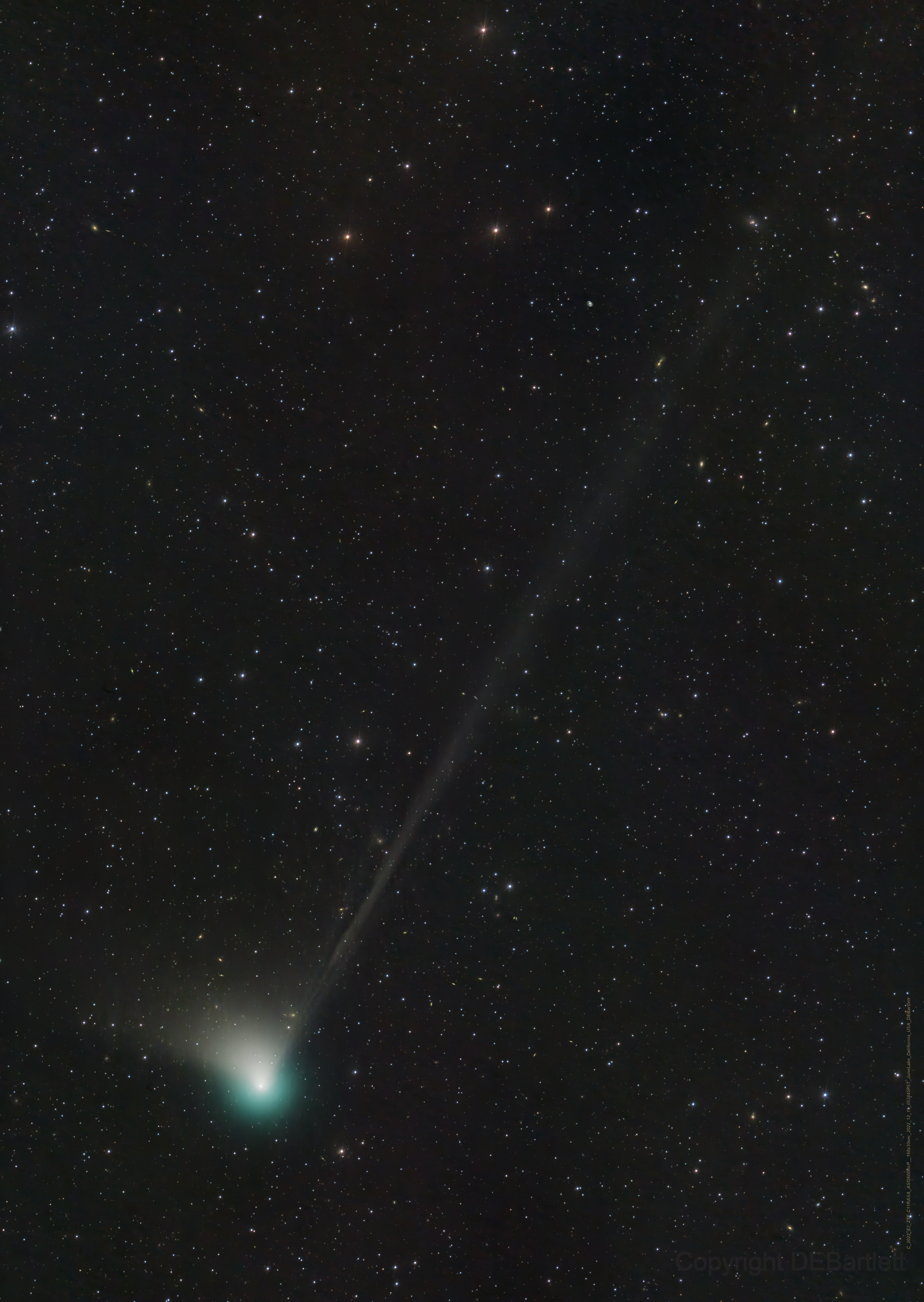
Comet C/2022 E3 (ZTF) was discovered by astronomers using the wide-field survey camera at the Zwicky Transient Facility this year in early March. Since then the new long-period comet has brightened substantially and is now sweeping across the northern constellation Corona Borealis in predawn skies. It's still too dim to see without a telescope though. But this fine telescopic image from December 19 does show the comet's brighter greenish coma, short broad dust tail, and long faint ion tail stretching across a 2.5 degree wide field-of-view. On a voyage through the inner Solar System comet 2022 E3 will be at perihelion, its closest to the Sun, in the new year on January 12 and at perigee, its closest to our fair planet, on February 1. The brightness of comets is notoriously unpredictable, but by then C/2022 E3 (ZTF) could become only just visible to the eye in dark night skies.
El cometa C/2022 E3 (ZTF) fue descubierto por astrónomos utilizando la cámara de gran campo de la instalación Zwicky Transient Facility este año a principios de marzo. Desde entonces, el nuevo cometa de período largo ha aumentado significativamente su brillo y ahora se desplaza por la constelación del norte Corona Borealis en el cielo antes del amanecer. Sin embargo, aún es demasiado tenue para verse sin telescopio. Pero esta excelente imagen telescópica del 19 de diciembre muestra la coma verde más brillante del cometa, su cola de polvo corta y ancha, y su larga cola iónica tenue que se extiende a través de un campo de visión de 2,5 grados. En su viaje por el sistema solar interior, el cometa 2022 E3 alcanzará el perihelio, su punto más cercano al Sol, el 12 de enero del nuevo año, y el perigeo, su punto más cercano a nuestro planeta, el 1 de febrero. La luminosidad de los cometas es notablemente impredecible, pero para entonces, el C/2022 E3 (ZTF) podría convertirse apenas visible a simple vista en cielos oscuros.