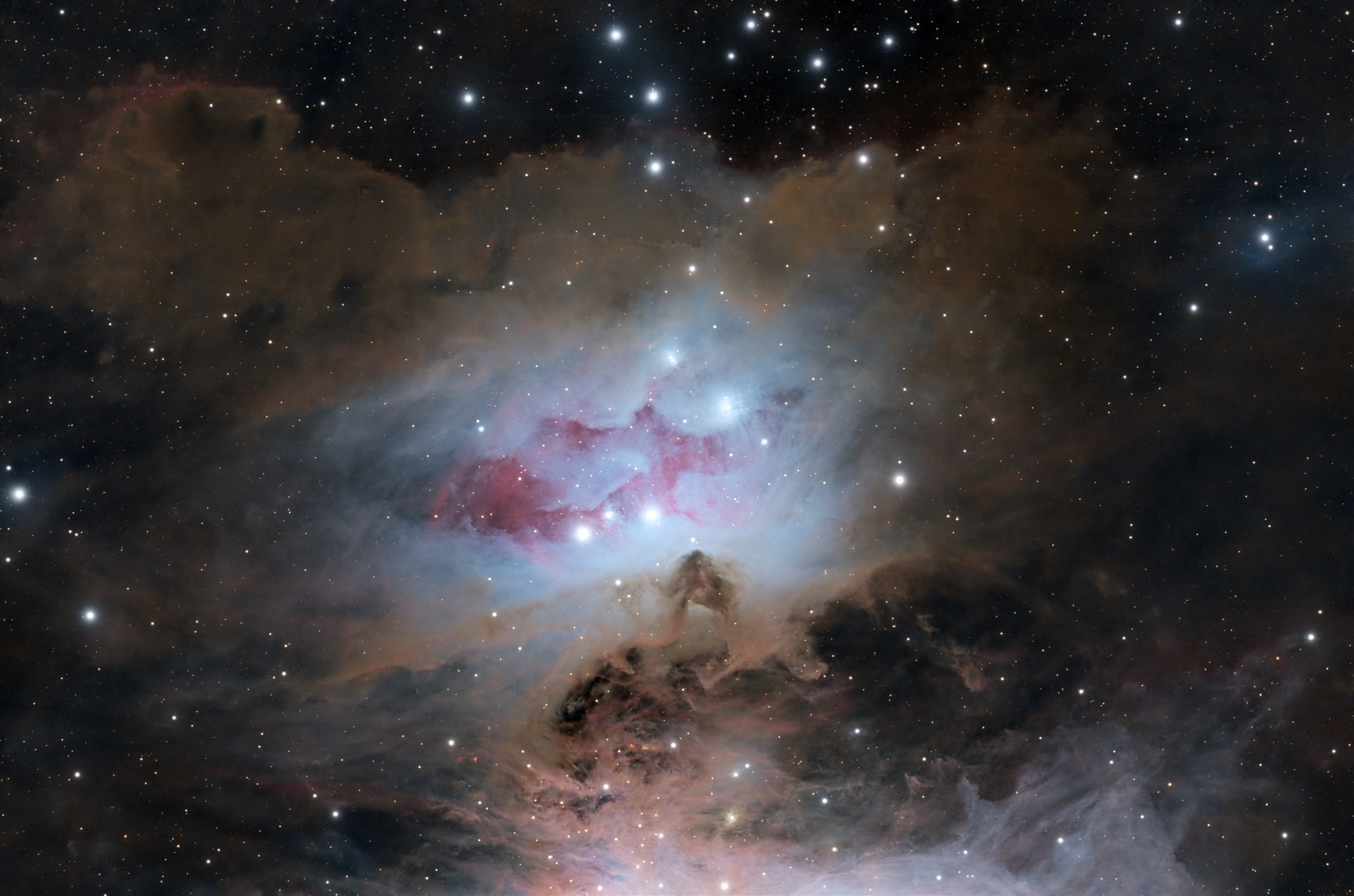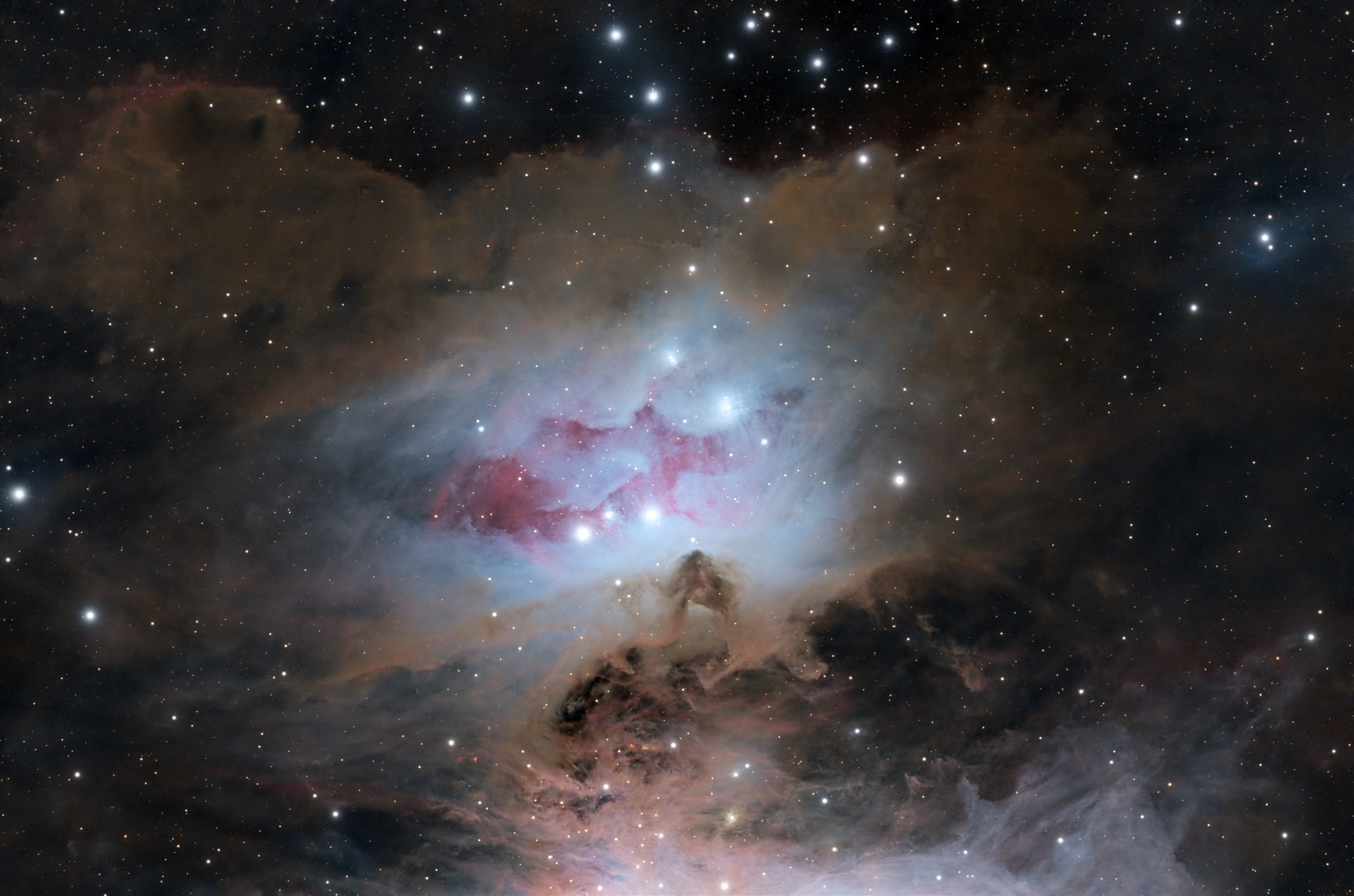
The 1970s are sometimes ignored by astronomers. For example, this beautiful grouping of reflection nebulae in Orion - NGC 1977, NGC 1975, and NGC 1973 - is usually overlooked in favor of the substantial glow from the nearby stellar nursery better known as the Orion Nebula. Found along Orion's sword just north of the bright Orion Nebula complex, these reflection nebulae are also associated with Orion's giant molecular cloud about 1,500 light-years away, but are dominated by the characteristic blue color of interstellar dust reflecting light from hot young stars. In this sharp color image a portion of the Orion Nebula appears along the bottom border with the cluster of reflection nebulae at picture center. NGC 1977 stretches across the field just below center, separated from NGC 1973 (above right) and NGC 1975 (above left) by dark regions laced with faint red emission from hydrogen atoms. Taken together, the dark regions suggest the popular moniker, the Running Man Nebula. At the estimated distance of Orion's dusty molecular cloud this running man would be about 15 light-years across.
A veces, los astrónomos ignoran la década de 1970. Por ejemplo, este hermoso grupo de nebulosas de reflexión en Orión —NGC 1977, NGC 1975 y NGC 1973— suele pasar desapercibido en favor del resplandor más intenso de la vecina región de formación estelar conocida como la Nebulosa de Orión. Ubicadas a lo largo de la espada de Orión, justo al norte del complejo brillante de la Nebulosa de Orión, estas nebulosas de reflexión también están asociadas con la nube molecular gigante de Orión, situada a unos 1500 años luz de distancia, pero se destacan por el color azul característico del polvo interestelar reflejando la luz de estrellas jóvenes y calientes. En esta imagen nítida y en color, una porción de la Nebulosa de Orión aparece a lo largo del borde inferior, con el grupo de nebulosas de reflexión en el centro de la imagen. NGC 1977 se extiende a través del campo justo debajo del centro, separada de NGC 1973 (arriba a la derecha) y NGC 1975 (arriba a la izquierda) por regiones oscuras teñidas con una débil emisión rojiza de átomos de hidrógeno. Tomadas juntas, estas regiones oscuras sugieren el nombre popular de Nebulosa del Hombre Corredor. A la distancia estimada de la nube molecular polvorienta de Orión, este hombre corredor tendría aproximadamente 15 años luz de ancho.