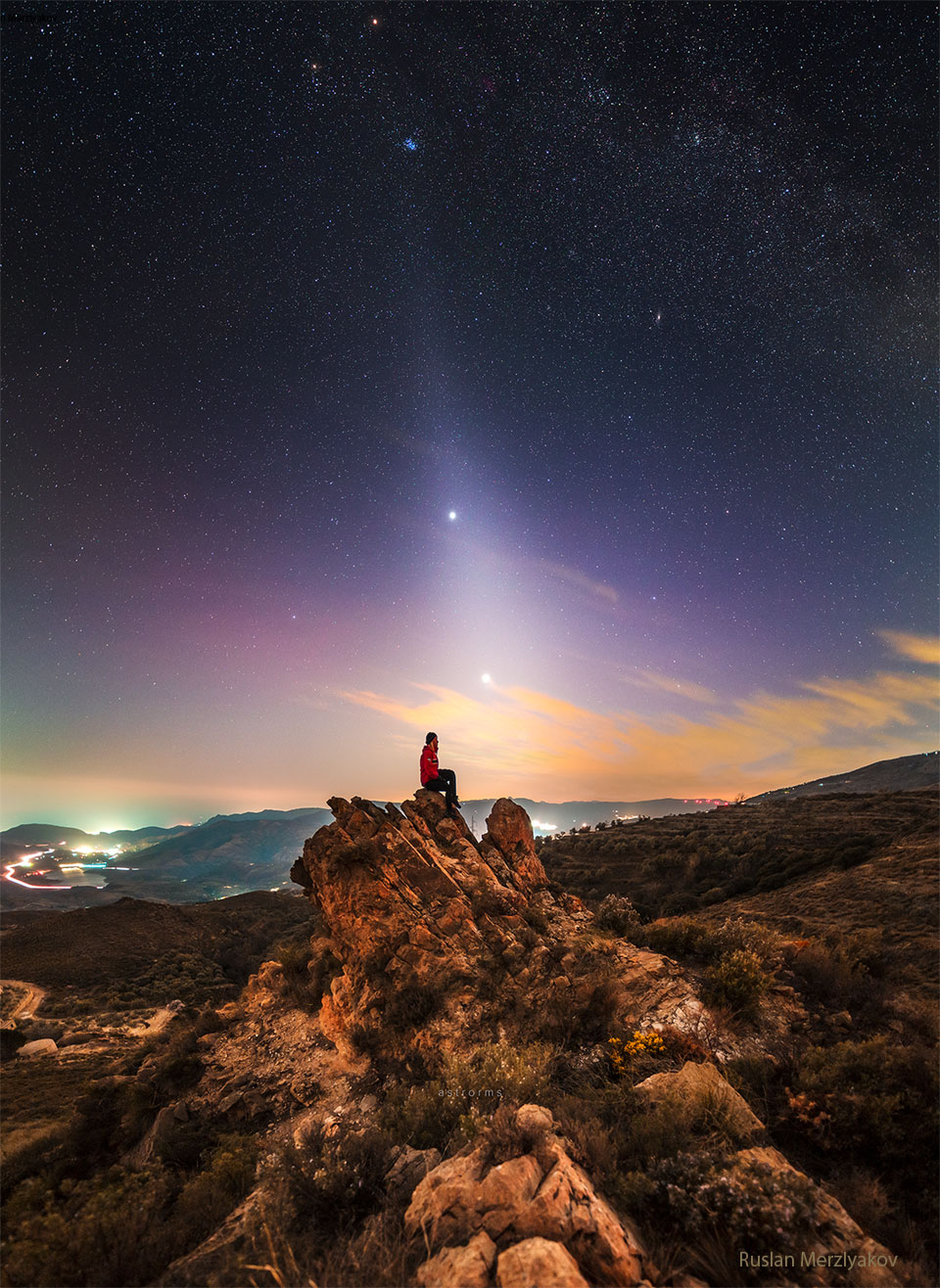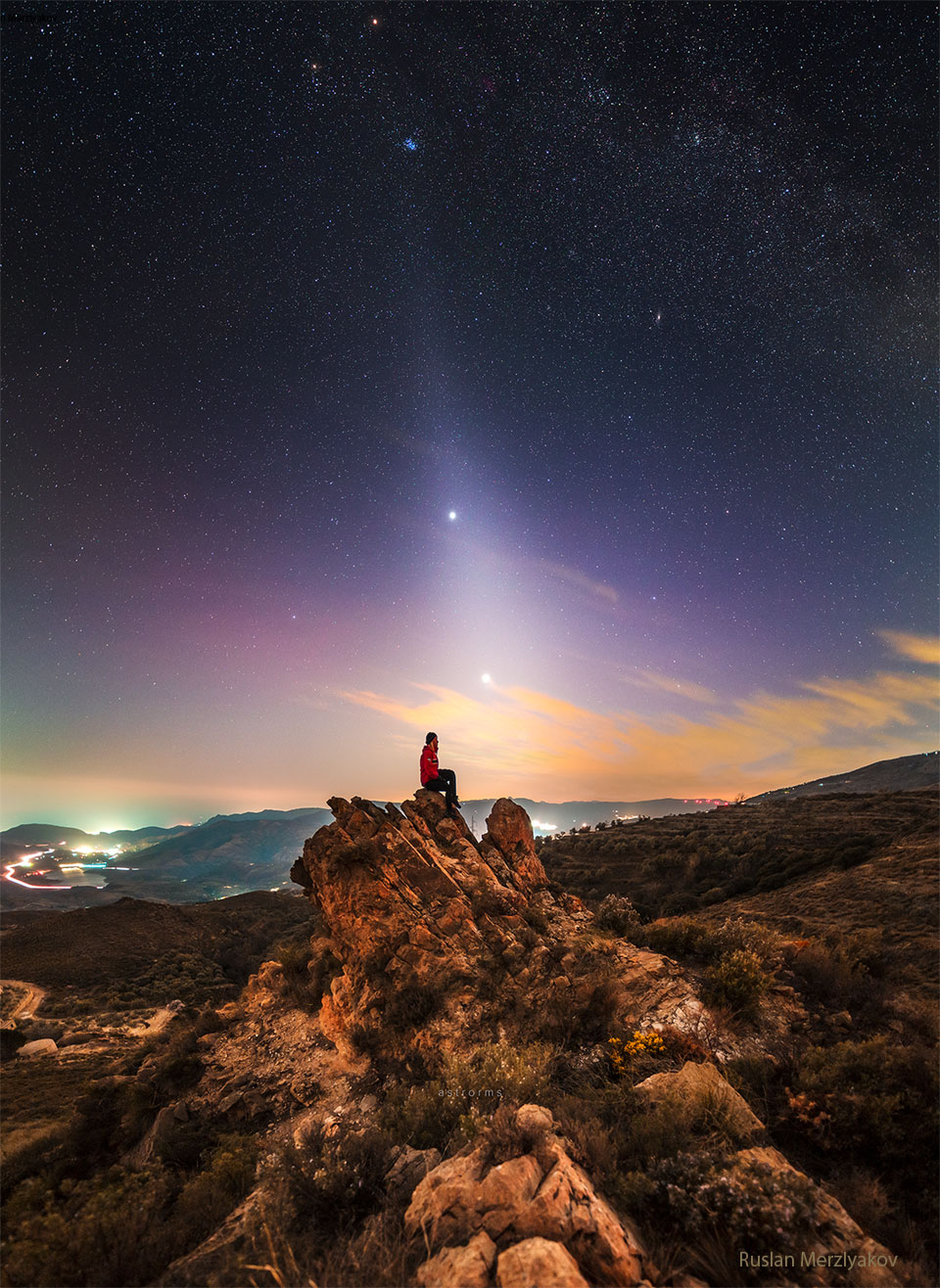
What's causing that unusual ray of light extending from the horizon? Dust orbiting the Sun. At certain times of the year, a band of sun-reflecting dust from the inner Solar System appears prominently after sunset or before sunrise and is called zodiacal light. The dust was emitted mostly from faint Jupiter-family comets and slowly spirals into the Sun. The featured HDR image, acquired in mid-February from the Sierra Nevada National Park in Spain, captures the glowing band of zodiacal light going right in front of the bright evening planets Jupiter (upper) and Venus (lower). Emitted from well behind the zodiacal light is a dark night sky that prominently includes the Pleiades star cluster. Jupiter and Venus are slowly switching places in the evening sky, and just in the next few days nearing their closest angular approach.
¿Qué causa ese rayo de luz inusual que se extiende desde el horizonte? Polvo que orbita alrededor del Sol. En ciertos momentos del año, una banda de polvo que refleja la luz solar del Sistema Solar interior aparece prominentemente después del atardecer o antes del amanecer y se llama luz zodiacal. El polvo fue emitido principalmente por cometas familiares de Júpiter y lentamente se espiraliza hacia el Sol. La imagen en HDR destacada, capturada a mediados de febrero en el Parque Nacional de Sierra Nevada en España, muestra la banda brillante de luz zodiacal que pasa justo delante de los planetas nocturnos brillantes Júpiter (superior) y Venus (inferior). Emitida desde bien detrás de la luz zodiacal, el cielo nocturno oscuro incluye prominentemente el cúmulo estelar de las Pléyades. Júpiter y Venus están lentamente intercambiando posiciones en el cielo nocturno, y en los próximos días alcanzarán su aproximación angular más cercana.