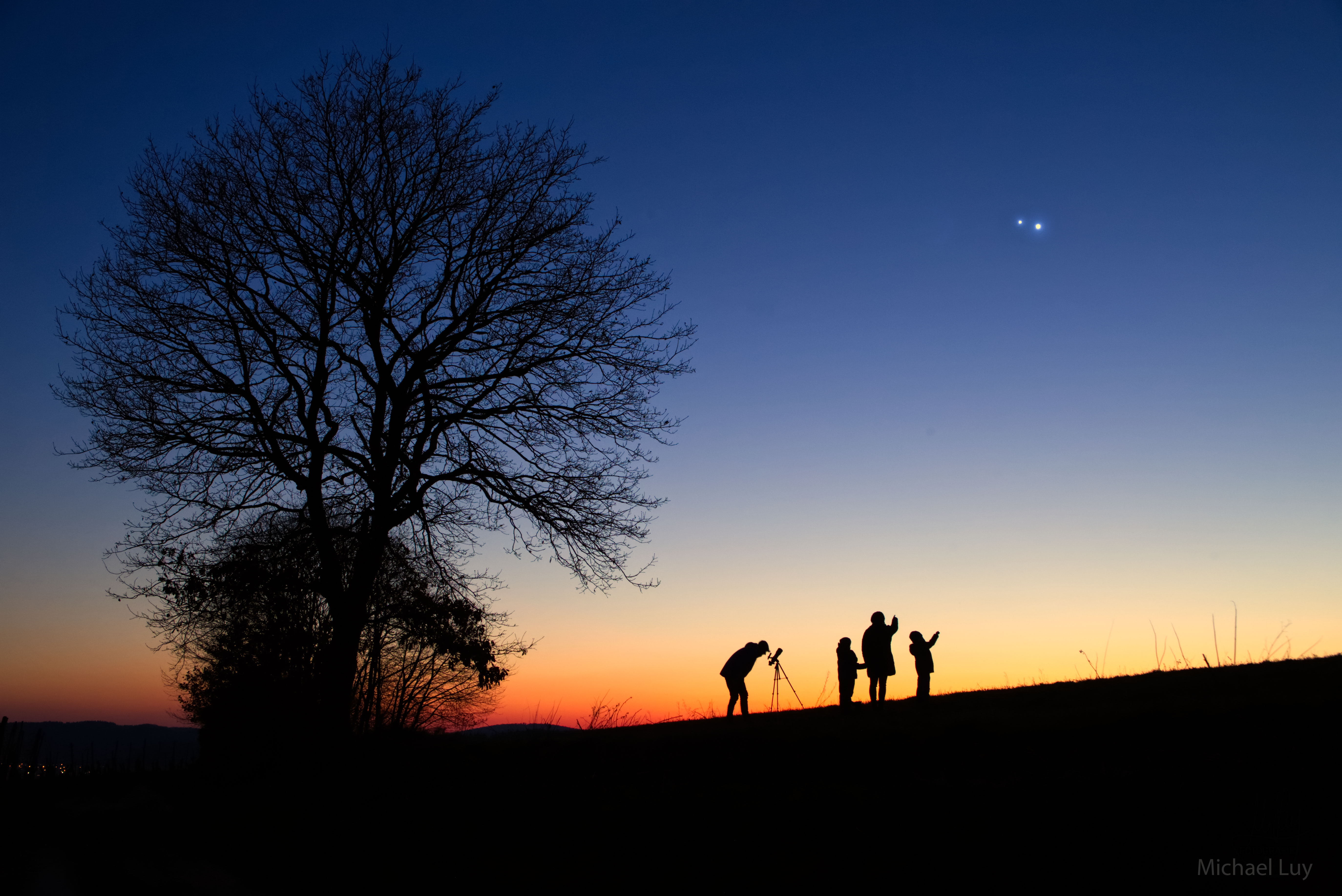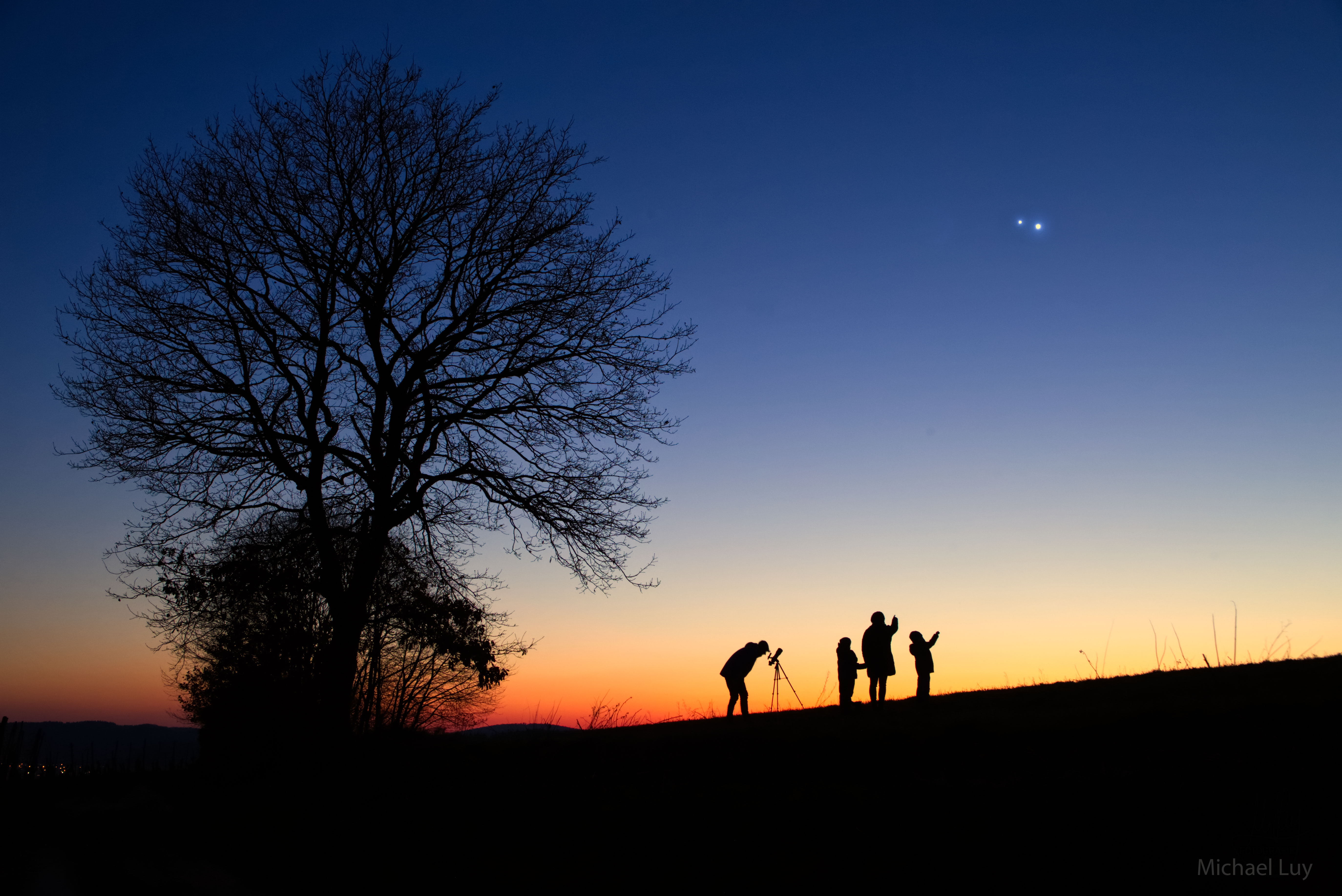
This was a sky to show the kids. Early this month the two brightest planets in the night sky, Jupiter and Venus, appeared to converge. At their closest, the two planets were separated by only about the angular width of the full moon. The spectacle occurred just after sunset and was seen and photographed all across planet Earth. The displayed image was taken near to the time of closest approach from Wiltingen, Germany, and features the astrophotographer, spouse, and their two children. Of course, Venus remains much closer to both the Sun and the Earth than Jupiter -- the apparent closeness between the planets in the sky of Earth was only angular. Jupiter and Venus have passed and now appear increasingly far apart. Similar planetary convergence opportunities will eventually arise. In a few months, for example, Mars and Venus will appear to congregate just as the Sun sets. Jupiter & Venus Conjunction Gallery: Notable Submissions to APOD
Crédito: NASA, APOD Esta era una noche para mostrar a los niños. A principios de este mes, los dos planetas más brillantes del cielo nocturno, Júpiter y Venus, parecieron converger. En su punto más cercano, los dos planetas estaban separados por apenas aproximadamente el ancho angular de la luna llena. El espectáculo ocurrió justo después del atardecer y fue visto y fotografiado en todo el planeta Tierra. La imagen mostrada fue tomada cerca del momento de la aproximación más cercana desde Wiltingen, Alemania, y destaca al fotógrafo astronómico, su cónyuge y sus dos hijos. Por supuesto, Venus permanece mucho más cerca tanto del Sol como de la Tierra que Júpiter; la proximidad aparente entre los planetas en el cielo terrestre era solo angular. Júpiter y Venus ya han pasado y ahora aparecen cada vez más separados. Oportunidades similares de convergencia planetaria eventualmente surgirán. En unos meses, por ejemplo, Marte y Venus parecerán congregarse justo cuando el Sol se ponga. Galería de conjunción de Júpiter y Venus: Envíos notables a APOD