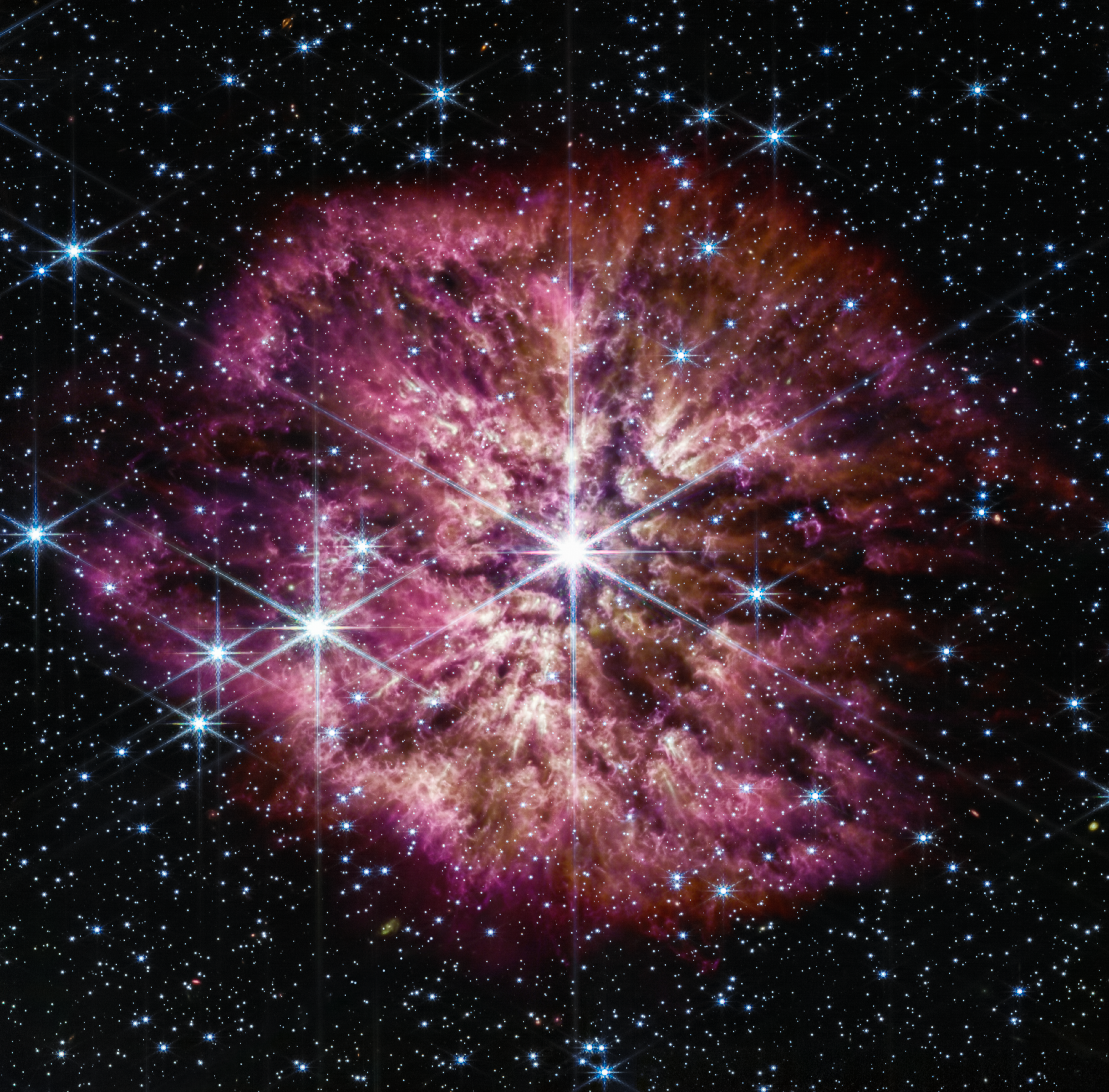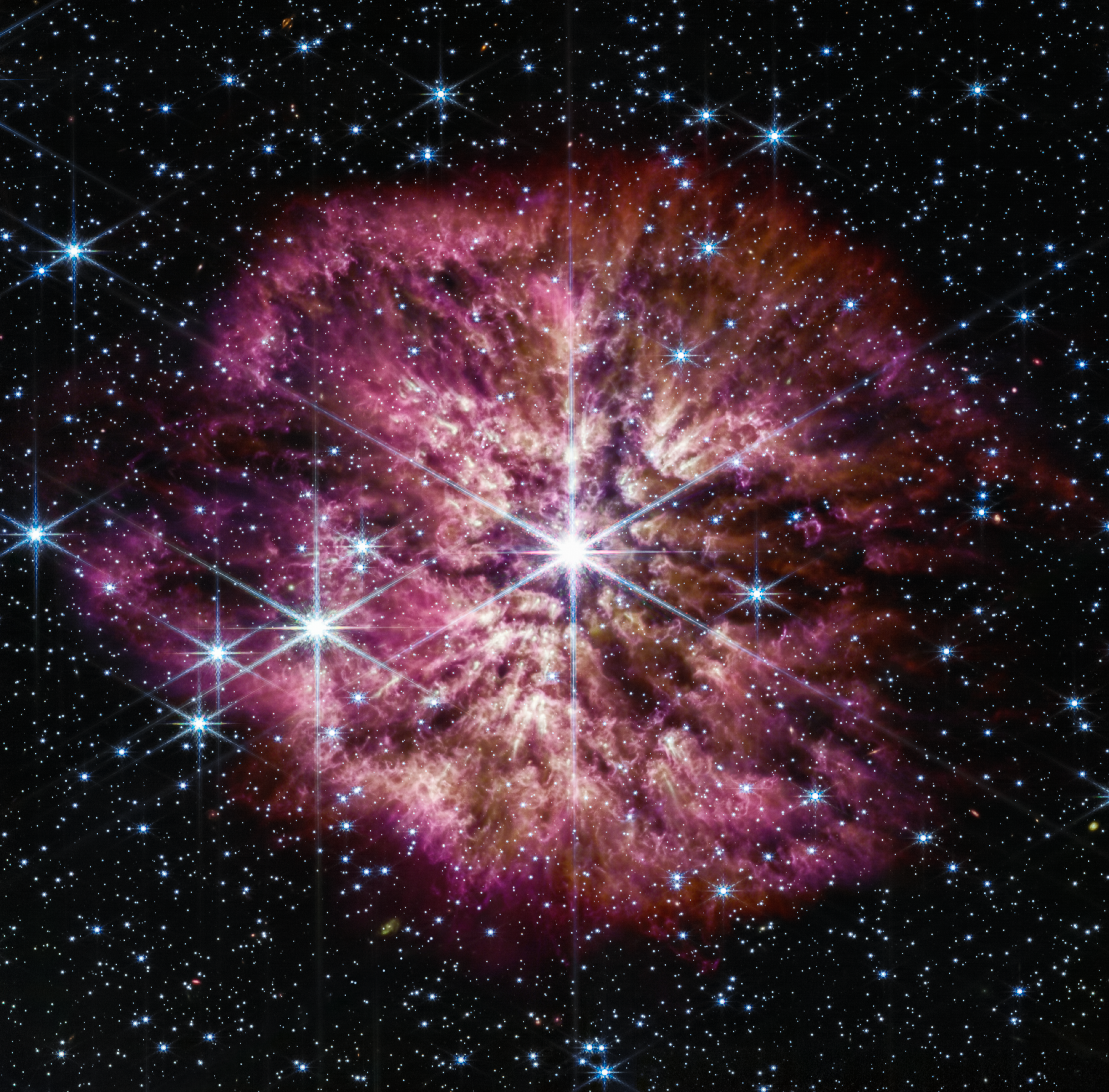
Driven by powerful stellar winds, expanding shrouds of gas and dust frame hot, luminous star Wolf-Rayet 124 in this sharp infrared view. The eye-catching 6-spike star pattern is characteristic of stellar images made with the 18 hexagonal mirrors of the James Webb Space Telescope. About 15,000 light-years distant toward the pointed northern constellation Sagitta, WR 124 has over 30 times the mass of the Sun. Produced in a brief and rarely spotted phase of massive star evolution in the Milky Way, this star's turbulent nebula is nearly 6 light-years across. It heralds WR 124's impending stellar death in a supernova explosion. Formed in the expanding nebula, dusty interstellar debris that survives the supernova will influence the formation of future generations of stars.
Impulsado por vientos estelares poderosos, amplios velos de gas y polvo enmarcan la estrella caliente y luminosa Wolf-Rayet 124 en esta nítida imagen en el infrarrojo. El patrón característico de 6 espigas en la imagen de la estrella es típico de las imágenes estelares obtenidas con los 18 espejos hexagonales del Telescopio Espacial James Webb. A unos 15 000 años luz de distancia hacia la constelación norteña y puntiaguda de Sagitta, WR 124 tiene más de 30 veces la masa del Sol. Producida en una fase breve y rara de la evolución de estrellas masivas en la Vía Láctea, la nebulosa turbulenta de esta estrella tiene casi 6 años luz de diámetro. Anuncia la inminente muerte estelar de WR 124 en una explosión de supernova. Los restos interestelares de polvo formados en la expansión de la nebulosa influirán en la formación de futuras generaciones de estrellas.