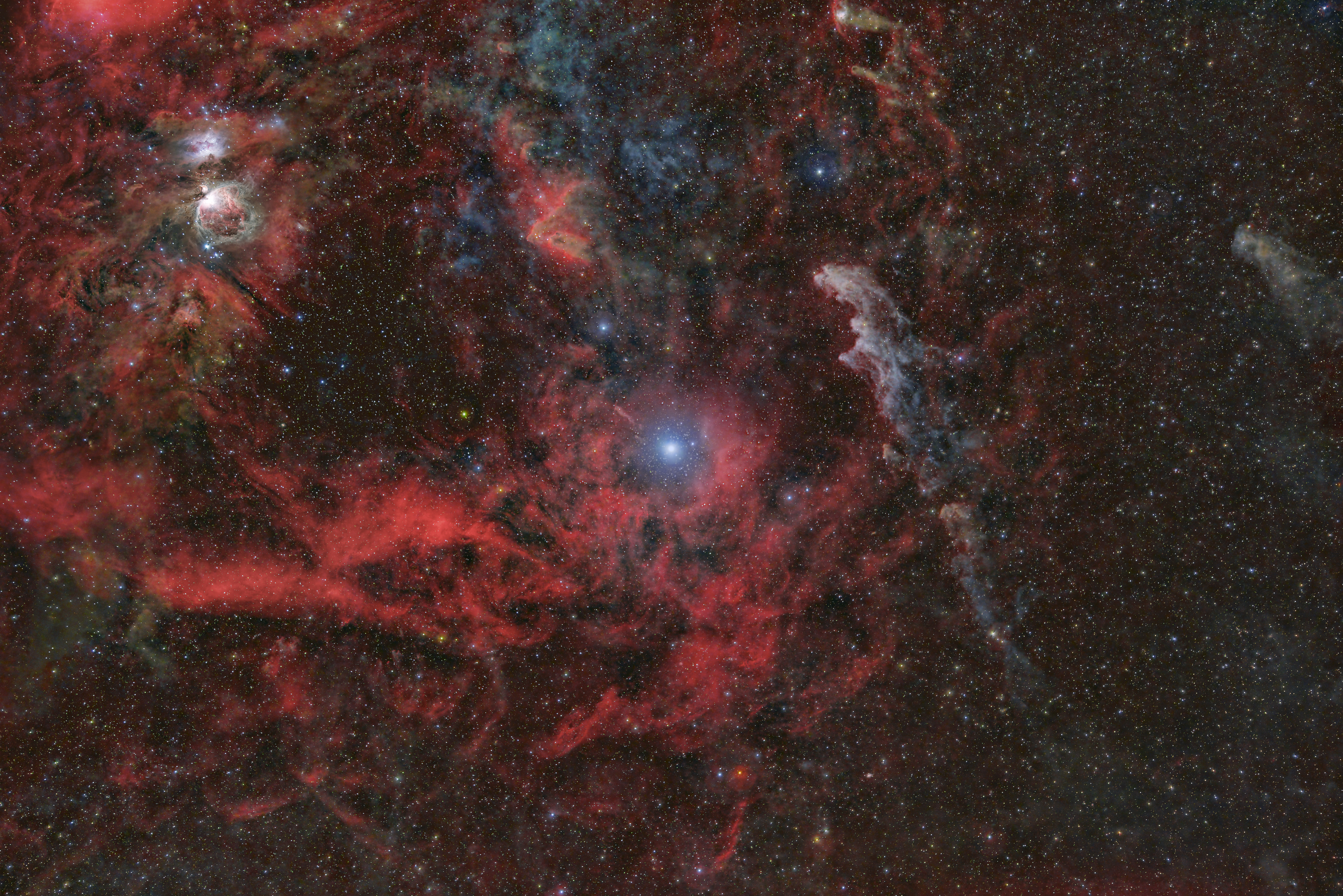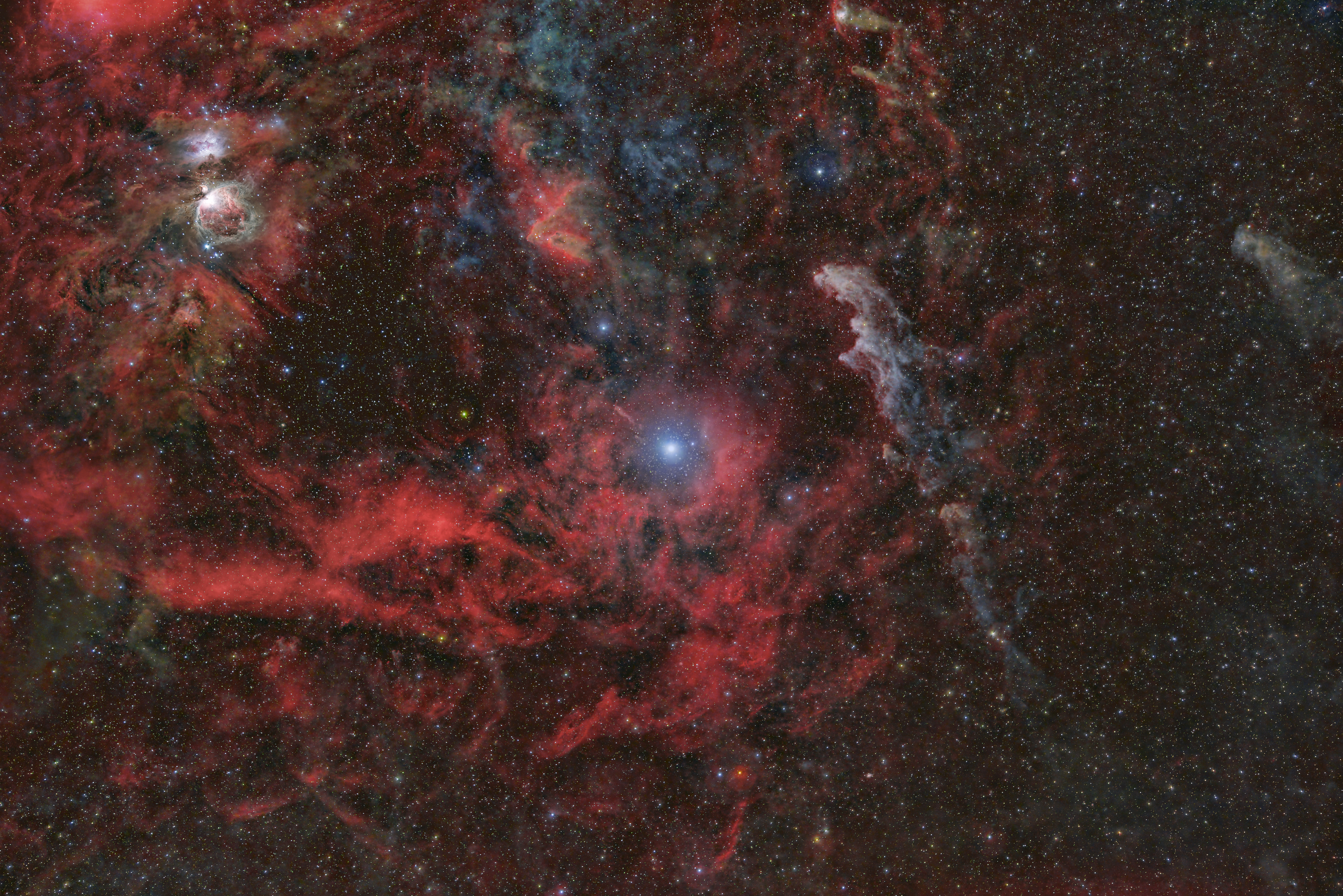
Brilliant, blue, supergiant star Rigel marks the foot of Orion the Hunter in planet Earth's night. Designated Beta Orionis, it's at the center of this remarkably deep and wide field of view. Rigel's blue color indicates that it is much hotter than its rival supergiant in Orion the yellowish Betelgeuse (Alpha Orionis), though both stars are massive enough to eventually end their days as core collapse supernovae. Some 860 light-years away, Rigel is hotter than the Sun too and extends to about 74 times the solar radius. That's about the size of the orbit of Mercury. In the 10 degree wide frame toward the nebula rich constellation, the Orion Nebula is at the upper left. To the right of Rigel and illuminated by its brilliant blue starlight lies the dusty Witch Head Nebula. Rigel is part of a multiple star system, though its companion stars are much fainter.
La brillante, azul y supergigante Rigel marca el pie de Orión, el Cazador, en la noche terrestre. Designada como Beta Orionis, se encuentra en el centro de este campo de visión notablemente profundo y amplio. El color azul de Rigel indica que es mucho más caliente que su rival supergigante en Orión, Betelgeuse (Alpha Orionis), que tiene un tono amarillento, aunque ambas estrellas son lo suficientemente masivas como para terminar sus días como supernovas por colapso del núcleo. A unos 860 años luz de distancia, Rigel es más caliente que el Sol y tiene un radio aproximado de 74 veces el del Sol. Eso equivale aproximadamente al tamaño de la órbita de Mercurio. En el marco de 10 grados de ancho hacia la constelación rica en nebulosas, la Nebulosa de Orión se encuentra en la esquina superior izquierda. A la derecha de Rigel y iluminada por su brillante luz azul se encuentra la nebulosa polvorienta de la Cabeza de Bruja. Rigel forma parte de un sistema estelar múltiple, aunque sus estrellas compañeras son mucho más tenues.