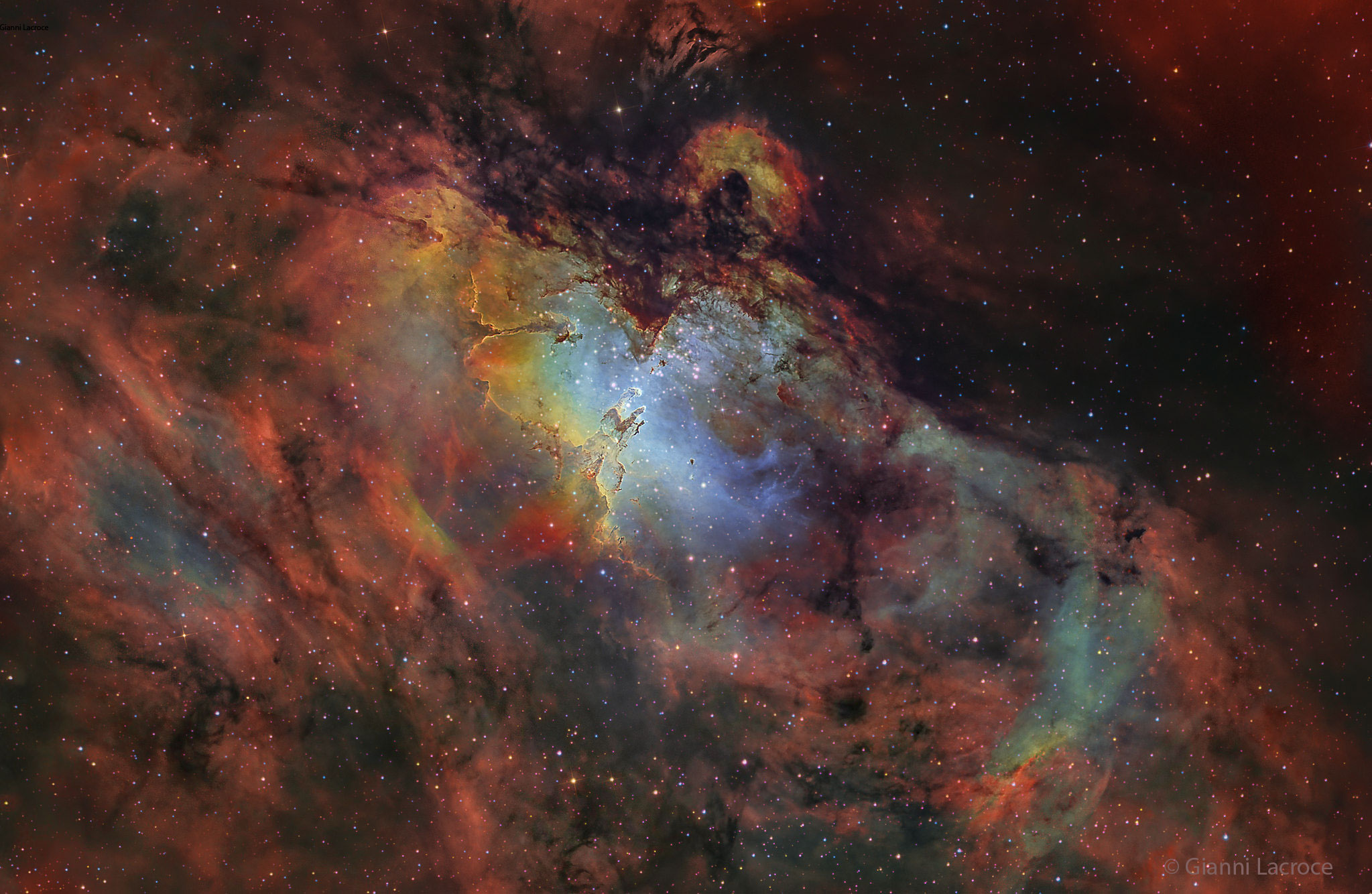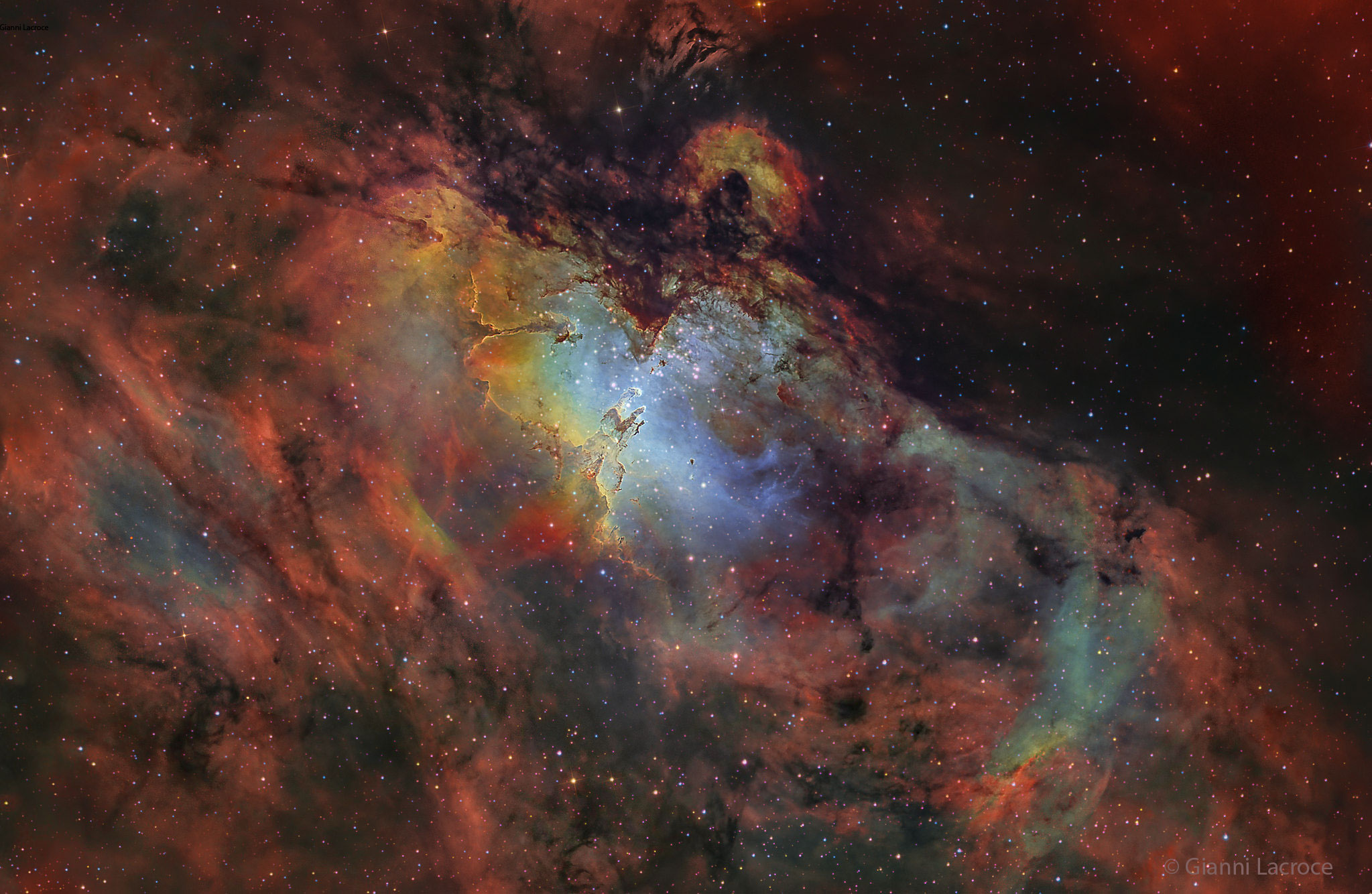
From afar, the whole thing looks like an eagle. A closer look at the Eagle Nebula, however, shows the bright region is actually a window into the center of a larger dark shell of dust. Through this window, a brightly-lit workshop appears where a whole open cluster of stars is being formed. In this cavity, tall pillars and round globules of dark dust and cold molecular gas remain where stars are still forming. Already visible are several young bright blue stars whose light and winds are burning away and pushing back the remaining filaments and walls of gas and dust. The Eagle emission nebula, tagged M16, lies about 6500 light years away, spans about 20 light-years, and is visible with binoculars toward the constellation of the Serpent (Serpens). This picture involved long and deep exposures and combined three specific emitted colors emitted by sulfur (colored as yellow), hydrogen (red), and oxygen (blue).
Desde lejos, todo parece un águila. Una mirada más cercana a la Nebulosa del Águila, sin embargo, revela que la región brillante es en realidad una ventana hacia el centro de una concha más grande de polvo oscuro. A través de esta ventana aparece un taller iluminado donde se está formando un todo un cúmulo abierto de estrellas. En esta cavidad, permanecen pilares altos y globulos redondos de polvo oscuro y gas molecular frío, donde aún se están formando estrellas. Ya se pueden ver varias estrellas jóvenes y brillantes de color azul cuya luz y vientos están quemando y empujando hacia atrás los restantes filamentos y paredes de gas y polvo. La nebulosa de emisión del Águila, etiquetada como M16, se encuentra a unos 6500 años luz de distancia, abarca unos 20 años luz y es visible con binoculares hacia la constelación de la Serpiente (Serpens). Esta imagen involucró exposiciones largas y profundas, combinando tres colores específicos emitidos por el azufre (teñido de amarillo), el hidrógeno (rojo) y el oxígeno (azul).