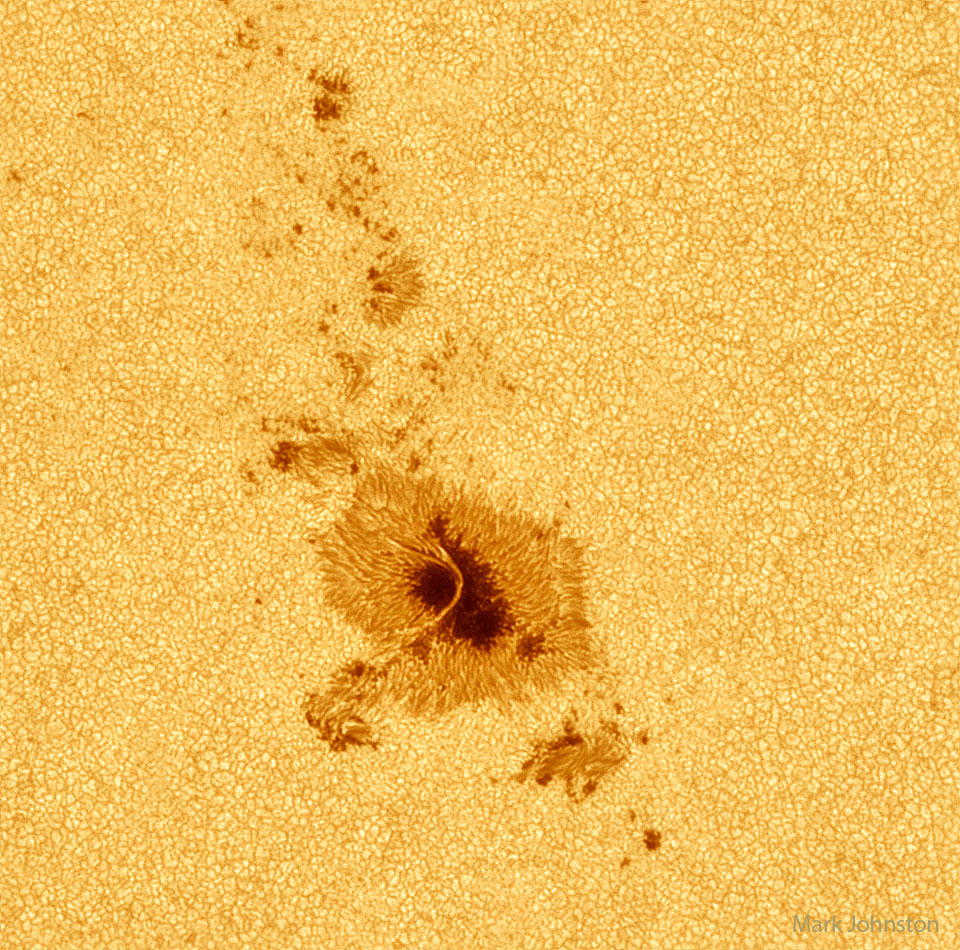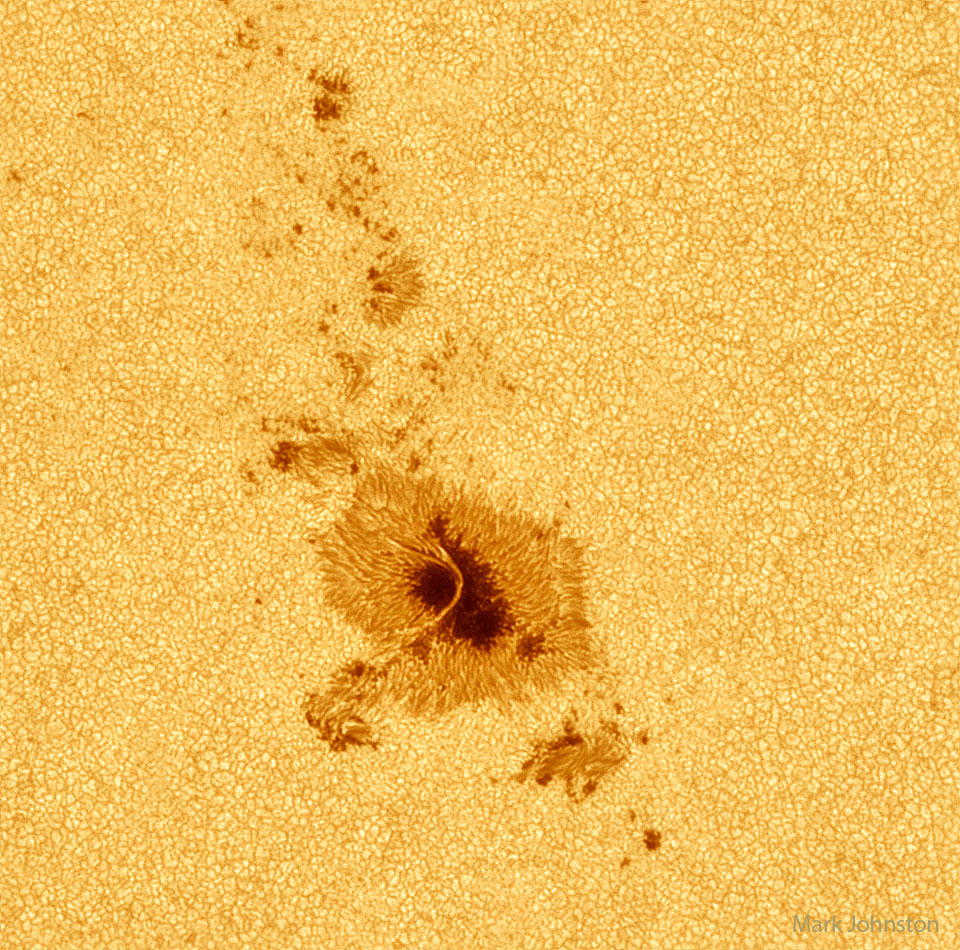
Why would a small part of the Sun appear slightly dark? Visible is a close-up picture of sunspots, depressions on the Sun's surface that are slightly cooler and less bright than the rest of the Sun. The Sun's complex magnetic field creates these cool regions by inhibiting hot material from entering the spots. Sunspots can be larger than the Earth and typically last for about a week. Part of active region AR 3297 crossing the Sun in early May, the large lower sunspot is spanned by an impressive light bridge of hot and suspended solar gas. This high-resolution picture also shows clearly that the Sun's surface is a bubbling carpet of separate cells of hot gas. These cells are known as granules. A solar granule is about 1000 kilometers across and lasts for only about 15 minutes. Your Sky Surprise: What picture did APOD feature on your birthday? (post 1995)
¿Por qué una pequeña parte del Sol aparece ligeramente oscura? Se muestra una imagen detallada de manchas solares, depresiones en la superficie solar que son ligeramente más frías y menos brillantes que el resto del Sol. El complejo campo magnético del Sol crea estas regiones frías al impedir que el material caliente entre en las manchas. Las manchas solares pueden ser más grandes que la Tierra y normalmente duran aproximadamente una semana. Parte de la región activa AR 3297 que cruzaba el Sol a principios de mayo, la gran mancha inferior está atravesada por un impresionante puente de luz formado por gas solar caliente y suspendido. Esta imagen de alta resolución también muestra claramente que la superficie del Sol es una alfombra burbujeante de células individuales de gas caliente. Estas células se conocen como granulos. Un granulo solar tiene aproximadamente 1000 kilómetros de diámetro y dura solo unos 15 minutos.