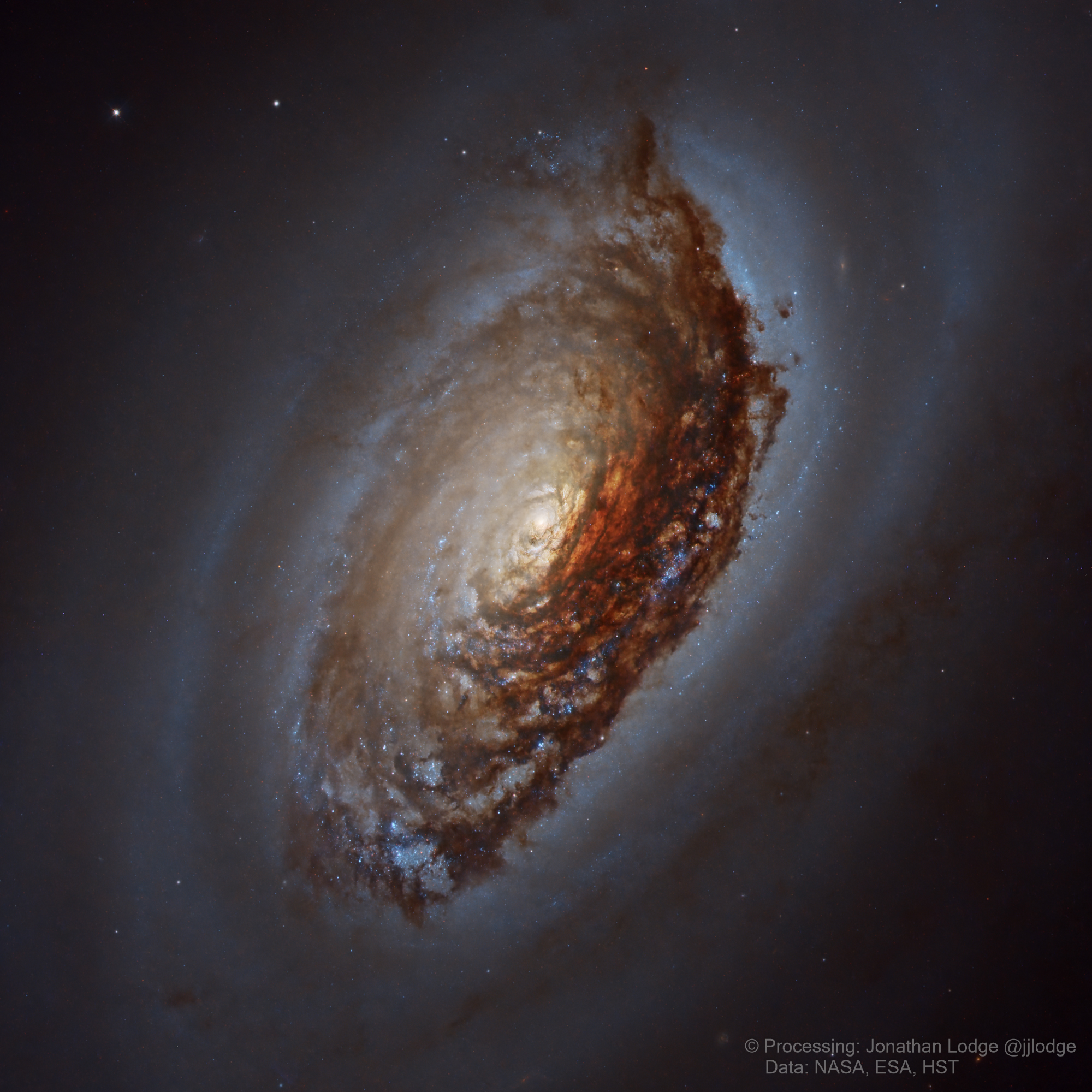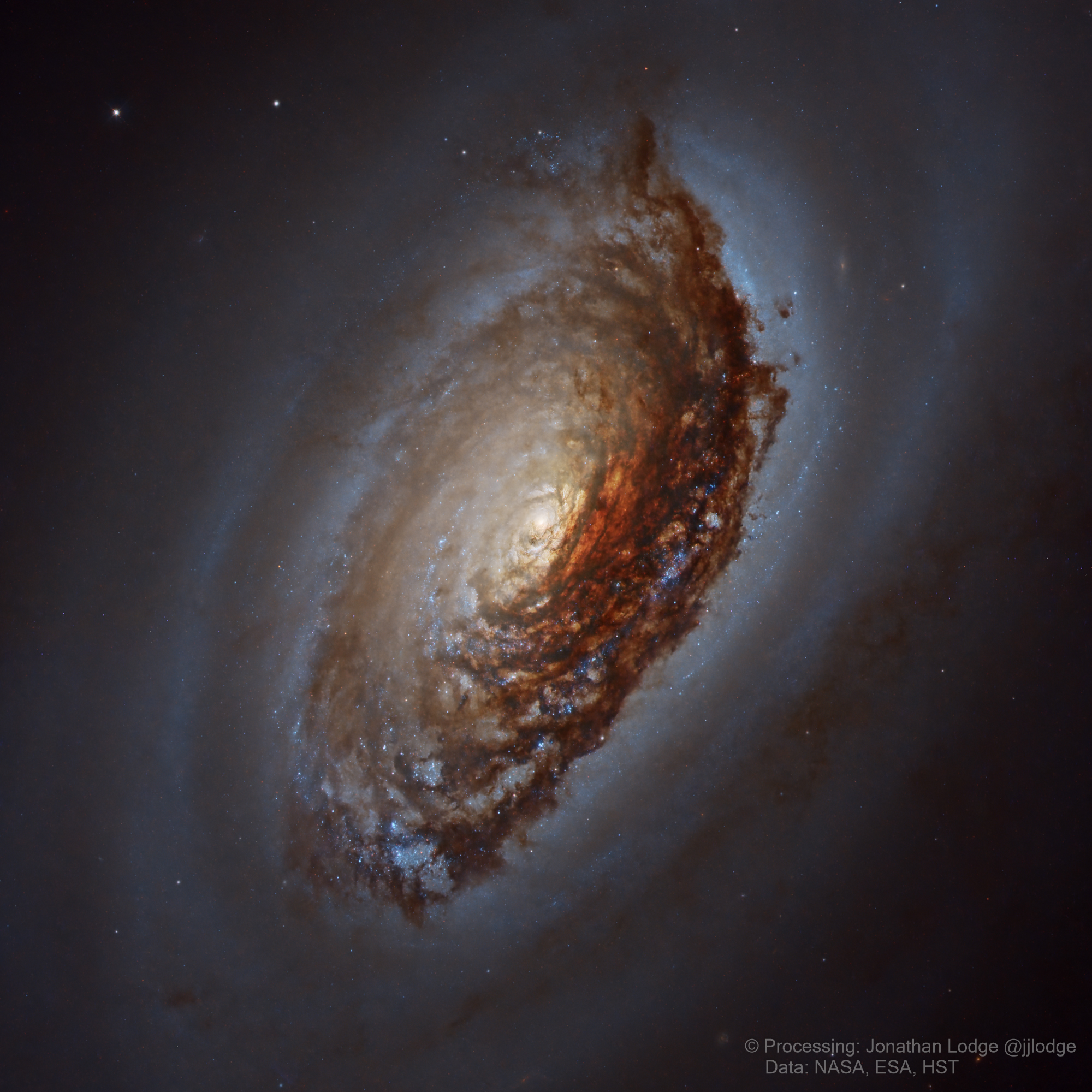
This magnificent spiral galaxy is Messier 64, often called the Black Eye Galaxy or the Sleeping Beauty Galaxy for its dark-lidded appearance in telescopic views. The spiral's central region, about 7,400 light-years across, is pictured in this reprocessed image from the Hubble Space Telescope. M64 lies some 17 million light-years distant in the otherwise well-groomed northern constellation Coma Berenices. The enormous dust clouds partially obscuring M64's central region are laced with young, blue star clusters and the reddish glow of hydrogen associated with star forming regions. But imposing clouds of dust are not this galaxy's only peculiar feature. Observations show that M64 is actually composed of two concentric, counter-rotating systems. While all the stars in M64 rotate in the same direction as the interstellar gas in the galaxy's central region, gas in the outer regions, extending to about 40,000 light-years, rotates in the opposite direction. The dusty eye and bizarre rotation are likely the result of a billion year old merger of two different galaxies.
Esta magnífica galaxia espiral es la M64, a menudo llamada Galaxia Ojo Negro o Galaxia Bella Durmiente por su apariencia de ojo oscuro en vistas telescópicas. La región central de la espiral, de unos 7.400 años luz de diámetro, se muestra en esta imagen reprocesada del Telescopio Espacial Hubble. La M64 se encuentra a unos 17 millones de años luz de distancia en la constelación del norte, Coma Berenices. Las nubes enormes de polvo que parcialmente ocultan la región central de la M64 están teñidas de jóvenes cúmulos estelares azules y el brillo rojizo del hidrógeno asociado con regiones de formación estelar. Pero las nubes imponentes de polvo no son la única característica peculiar de esta galaxia. Las observaciones muestran que la M64 está compuesta en realidad por dos sistemas concéntricos que giran en direcciones opuestas. Mientras que todas las estrellas de la M64 giran en la misma dirección que el gas interestelar en la región central de la galaxia, el gas en las regiones externas, que se extiende hasta unos 40.000 años luz, gira en dirección contraria. El ojo polvoriento y la rotación extraña probablemente sean el resultado de una fusión de dos galaxias diferentes hace mil millones de años.