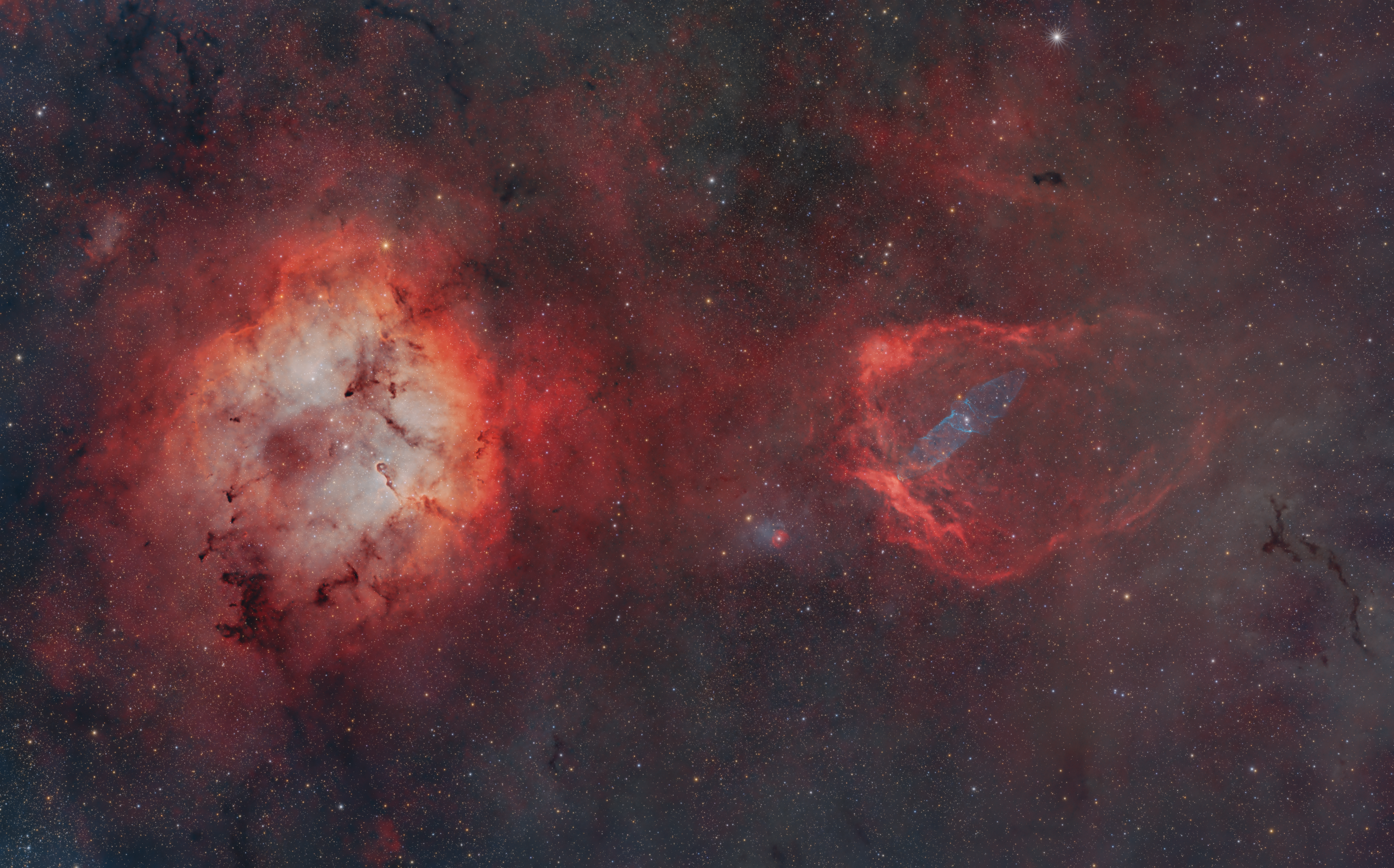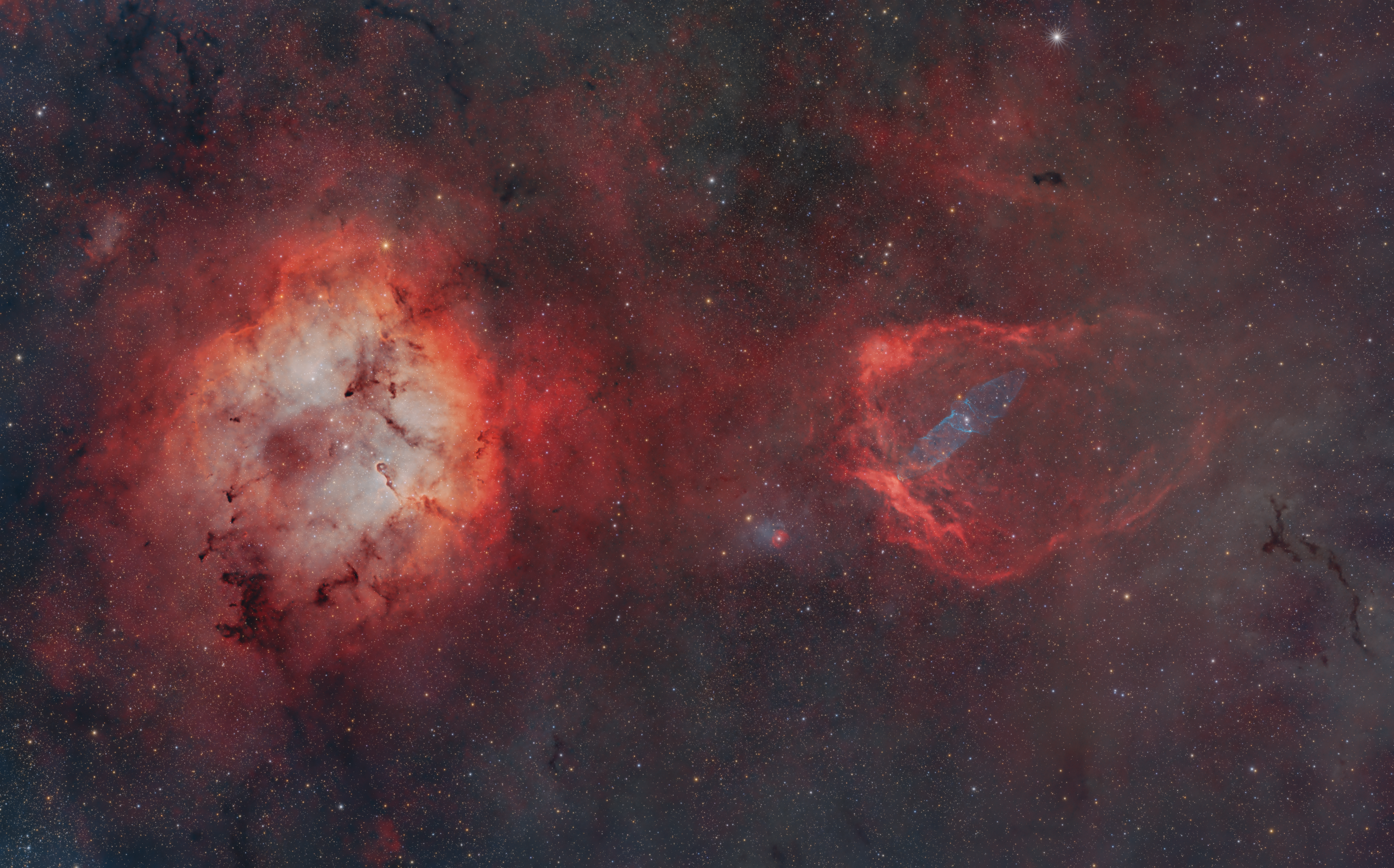
Sprawling emission nebulae IC 1396 and Sh2-129 mix glowing interstellar gas and dark dust clouds in this nearly 12 degree wide field of view toward the northern constellation Cepheus the King. Energized by its central star IC 1396 (left), is hundreds of light-years across and some 3,000 light-years distant. The nebula's intriguing dark shapes include a winding dark cloud popularly known as the Elephant's Trunk below and right of center. Tens of light-years long, it holds the raw material for star formation and is known to hide protostars within. Located a similar distance from planet Earth, the bright knots and swept back ridges of emission of Sh2-129 on the right suggest its popular name, the Flying Bat Nebula. Within the Flying Bat, the most recently recognized addition to this royal cosmic zoo is the faint bluish emission from Ou4, the Giant Squid Nebula. Near the lower right edge of the frame, the suggestive dark marking on the sky cataloged as Barnard 150 is also known as the dark Seahorse Nebula. Notable submissions to APOD: Perseids Meteor Shower 2023
Crédito: NASA, CGRO SSC Las nebulosas de emisión IC 1396 y Sh2-129 se extienden en esta imagen de casi 12 grados de ancho hacia la constelación norteña de Cefeo, el Rey. Energizada por su estrella central IC 1396 (a la izquierda), esta región tiene cientos de años luz de diámetro y se encuentra a unos 3000 años luz de distancia. Las formas oscuras intrigantes de la nebulosa incluyen una nube oscura enrollada conocida popularmente como el Pico de Elefante, ubicada debajo y a la derecha del centro. De decenas de años luz de longitud, contiene la materia prima para la formación estelar y se sabe que oculta protoestrellas en su interior. A una distancia similar de la Tierra, los nudos brillantes y las crestas retrocedidas de emisión de Sh2-129 a la derecha sugieren su nombre popular, la Nebulosa Murciélago Volador. Dentro del Murciélago Volador, la adición más recientemente reconocida a esta zona zoológica cósmica es la débil emisión azulosa de Ou4, la Nebulosa Pulpo Gigante. Cerca del borde inferior derecho del marco, la sugerente marca oscura en el cielo catalogada como Barnard 150 también se conoce como la Nebulosa Caballito de Mar Oscuro.