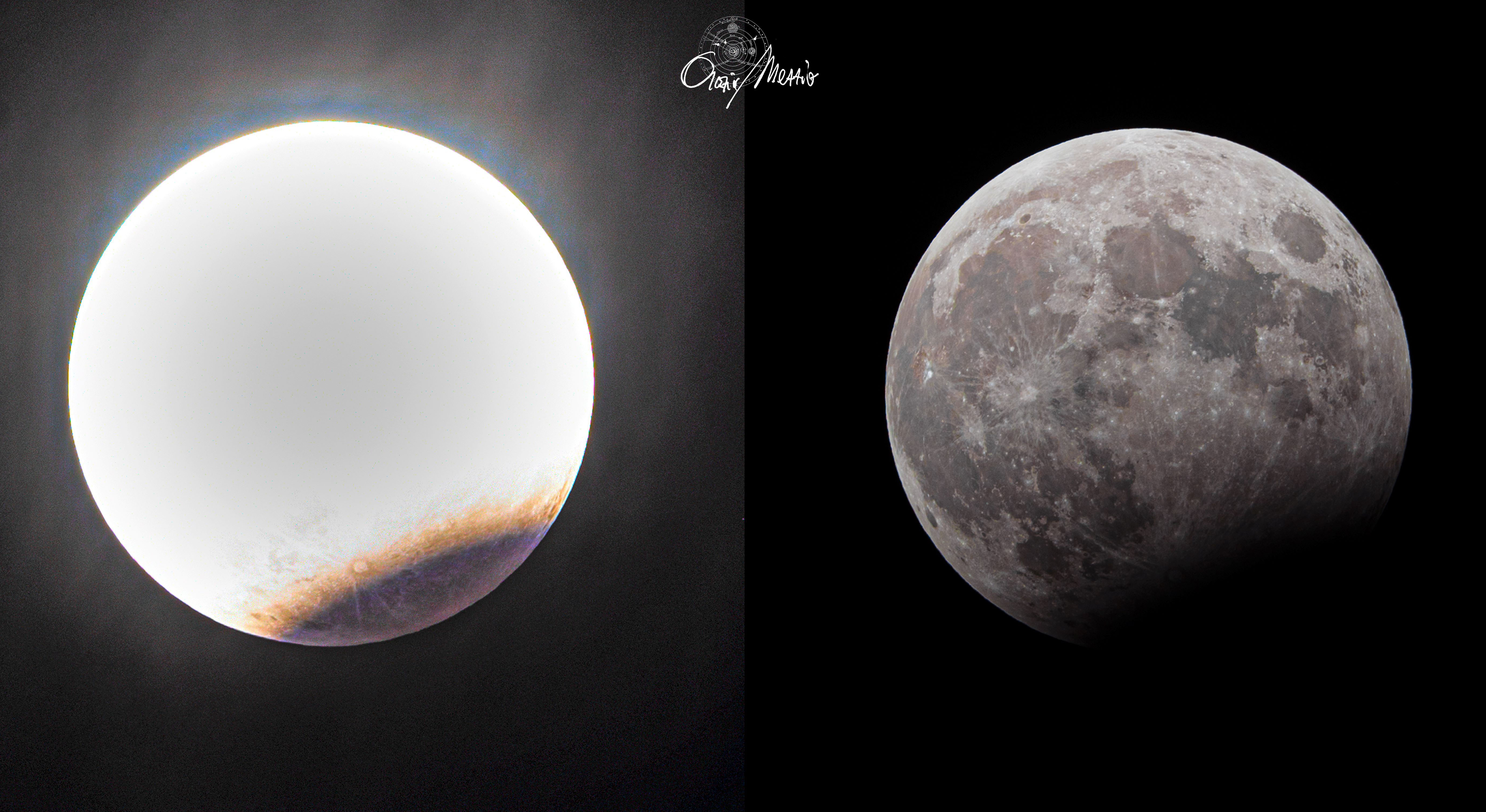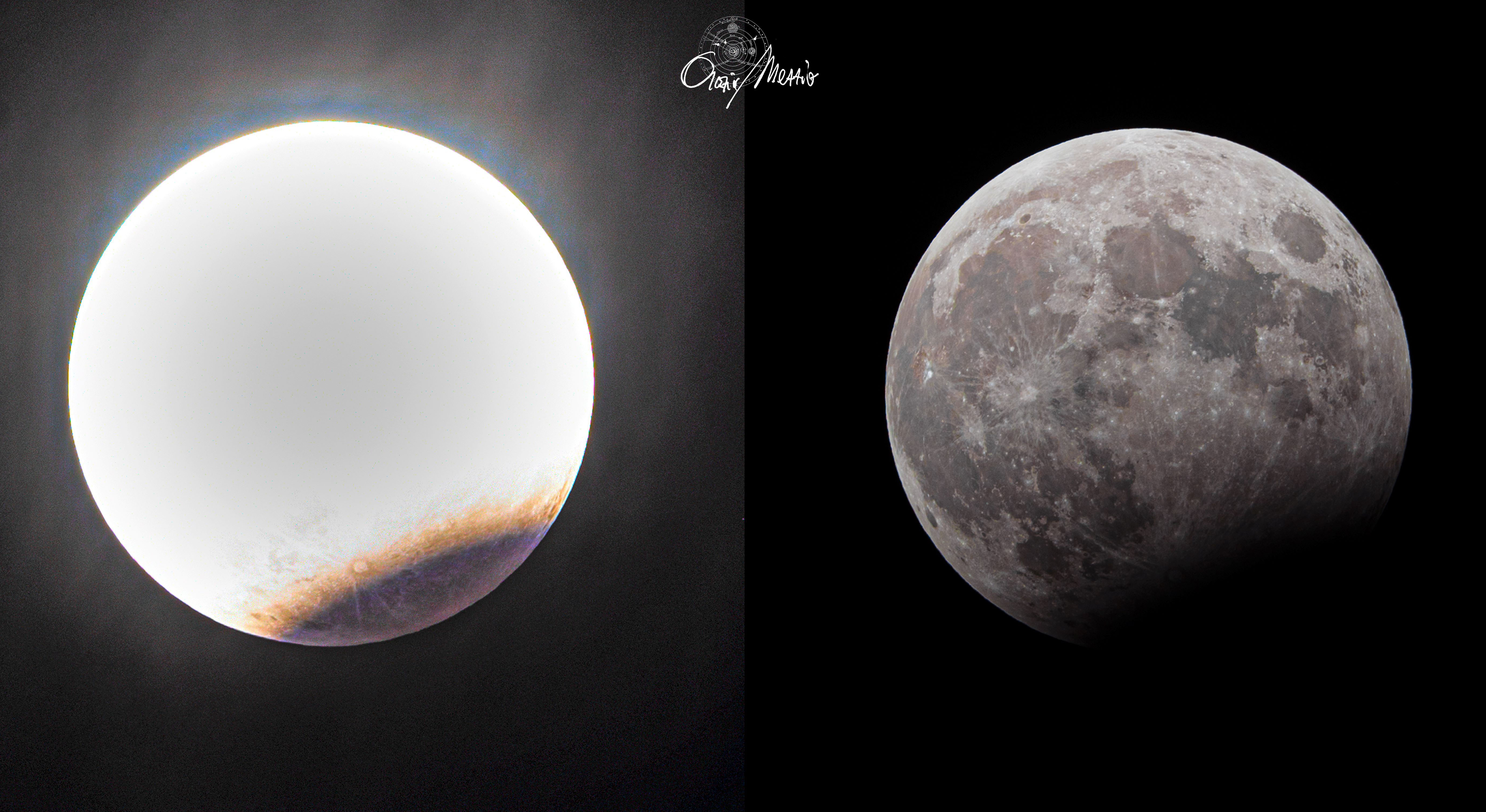
What's happened to the Moon? Within the last day, part of the Moon moved through the Earth's shadow. This happens about once or twice a year, but not every month since the Moon's orbit around the Earth is slightly tilted. Pictured here, the face of a full Hunter's Moon is shown twice from Italy during this partial lunar eclipse. On the left, most of the Moon appears overexposed except for the eclipsed bottom right, which shows some familiar lunar surface details. In contrast, on the right, most of the (same) Moon appears normally exposed, with the exception of the bottom right, which now appears dark. All lunar eclipses are visible from the half of the Earth facing the Moon at the time of the eclipse, but this eclipse was visible specifically from Europe, Africa, Asia, and Australia, clouds permitting. In April, a total solar eclipse will be visible from North America. Album: Selected partial lunar eclipse images sent in to APOD
¿Qué le ha sucedido a la Luna? En el último día, una parte de la Luna pasó a través de la sombra de la Tierra. Esto ocurre aproximadamente una o dos veces al año, pero no todos los meses, ya que la órbita de la Luna alrededor de la Tierra está ligeramente inclinada. En la imagen, se muestra dos veces la cara de una Luna llena de cazador desde Italia durante este eclipse lunar parcial. A la izquierda, la mayor parte de la Luna aparece sobreexposta, excepto por la parte inferior derecha eclipsada, que muestra algunos detalles familiares de la superficie lunar. En contraste, a la derecha, la mayor parte de (la misma) Luna aparece expuesta normalmente, excepto por la parte inferior derecha, que ahora aparece oscura. Todos los eclipses lunares son visibles desde la mitad de la Tierra que mira hacia la Luna en el momento del eclipse, pero este eclipse fue visible específicamente desde Europa, África, Asia y Australia, si las nubes lo permitían. En abril, un eclipse solar total será visible desde Norteamérica.