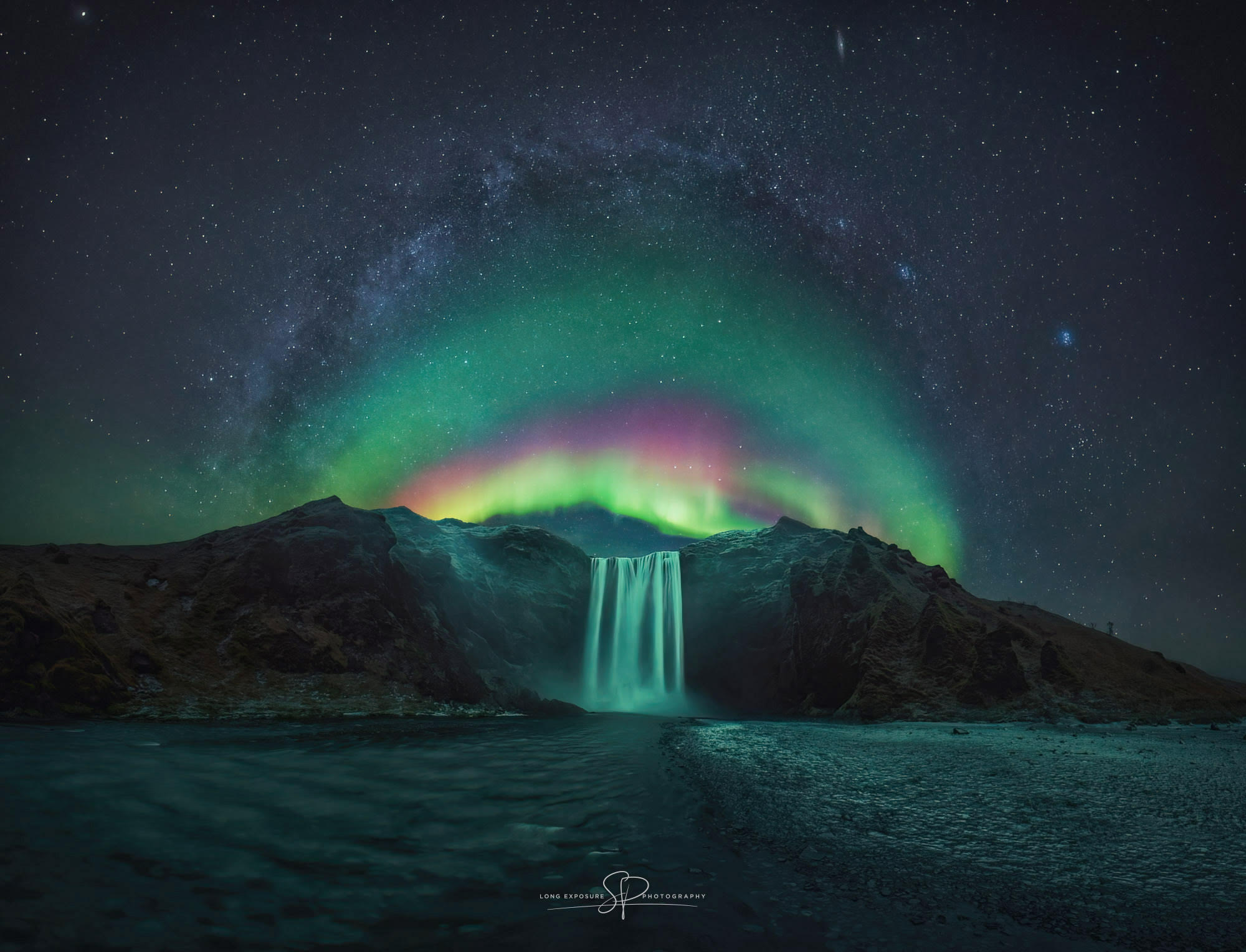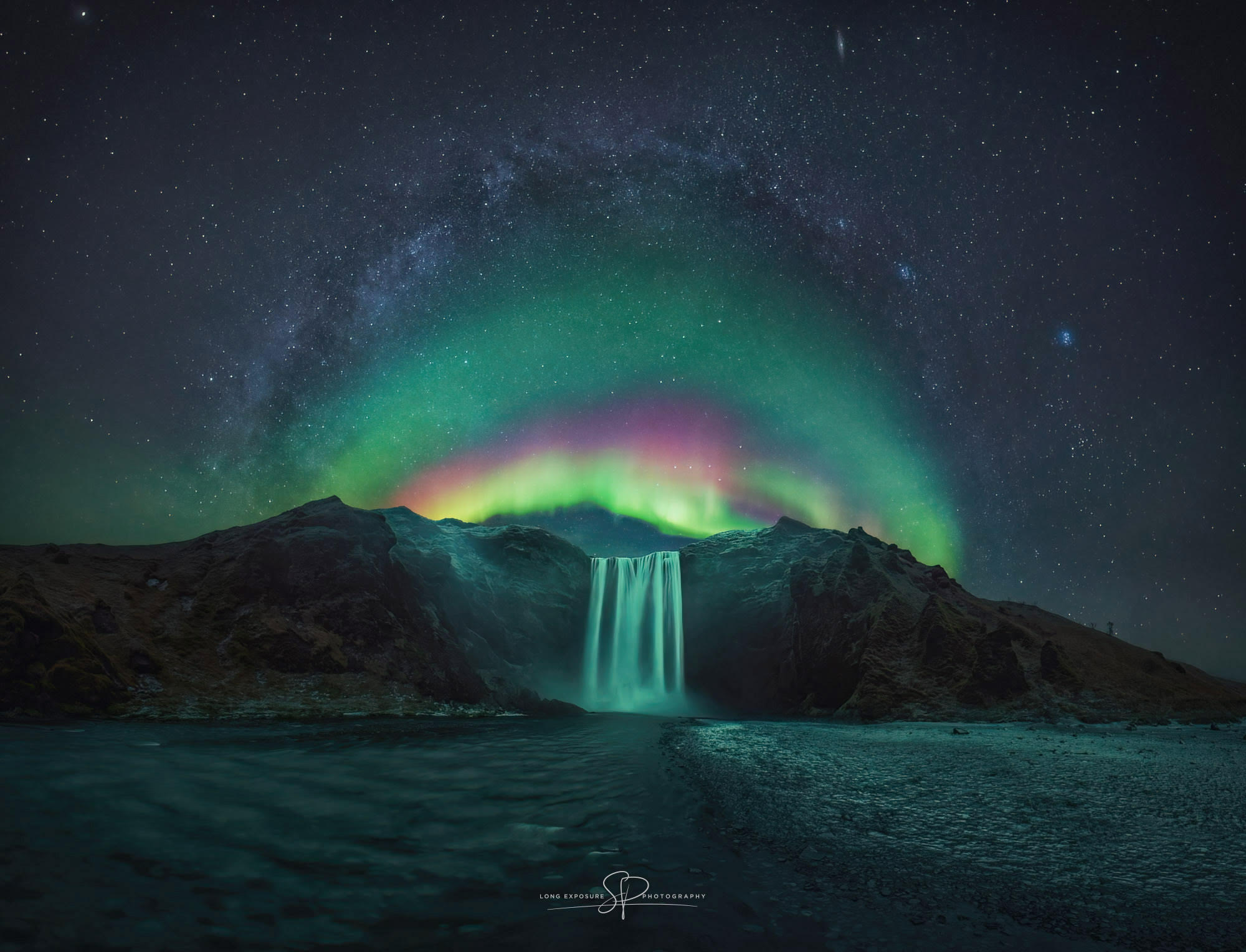
Yes, but can your aurora do this? First, yes, auroras can look like rainbows even though they are completely different phenomena. Auroras are caused by Sun-created particles being channeled into Earth's atmosphere by Earth's magnetic field, and create colors by exciting atoms at different heights. Conversely, rainbows are created by sunlight backscattering off falling raindrops, and different colors are refracted by slightly different angles. Unfortunately, auroras can’t create waterfalls, but if you plan well and are lucky enough, you can photograph them together. The featured picture is composed of several images taken on the same night last November near the Skógafoss waterfall in Iceland. The planning centered on capturing the central band of our Milky Way galaxy over the picturesque cascade. By luck, a spectacular aurora soon appeared just below the curving arch of the Milky Way. Far in the background, the Pleiades star cluster and the Andromeda galaxy can be found. Your Sky Surprise: What picture did APOD feature on your birthday? (post 1995)
Sí, pero ¿puede tu aurora hacer esto? Primero, sí, las auroras pueden parecerse a los arcoíris, aunque son fenómenos completamente diferentes. Las auroras son causadas por partículas creadas por el Sol que son canalizadas hacia la atmósfera terrestre por el campo magnético de la Tierra, y crean colores al excitar átomos a diferentes alturas. Por el contrario, los arcoíris son creados por la luz solar que se dispersa hacia atrás al rebotar en las gotas de lluvia en caída, y los diferentes colores se refractan a ángulos ligeramente distintos. Desafortunadamente, las auroras no pueden crear cascadas, pero si planeas bien y tienes suerte, puedes fotografiarlas juntas. La imagen destacada está compuesta por varias tomas realizadas la misma noche del mes pasado noviembre cerca de la cascada Skógafoss en Islandia. La planificación se centró en capturar la banda central de nuestra galaxia, la Vía Láctea, sobre la pintoresca cascada. Por suerte, pronto apareció una espectacular aurora justo debajo del arco curvo de la Vía Láctea. En el fondo lejano, se pueden encontrar el cúmulo estelar de las Pléyades y la galaxia de Andrómeda.