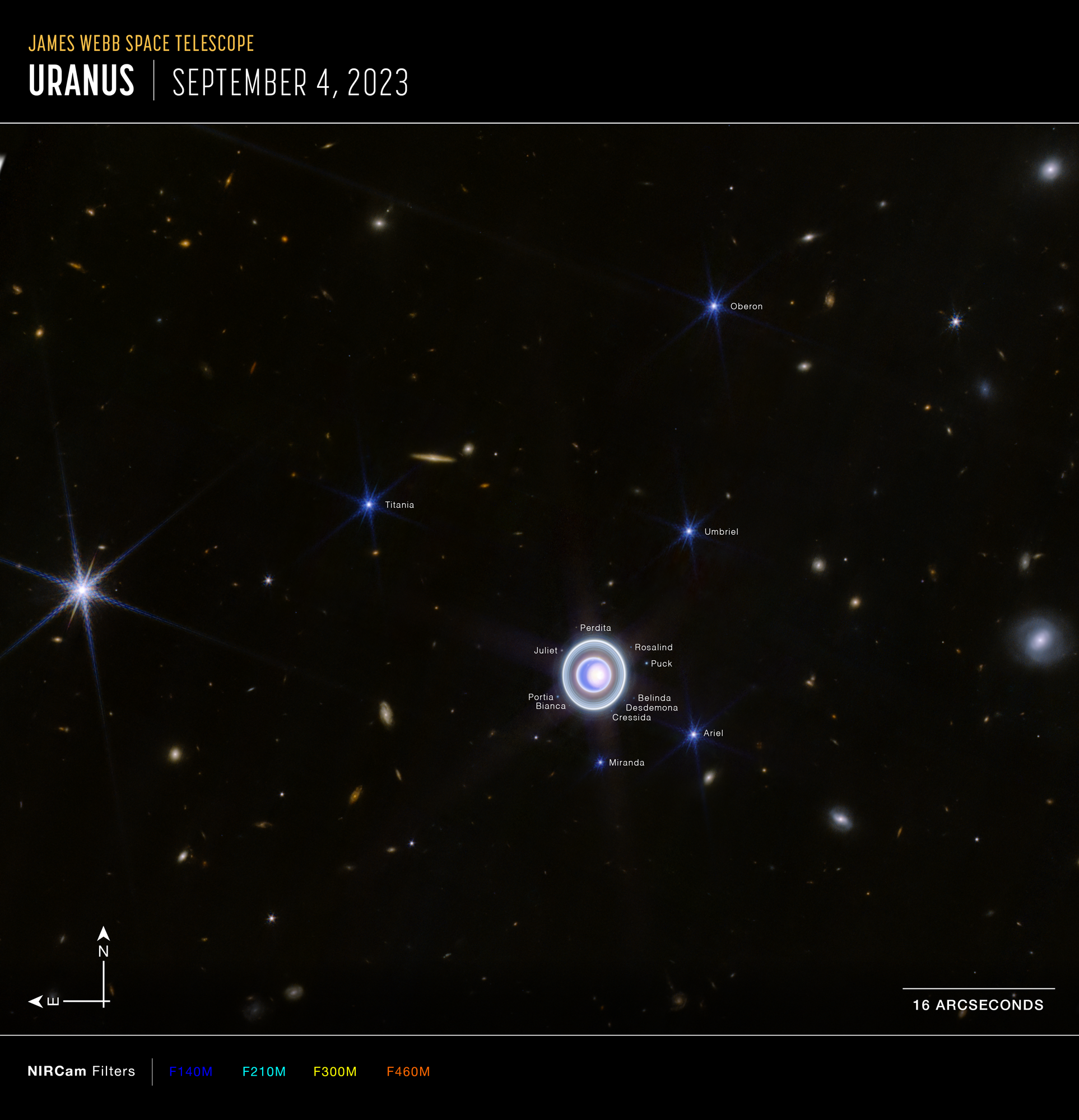
In 1986, Voyager 2 became the only spacecraft to explore ice giant planet Uranus close up. Still, this newly released image from the NIRCam (Near-Infrared Camera) on the James Webb Space Telescope offers a detailed look at the distant world. The tilted outer planet rotates on its axis once in about 17 hours. Its north pole is presently pointed near our line of sight, offering direct views of its northern hemisphere and a faint but extensive system of rings. Of the giant planet's 27 known moons, 14 are annotated in the image. Mixed with fuzzy background galaxies, the brighter moons show hints of Webb's characteristic diffraction spikes. And though these worlds of the outer Solar System were unknown in Shakespearean times, all but two of the 27 Uranian moons are named for characters in the English bard's plays.
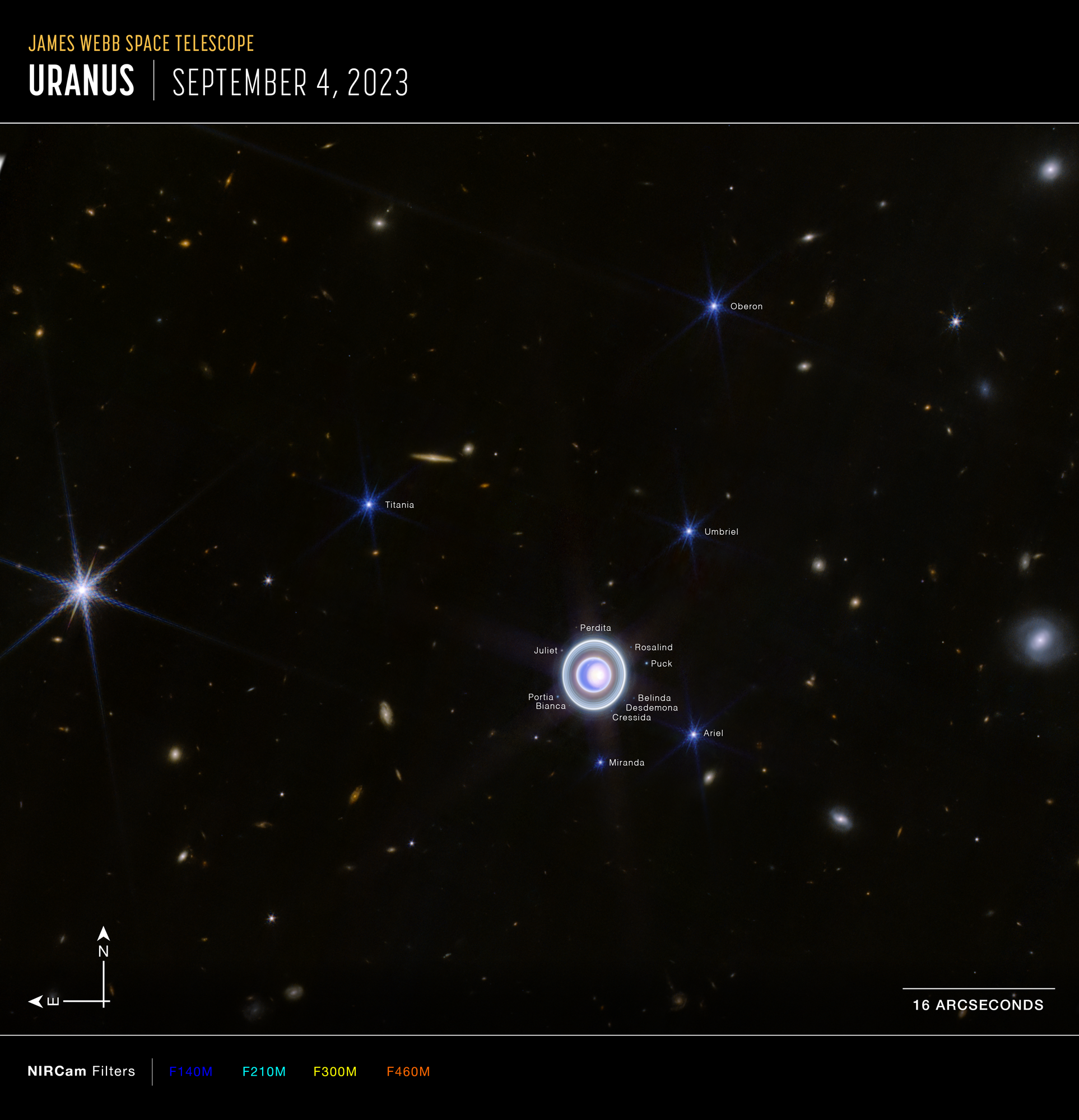
En 1986, Voyager 2 se convirtió en la única nave espacial en explorar de cerca el planeta gaseoso helado Urano. Sin embargo, esta imagen recientemente liberada del NIRCam (Cámara de Infrarrojo Cercano) del Telescopio Espacial James Webb ofrece una mirada detallada a este mundo distante. El planeta exterior inclinado rota sobre su eje una vez cada aproximadamente 17 horas. Su polo norte está actualmente orientado cerca de nuestra línea de visión, ofreciendo vistas directas de su hemisferio norte y un sistema de anillos extenso pero tenue. De los 27 satélites conocidos del planeta gigante, 14 están anotados en la imagen. Mezclados con galaxias de fondo borrosas, los satélites más brillantes muestran indicios de las características espirales de difracción de Webb. Y aunque estos mundos del sistema solar exterior eran desconocidos en la época shakespeariana, todos los 27 satélites de Urano, excepto dos, llevan el nombre de personajes de las obras del poeta inglés.