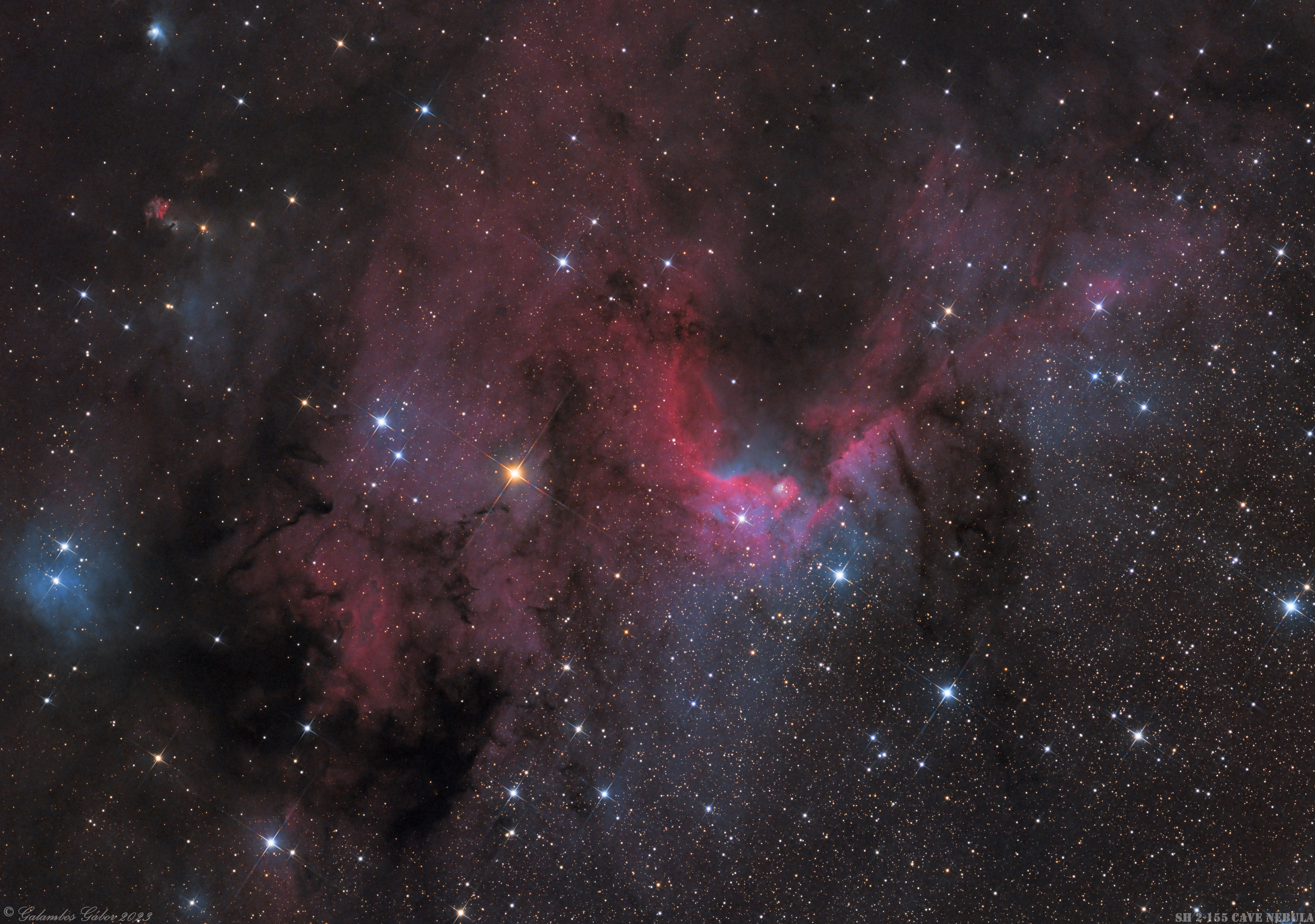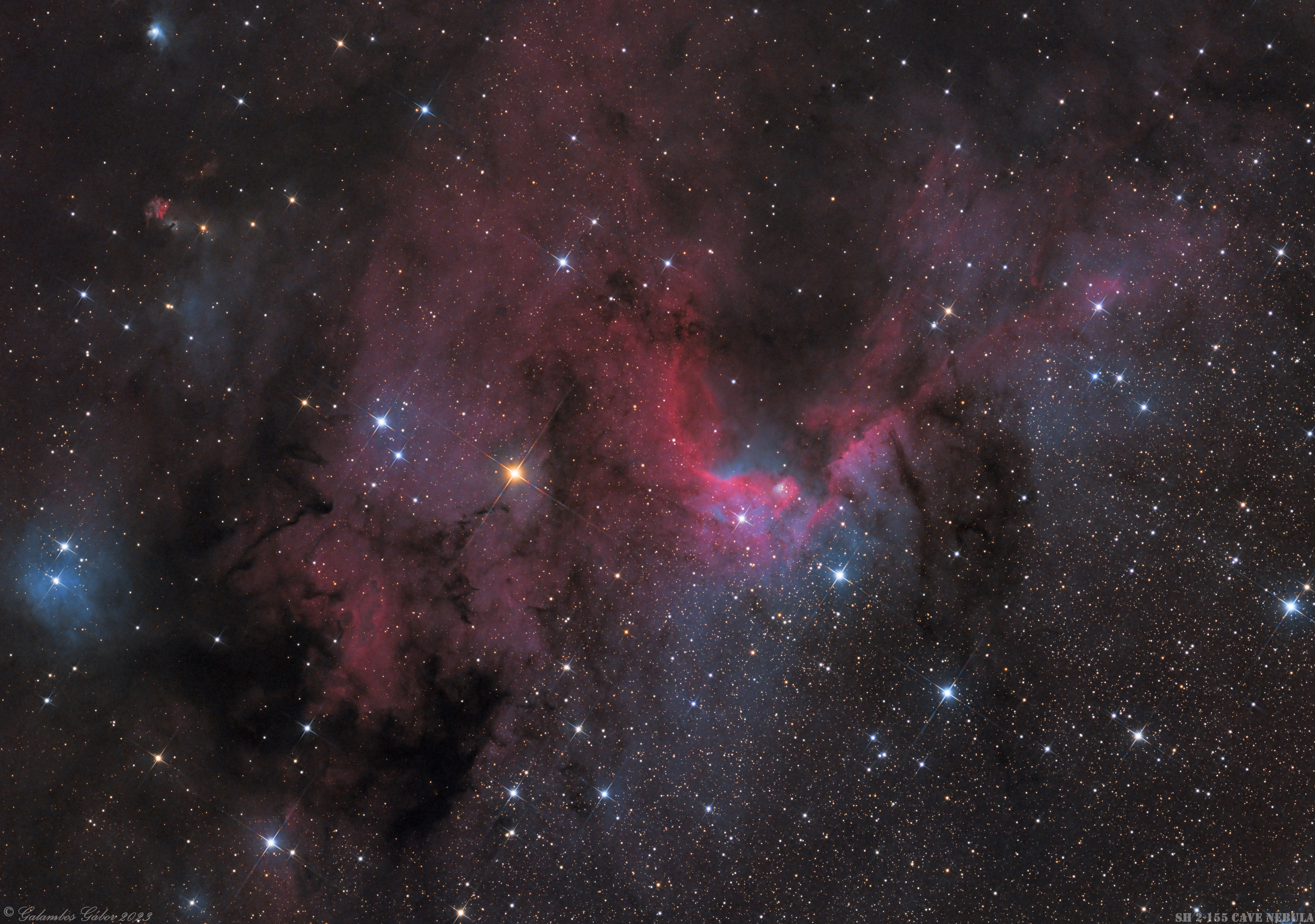
This colorful skyscape spans about three full moons across nebula rich starfields along the plane of our Milky Way Galaxy toward the royal northern constellation Cepheus. Near the edge of the region's massive molecular cloud some 2,400 light-years away, bright reddish emission region Sharpless (Sh)2-155 is at the center of the frame, also known as the Cave Nebula. About 10 light-years across the cosmic cave's bright walls of gas are ionized by ultraviolet light from the hot young stars around it. Dusty bluish reflection nebulae, like vdB 155 at the left, and dense obscuring clouds of dust also abound on the interstellar canvas. Astronomical explorations have revealed other dramatic signs of star formation, including the bright reddish fleck of Herbig-Haro (HH) 168. At the upper left in the frame, the Herbig-Haro object emission is generated by energetic jets from a newborn star.
Esta colorida escena celeste abarca aproximadamente el tamaño de tres lunas llenas, atravesando campos estelares ricos en nebulosas a lo largo del plano de nuestra Galaxia Vía Láctea, hacia la constelación norteña real de Cefeo. En el borde de una nube molecular masiva situada a unos 2.400 años luz de distancia, la región de emisión rojiza brillante Sharpless (Sh)2-155 se encuentra en el centro del marco, también conocida como la Nebulosa Cueva. Con unos 10 años luz de ancho, las brillantes paredes gaseosas de la cueva cósmica están ionizadas por la luz ultravioleta proveniente de las estrellas jóvenes y calientes que la rodean. También abundan en esta tela interestelar las nebulosas de reflexión azuladas y polvorientas, como la vdB 155 a la izquierda, así como densas nubes oscuras que ocultan la luz. Exploraciones astronómicas han revelado otros signos dramáticos de formación estelar, incluyendo el brillo rojizo brillante del objeto Herbig-Haro (HH) 168. En la parte superior izquierda del marco, la emisión del objeto Herbig-Haro es generada por chorros energéticos provenientes de una estrella recién nacida.