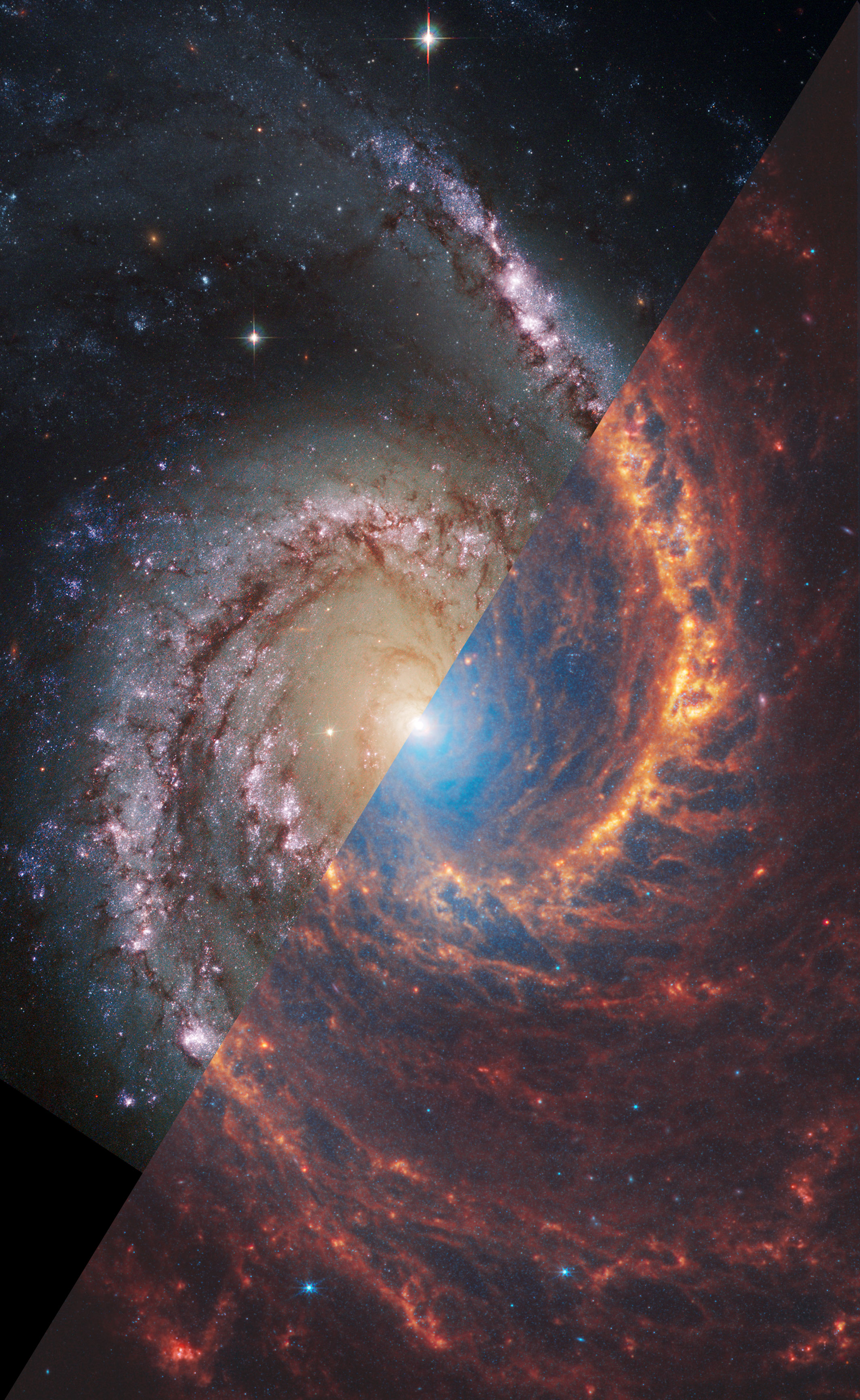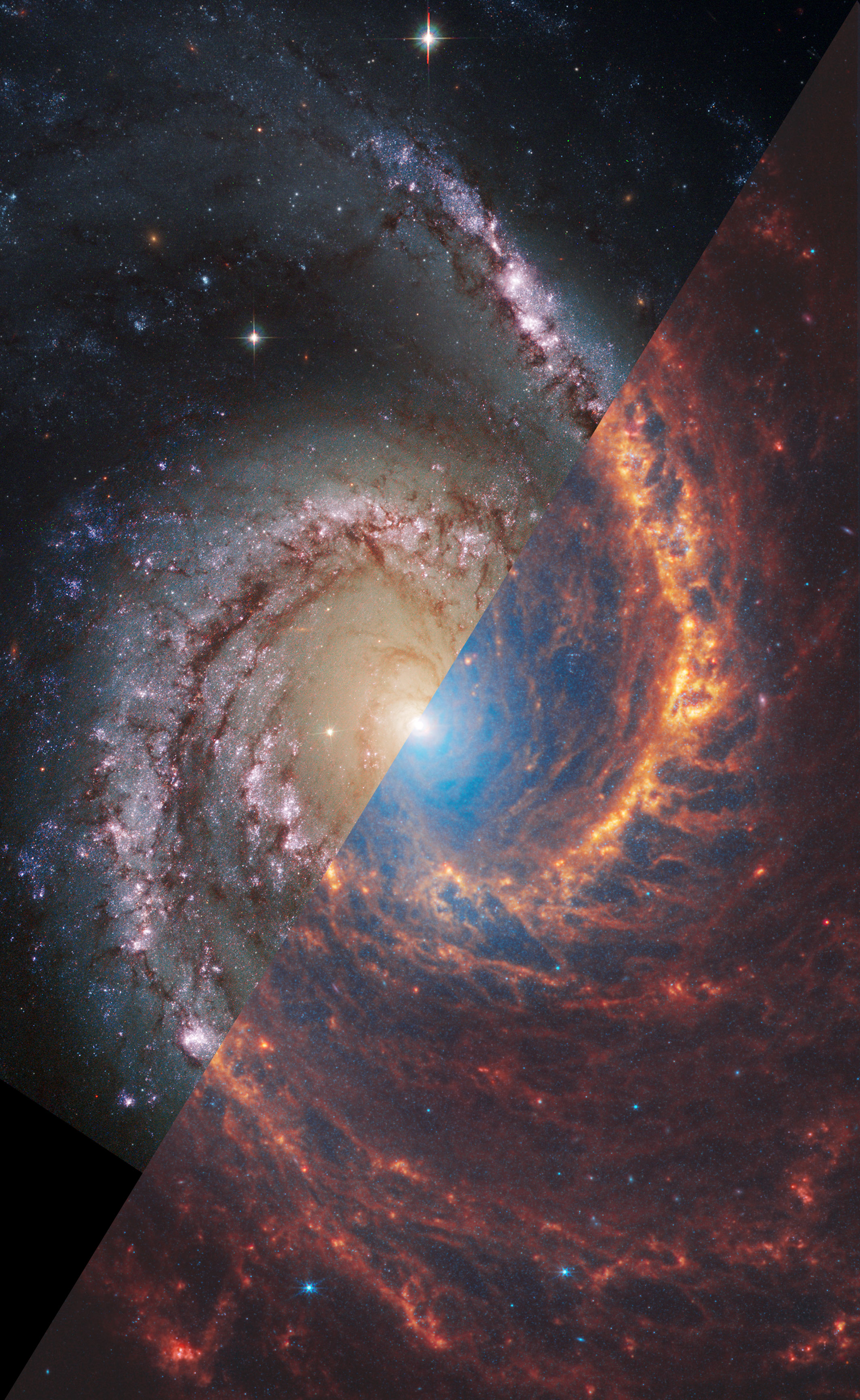
What's different about this galaxy? Very little, which makes the Spanish Dancer galaxy, NGC 1566, one of the most typical and photogenic spirals on the sky. There is something different about this galaxy image, though, because it is a diagonal combination of two images: one by the Hubble Space Telescope on the upper left, and the other by the James Webb Space Telescope on the lower right. The Hubble image was taken in ultraviolet light and highlights the locations of bright blue stars and dark dust along the galaxy's impressive spiral arms. In contrast, the Webb image was taken in infrared light and highlights where the same dust emits more light than it absorbed. In the rollover image, the other two sides of these images are revealed. Blinking between the two images shows which stars are particularly hot because they glow brighter in ultraviolet light, and the difference between seemingly empty space and infrared-glowing dust. Image Crunching Opportunity: Take NASA's Astrophoto Challenge
¿Qué es diferente en esta galaxia? Casi nada, lo que hace de la galaxia Bailarina Española, NGC 1566, una de las espirales más típicas y fotogénicas del cielo. Sin embargo, hay algo diferente en esta imagen de la galaxia, ya que es una combinación diagonal de dos imágenes: una tomada por el Telescopio Espacial Hubble en la esquina superior izquierda, y la otra por el Telescopio Espacial James Webb en la esquina inferior derecha. La imagen de Hubble fue capturada en luz ultravioleta y resalta las ubicaciones de estrellas brillantes de color azul y el polvo oscuro a lo largo de los impresionantes brazos espirales de la galaxia. En contraste, la imagen de Webb fue tomada en luz infrarroja y resalta donde el mismo polvo emite más luz de la que absorbe. En la imagen al pasar el ratón, se revelan los otros dos lados de estas imágenes. Alternar entre las dos imágenes muestra qué estrellas son particularmente calientes porque brillan más en luz ultravioleta, y la diferencia entre lo que parece ser espacio vacío y el polvo que emite luz en el infrarrojo.