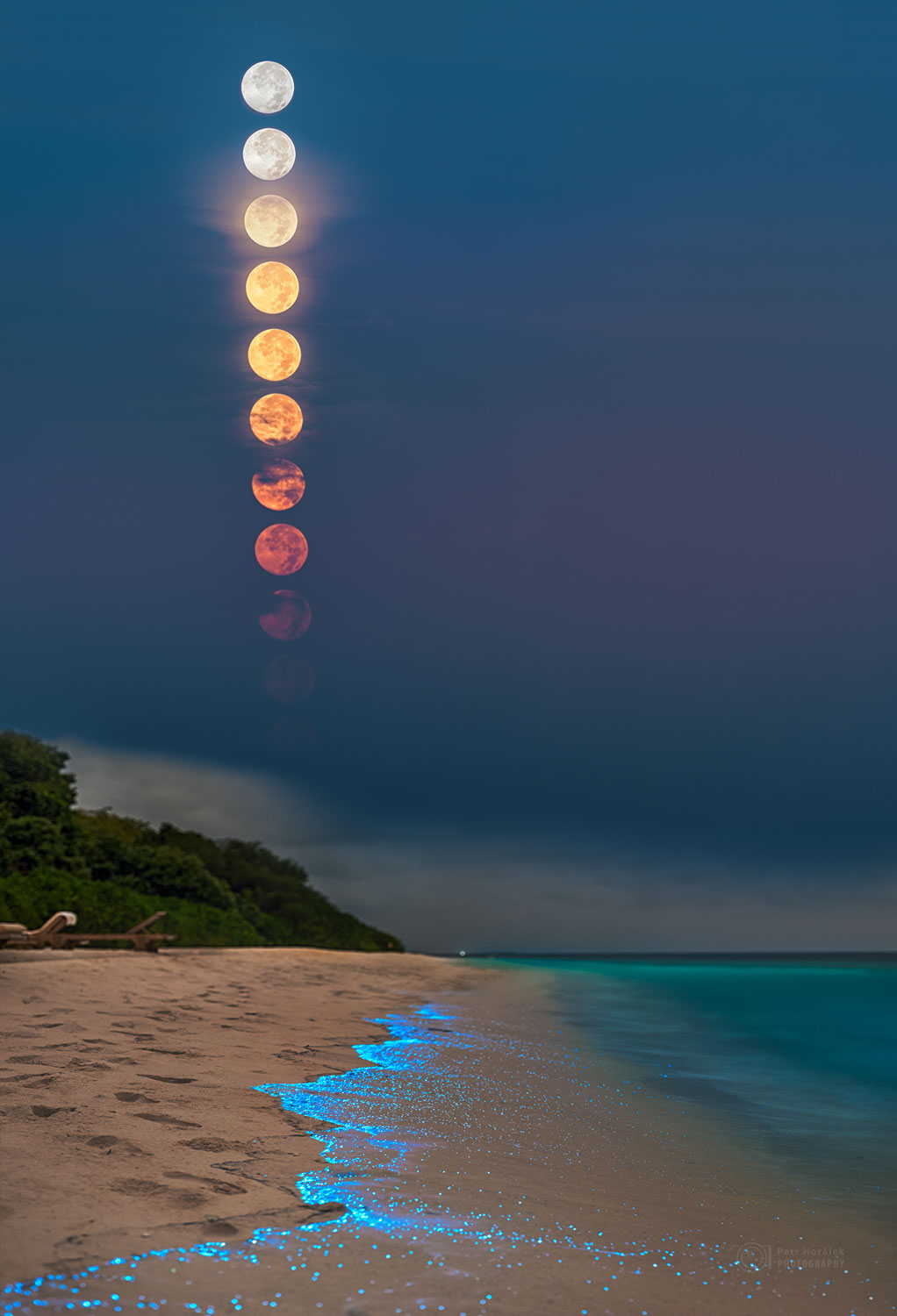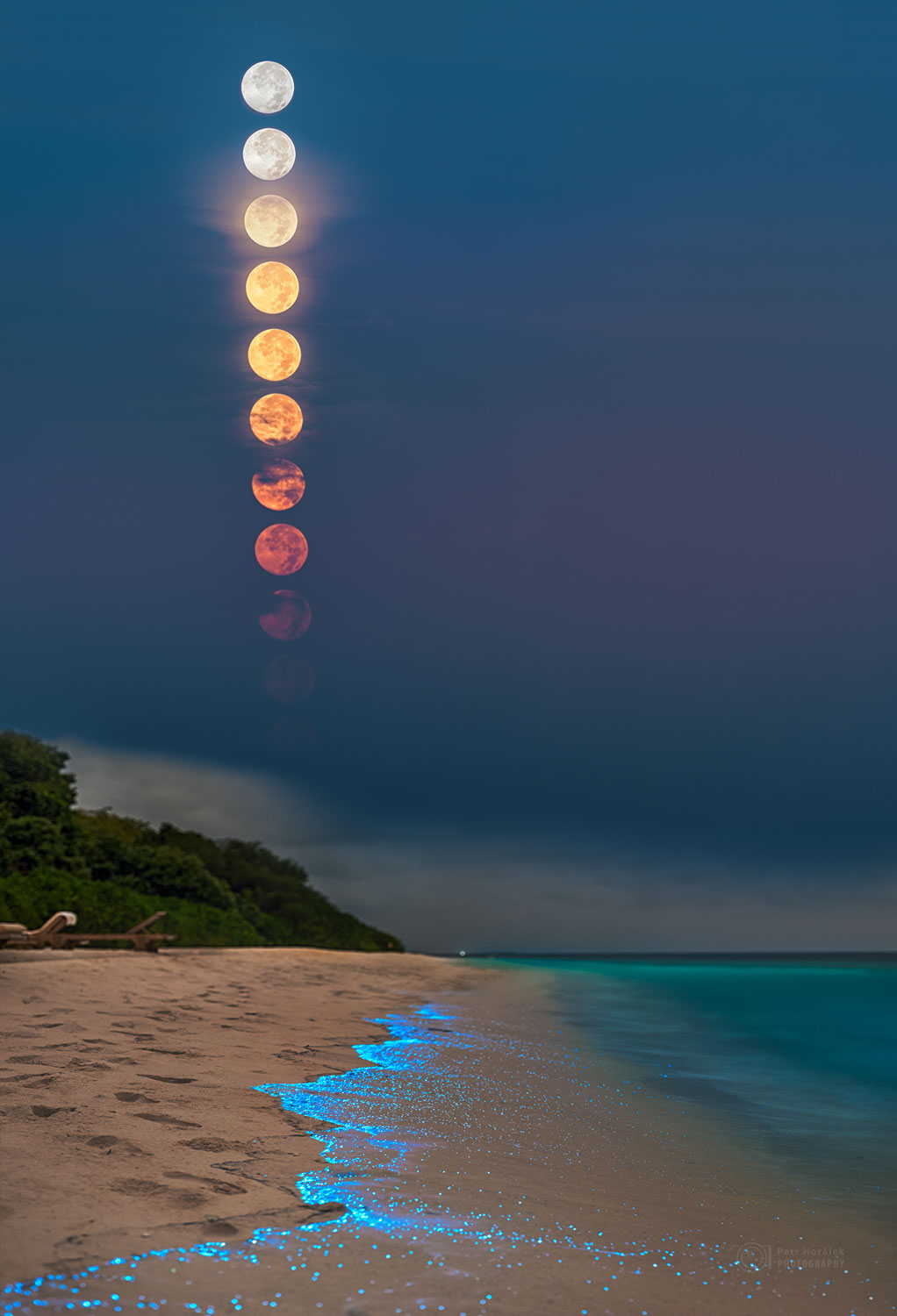
What glows in the night? This night featured a combination of usual and unusual glows. Perhaps the most usual glow was from the Moon, a potentially familiar object. The full Moon's nearly vertical descent results from the observer being near Earth's equator. As the Moon sets, air and aerosols in Earth's atmosphere preferentially scatter out blue light, making the Sun-reflecting satellite appear reddish when near the horizon. Perhaps the most unusual glow was from the bioluminescent plankton, likely less familiar objects. These microscopic creatures glow blue, it is thought, primarily to surprise and deter predators. In this case, the glow was caused primarily by plankton-containing waves crashing onto the beach. The image was taken on Soneva Fushi Island, Maldives just over one year ago. Your Sky Surprise: What picture did APOD feature on your birthday? (post 1995)
¿Qué brilla en la noche? Esta noche presentó una combinación de brillos habituales e inusuales. Quizás el brillo más habitual provino de la Luna, un objeto potencialmente familiar. La casi vertical caída de la luna llena se debe a que el observador se encontraba cerca del ecuador terrestre. Al ponerse la Luna, el aire y los aerosoles en la atmósfera terrestre dispersan selectivamente la luz azul, haciendo que el satélite que refleja la luz solar aparezca de color rojizo cuando está cerca del horizonte. Quizás el brillo más inusual provino del plancton bioluminiscente, objetos probablemente menos familiares. Estos microscópicos organismos brillan en azul, se piensa principalmente para sorprender y disuadir a sus depredadores. En este caso, el brillo fue causado principalmente por olas que contenían plancton y que se estrellaban contra la playa. La imagen fue tomada en la isla Soneva Fushi, Maldivas, hace justo un año. Tu sorpresa celeste: ¿Qué imagen presentó APOD el día de tu cumpleaños? (desde 1995)