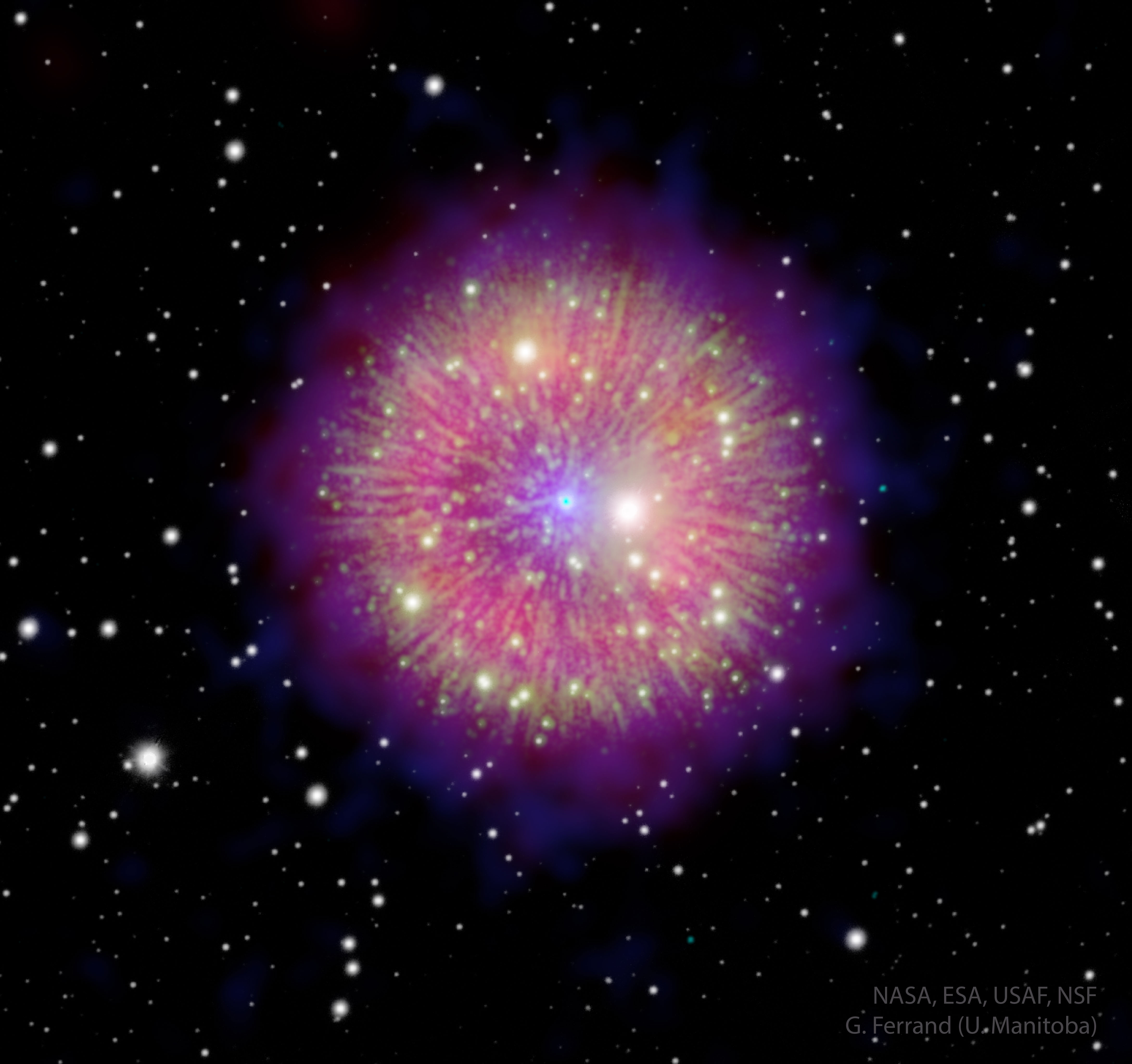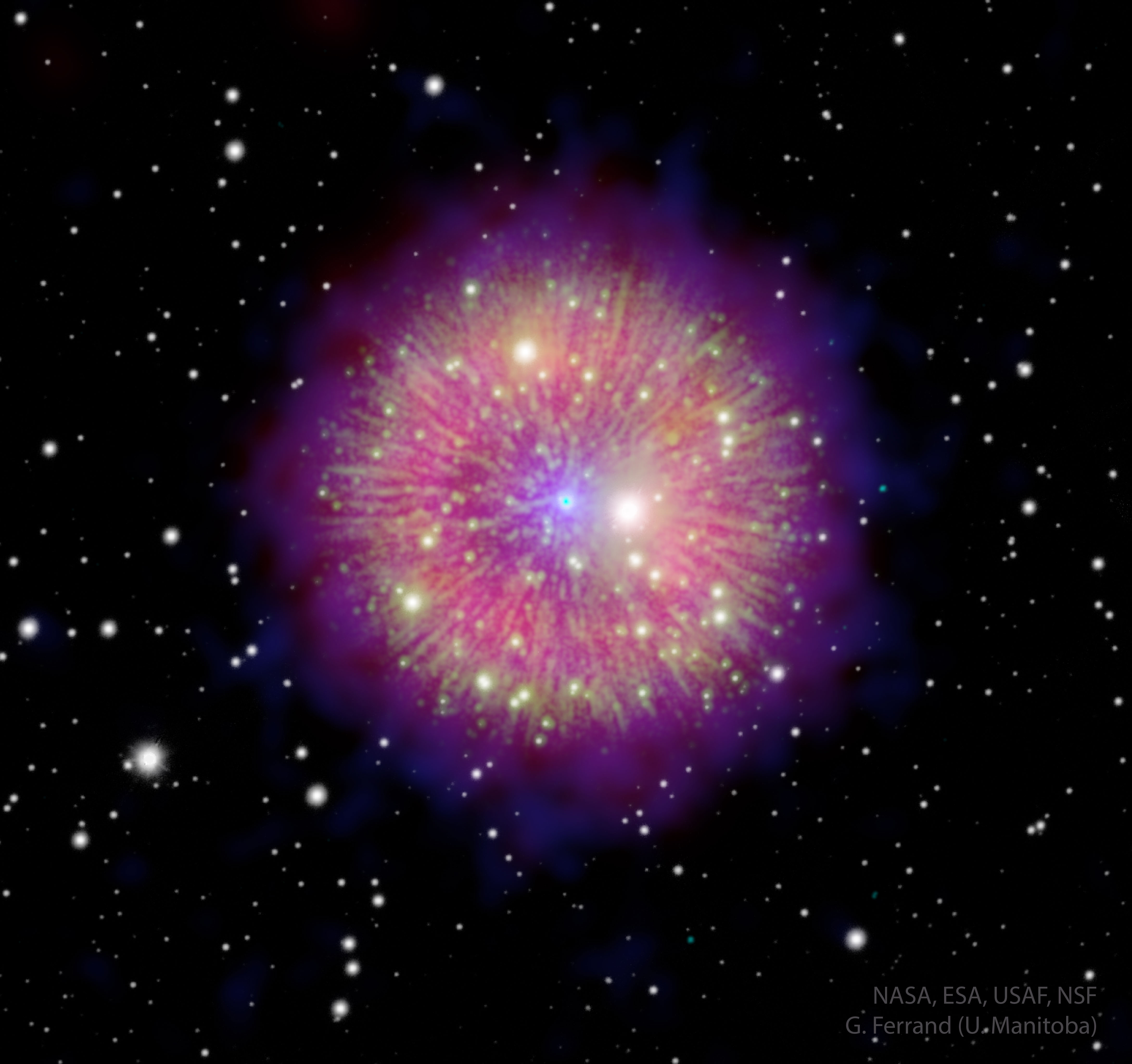
What created this unusual celestial firework? The nebula, dubbed Pa 30, appears in the same sky direction now as a bright "guest star" did in the year 1181. Although Pa 30's filaments look similar to that created by a nova (for example GK Per), and a planetary nebula (for example NGC 6751), some astronomers now propose that it was created by a rare type of supernova: a thermonuclear Type Iax, and so is (also) named SN 1181. In this model, the supernova was not the result of the detonation of a single star, but rather a blast that occurred when two white dwarf stars spiraled together and merged. The blue dot in the center is hypothesized to be a zombie star, the remnant white dwarf that somehow survived this supernova-level explosion. The featured image combines images and data obtained with infrared (WISE), visible (MDM, Pan-STARRS), and X-ray (Chandra, XMM) telescopes. Future observations and analyses may tell us more. NASA Coverage: Total Solar Eclipse of 2024 April 8
¿Qué creó esta nebulosa celeste inusual? La nebulosa, bautizada como Pa 30, aparece en la misma dirección del cielo ahora como lo hizo una brillante 'estrella invitada' en el año 1181. Aunque los filamentos de Pa 30 se parecen a los creados por una nova (por ejemplo, GK Per) y una nebulosa planetaria (por ejemplo, NGC 6751), algunos astrónomos ahora proponen que fue creada por un tipo raro de supernova: una supernova termonuclear del tipo Iax, y por lo tanto también se la llama SN 1181. En este modelo, la supernova no fue el resultado de la detonación de una sola estrella, sino más bien una explosión que ocurrió cuando dos enanas blancas se enroscaron entre sí y se fusionaron. El punto azul en el centro se hipotetiza que es una estrella zombi, la enana blanca restante que de alguna manera sobrevivió a esta explosión de supernova. La imagen destacada combina imágenes y datos obtenidos con telescopios en el infrarrojo (WISE), en la luz visible (MDM, Pan-STARRS) y en rayos X (Chandra, XMM). Observaciones y análisis futuros pueden revelarnos más información. Cobertura de la NASA: Eclipse solar total del 8 de abril de 2024