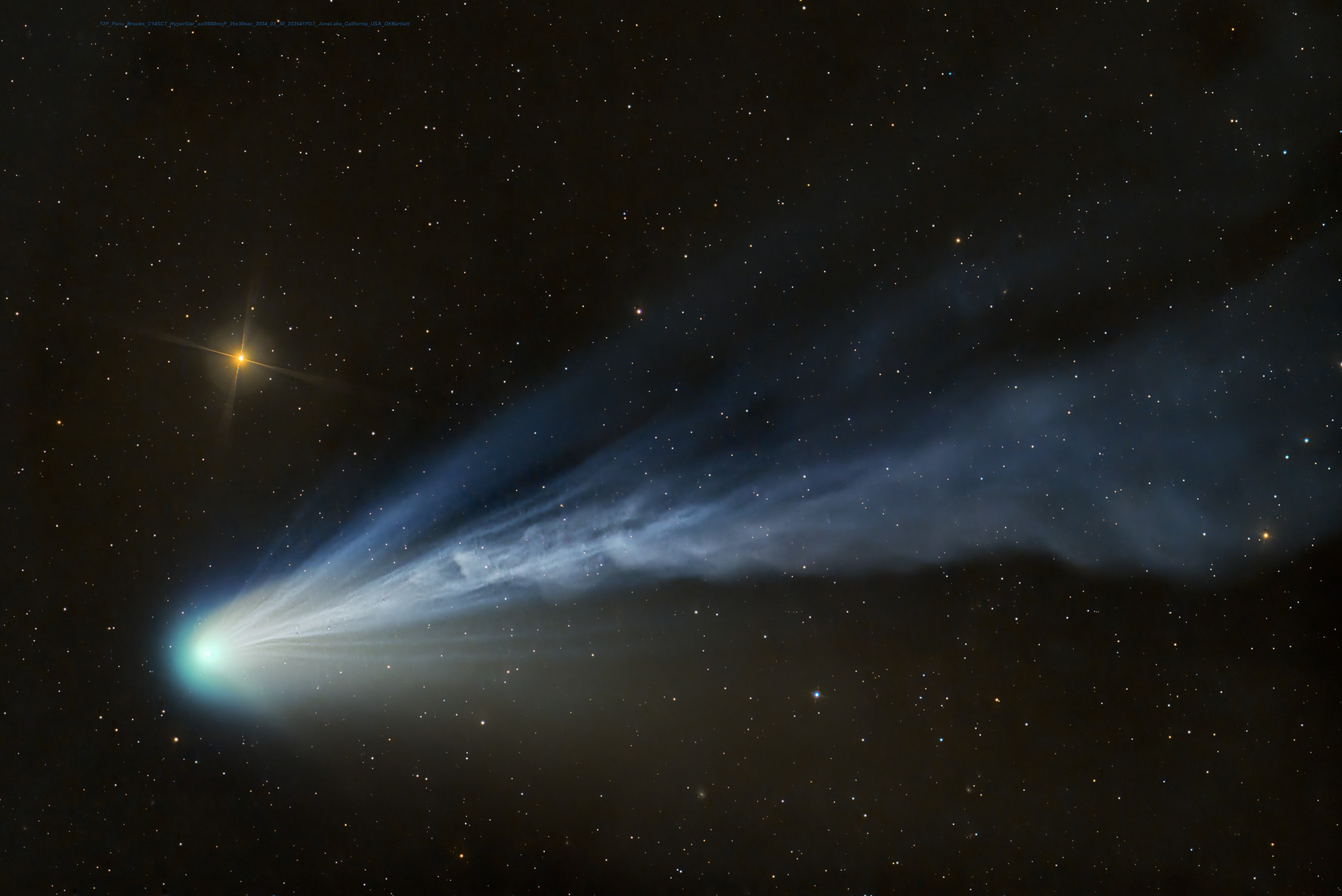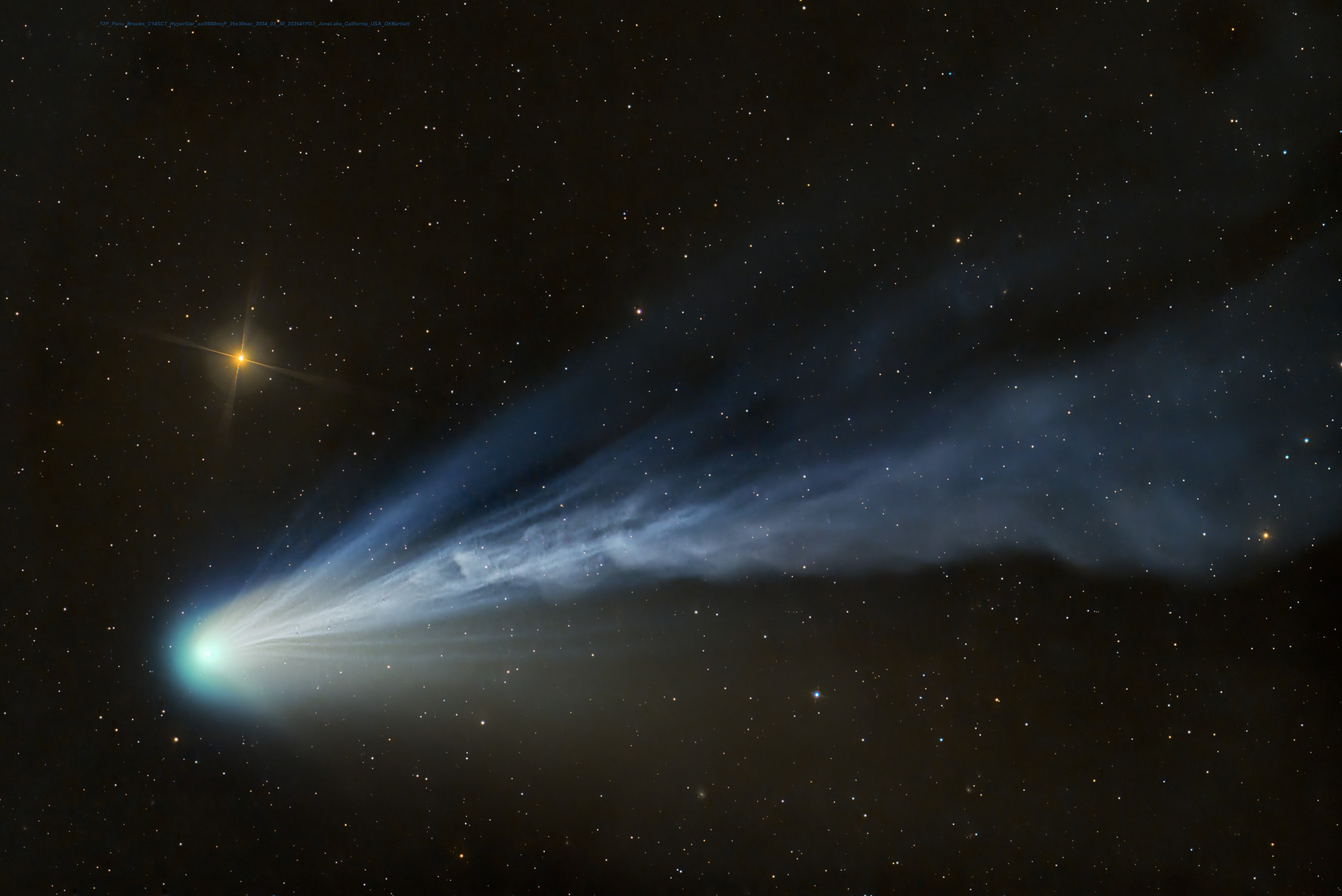
In dark evening skies over June Lake, northern hemisphere, planet Earth, Comet 12P/Pons-Brooks stood just above the western horizon on March 30. Its twisted turbulent ion tail and diffuse greenish coma are captured in this two degree wide telescopic field of view along with bright yellowish star Hamal also known as Alpha Arietis. Now Pons-Brooks has moved out of the northern night though, approaching perihelion on April 21. On April 8 you might still spot the comet in daytime skies. But to do it, you will have to stand in the path of totality and look away from the spectacle of an alluring solar corona and totally eclipsed Sun. NASA Coverage: Total Solar Eclipse of 2024 April 8
En cielos oscuros sobre el lago June, en el hemisferio norte de la Tierra, el cometa 12P/Pons-Brooks se encontraba justo por encima del horizonte occidental el 30 de marzo. Su cola iónica retorcida y turbulenta, junto con su coma verde y difusa, se capturan en este campo de visión telescópico de dos grados de ancho, junto con la brillante estrella amarilla Hamal, también conocida como Alpha Arietis. Ahora, Pons-Brooks ha salido de la noche del hemisferio norte, acercándose al perihelio el 21 de abril. El 8 de abril aún podrías haber observado al cometa en el cielo diurno. Pero para hacerlo, tendrías que estar en la trayectoria de totalidad y mirar lejos del espectáculo de una atractiva corona solar y un Sol totalmente eclipsado.