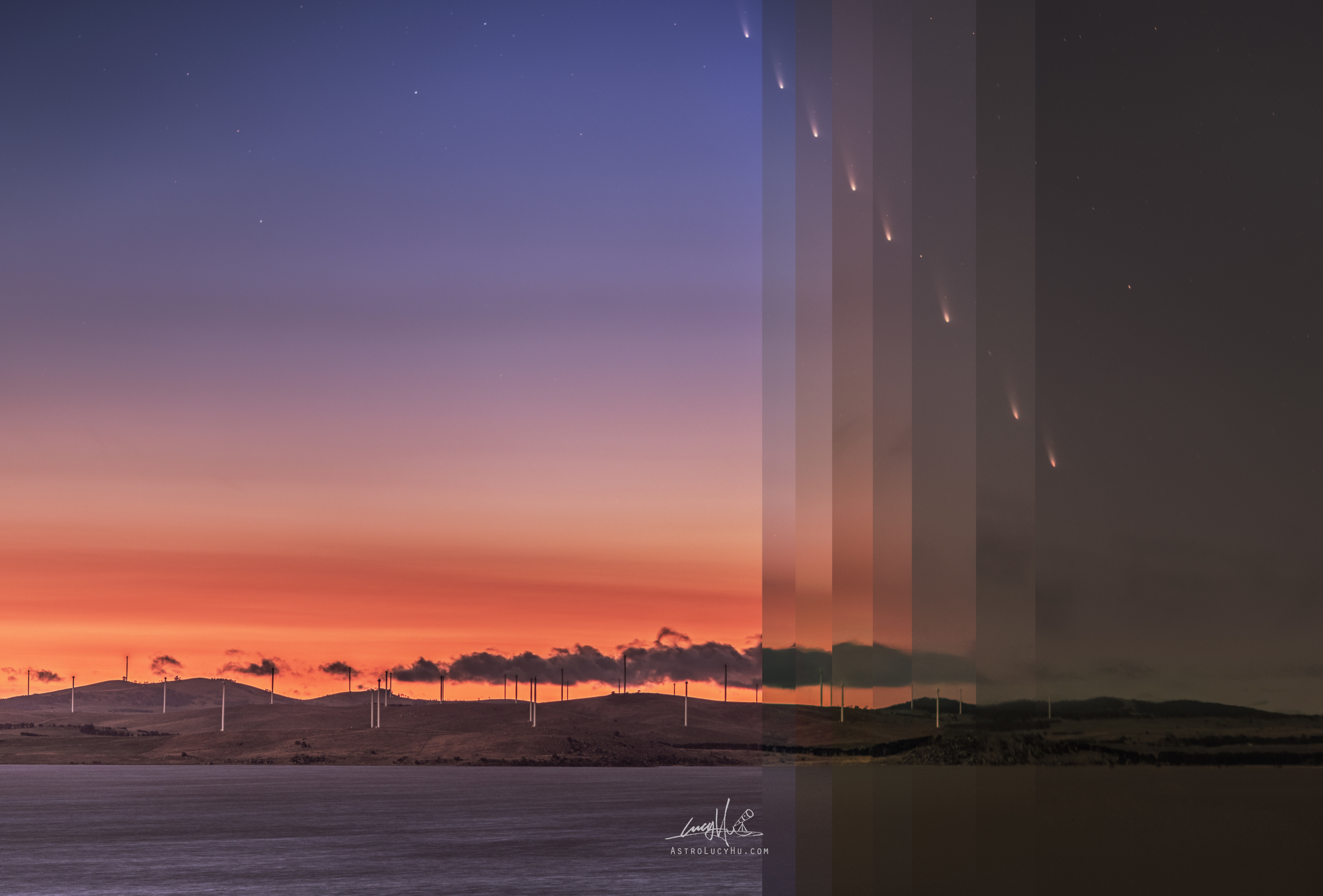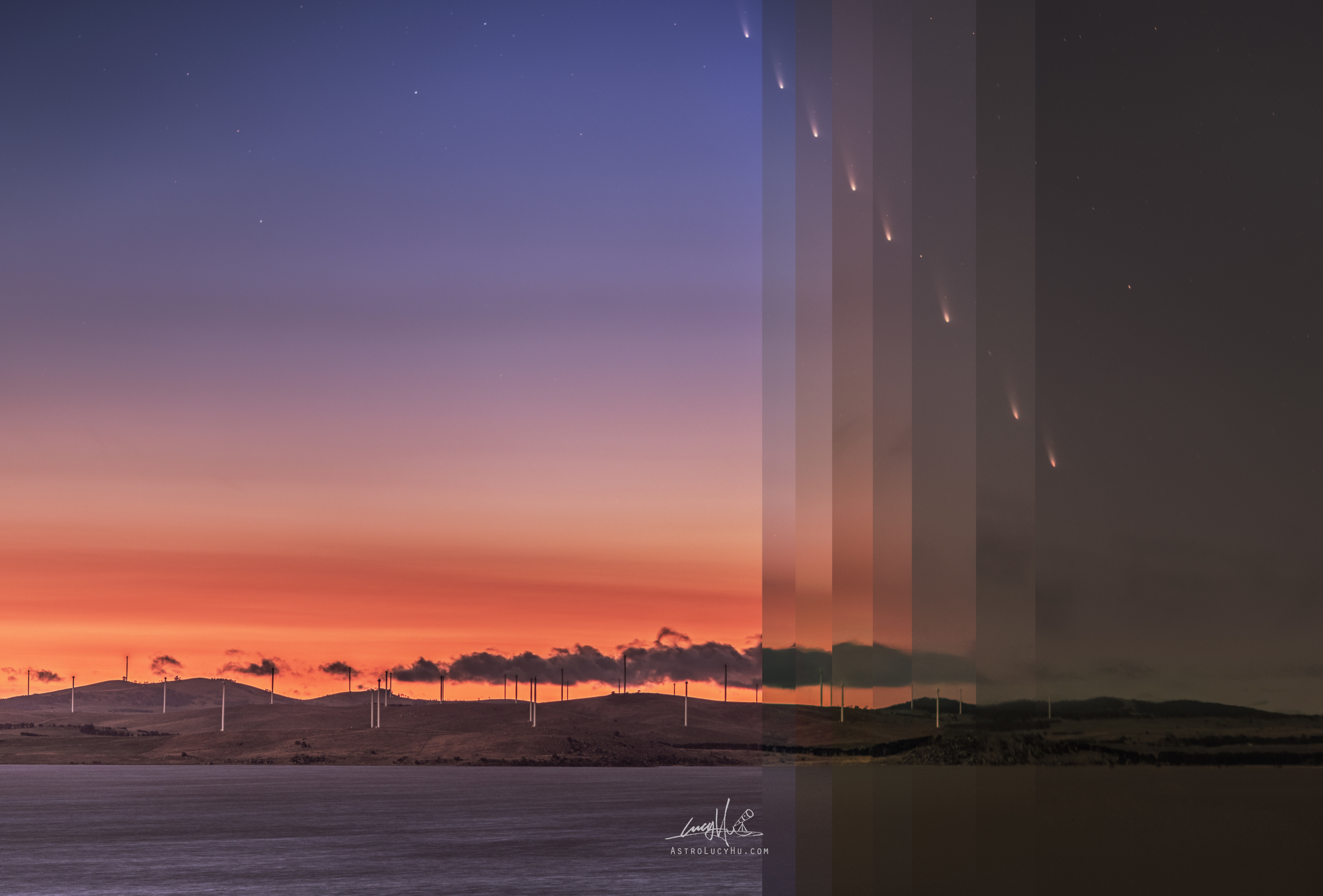
Comet Tsuchinshan-ATLAS is now visible in the early morning sky. Diving into the inner Solar System at an odd angle, this large dirty iceberg will pass its closest to the Sun -- between the orbits of Mercury and Venus -- in just two days. Long camera exposures are now capturing C/2023 A3 (Tsuchinshan–ATLAS), sometimes abbreviated as just A3, and its dust tail before and during sunrise. The featured image composite was taken four days ago and captured the comet as it rose above Lake George, NSW, Australia. Vertical bands further left are images of the comet as the rising Sun made the predawn sky increasingly bright and colorful. Just how bright the comet will become over the next month is currently unknown as it involves how much gas and dust the comet's nucleus will expel. Optimistic skywatchers are hoping for a great show where Tsuchinshan–ATLAS creates dust and ion tails visible across Earth's sky and becomes known as the Great Comet of 2024. Survey: Color Blindness and Astronomical Images Growing Gallery: Comet Tsuchinsan-ATLAS in 2024
El cometa Tsuchinshan-ATLAS es ahora visible en el cielo matutino. Sumergiéndose en el sistema solar interior a un ángulo inusual, este gran iceberg sucio pasará su punto más cercano al Sol — entre las órbitas de Mercurio y Venus — en solo dos días. Las exposiciones largas con cámara capturan ahora a C/2023 A3 (Tsuchinshan–ATLAS), a veces abreviado simplemente como A3, y su cola de polvo antes y durante el amanecer. La imagen compuesta destacada fue tomada hace cuatro días y capturó al cometa mientras se elevaba sobre el lago George, en NSW, Australia. Las bandas verticales más a la izquierda son imágenes del cometa a medida que el Sol naciente hacía que el cielo previo al amanecer se volviera cada vez más brillante y colorido. Actualmente no se sabe con certeza qué tan brillante se volverá el cometa en el próximo mes, ya que depende de cuánto gas y polvo expulse su núcleo. Los observadores del cielo optimistas esperan un gran espectáculo donde Tsuchinshan–ATLAS cree colas de polvo e iones visibles en todo el cielo terrestre y se convierta en conocido como el Gran Cometa de 2024.