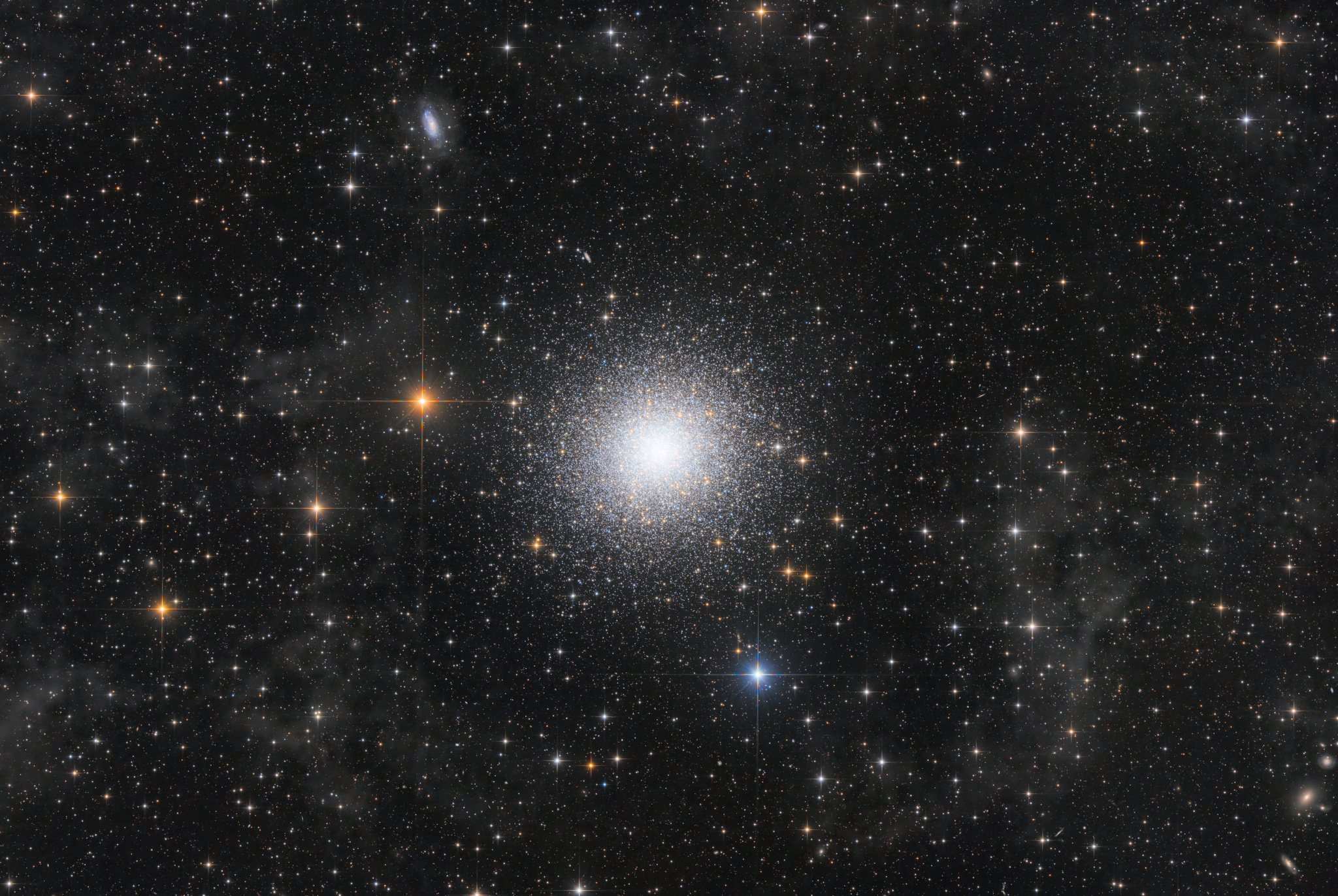
In 1716, English astronomer Edmond Halley noted, "This is but a little Patch, but it shows itself to the naked Eye, when the Sky is serene and the Moon absent." Of course, M13 is now less modestly recognized as the Great Globular Cluster in Hercules, one of the brightest globular star clusters in the northern sky. Sharp telescopic views like this one reveal the spectacular cluster's hundreds of thousands of stars. At a distance of 25,000 light-years, the cluster stars crowd into a region 150 light-years in diameter. Approaching the cluster core, upwards of 100 stars could be contained in a cube just 3 light-years on a side. For comparison, the closest star to the Sun is over 4 light-years away. The deep, wide-field image also reveals distant background galaxies including NGC 6207 at the upper left, and faint, foreground Milky Way dust clouds known to some as integrated flux nebulae.
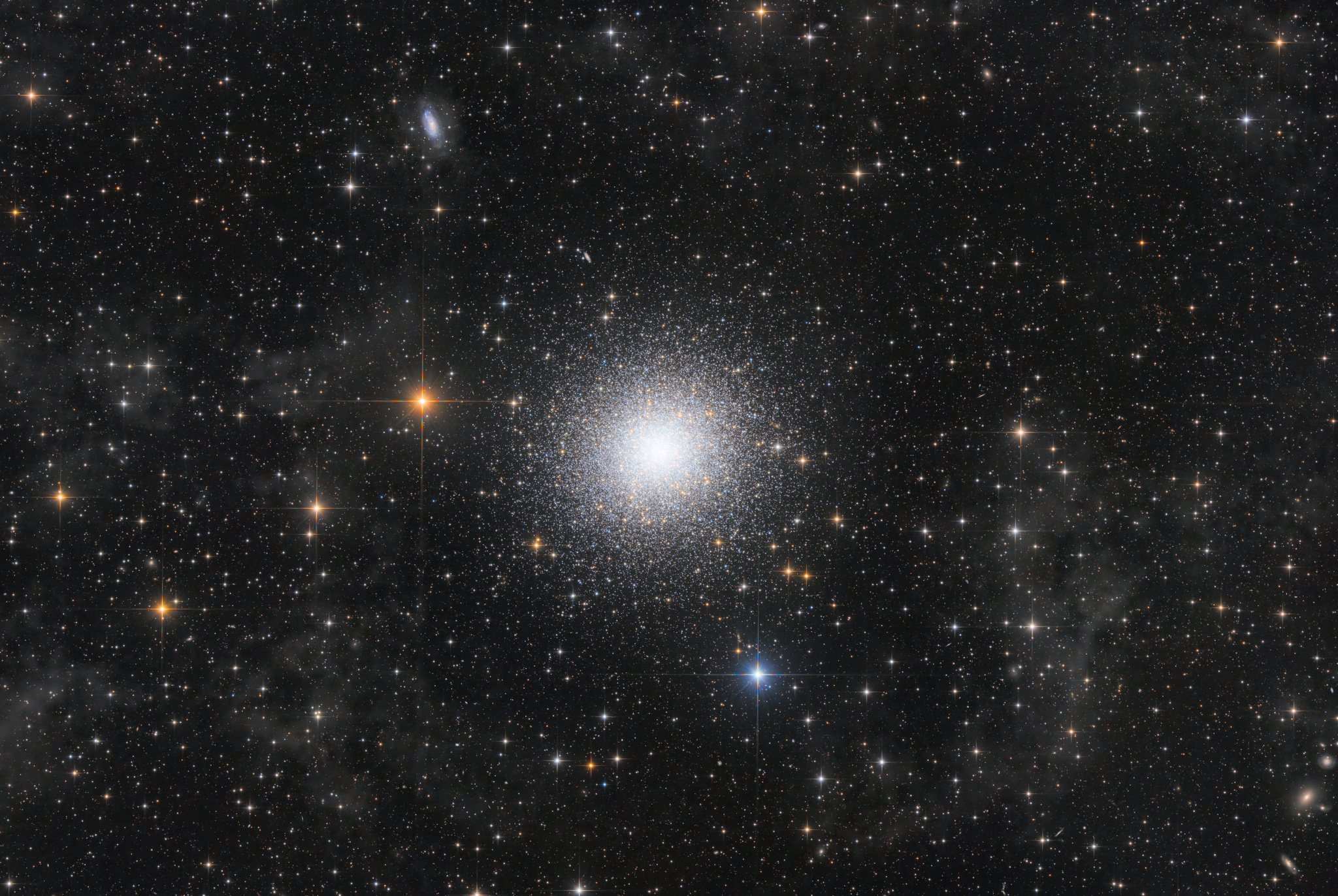
En 1716, el astrónomo inglés Edmond Halley observó, 'Este es solo un pequeño parche, pero se muestra al ojo desnudo cuando el cielo está sereno y la Luna ausente'. Por supuesto, M13 es ahora reconocido con menos modestia como el Gran Cúmulo Globular en Hércules, uno de los cúmulos globulares más brillantes en el cielo norte. Las vistas telescópicas nítidas como esta revelan los cientos de miles de estrellas del espectacular cúmulo. A una distancia de 25 000 años luz, las estrellas del cúmulo se apiñan en una región de 150 años luz de diámetro. Al acercarse al núcleo del cúmulo, podrían contenerse hasta 100 estrellas en un cubo de solo 3 años luz de lado. Para comparar, la estrella más cercana al Sol está a más de 4 años luz de distancia. La imagen profunda y de gran campo también revela galaxias de fondo distantes, incluida la NGC 6207 en la parte superior izquierda, y nubes de polvo de la Vía Láctea de primer plano tenues, conocidas para algunos como nebulosas de flujo integrado.