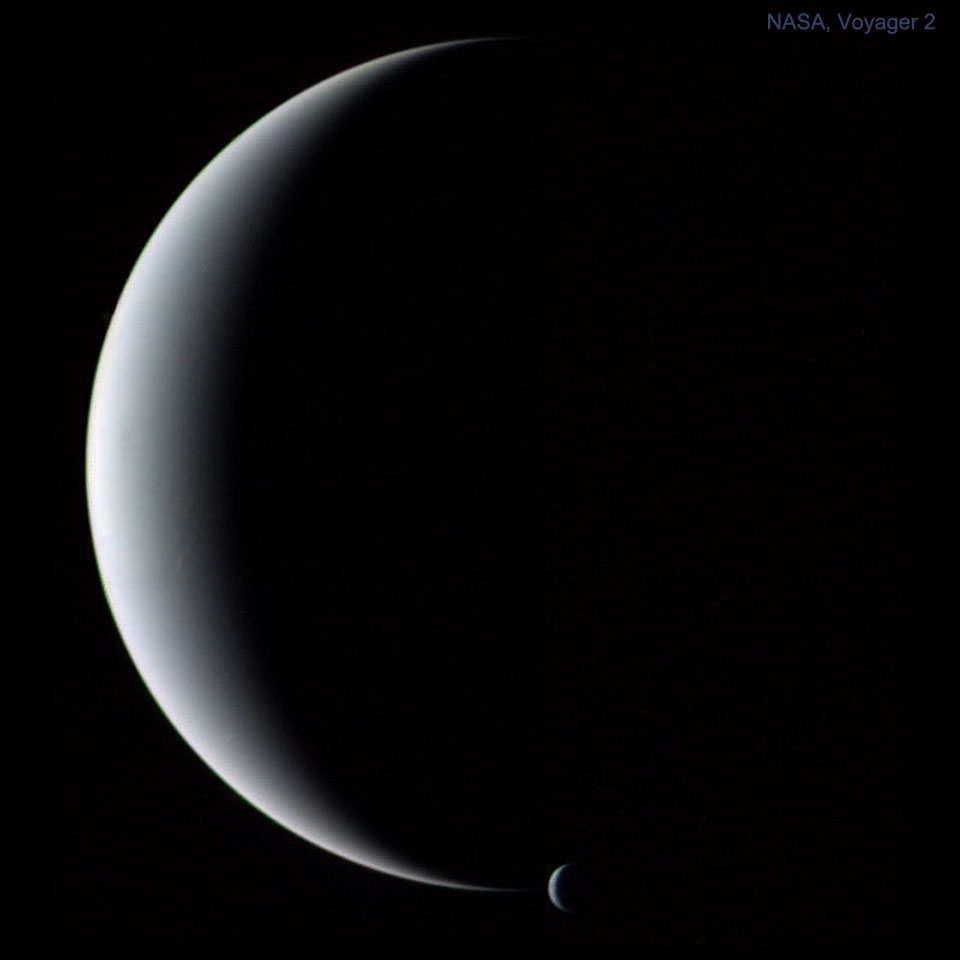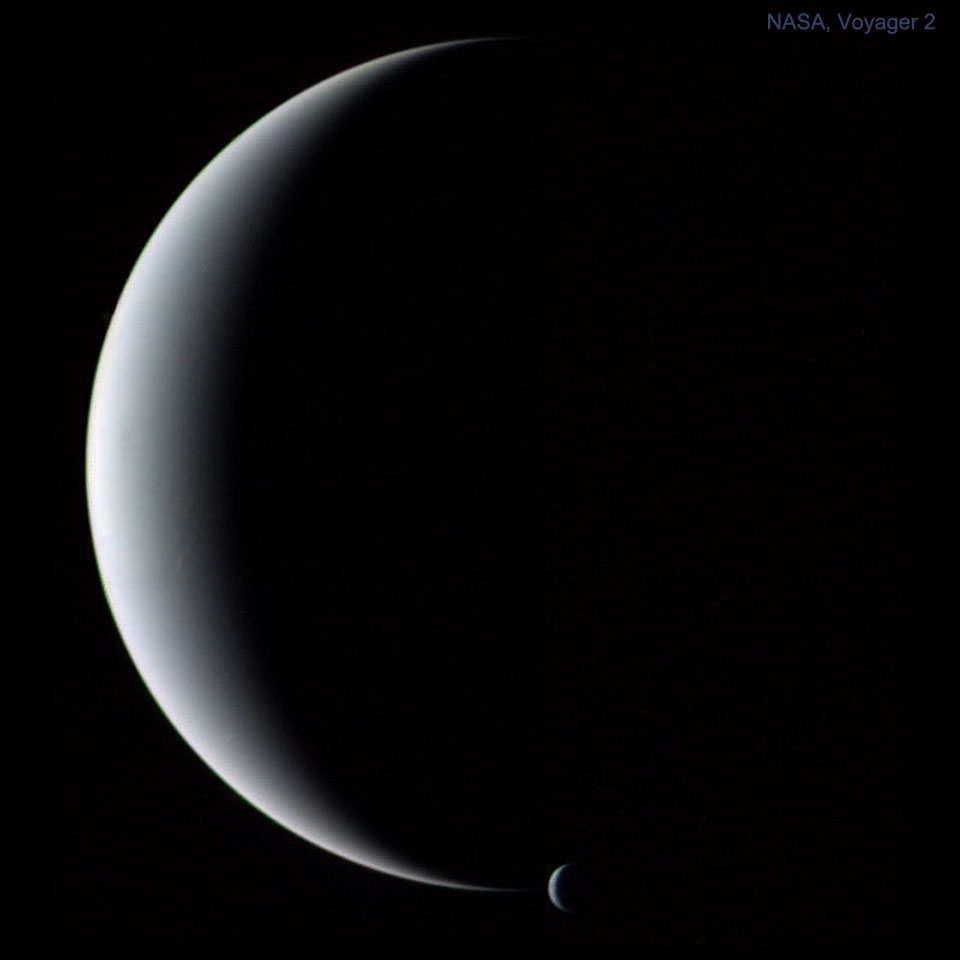
Ice giant Neptune is faint in Earth's night sky. Some 30 times farther from the Sun than our fair planet, telescopes are needed to catch a glimpse of the dim and distant world. This dramatic view of Neptune's night just isn't possible for telescopes in the vicinity of planet Earth though. Peering out from the inner Solar System they can only bring Neptune's day side into view. In fact this night side image with Neptune's slender crescent next to the crescent of its large moon Triton was captured by Voyager 2. Launched from planet Earth in 1977 the Voyager 2 spacecraft made a close fly by of the Solar System's outermost planet in 1989, looking back on Neptune at night as the robotic spacecraft continued its voyage to interstellar space.
El gigante de hielo Neptuno es tenue en el cielo nocturno de la Tierra. A unos 30 veces la distancia del Sol que nuestro planeta, se necesitan telescopios para captar una mirada de este mundo oscuro y distante. Esta dramática vista de la noche de Neptuno simplemente no es posible para los telescopios en las inmediaciones del planeta Tierra. Mirando desde el interior del Sistema Solar, solo pueden mostrar el lado diurno de Neptuno. De hecho, esta imagen del lado nocturno de Neptuno, con su delgado creciente junto al creciente de su gran luna Tritón, fue capturada por Voyager 2. Lanzado desde el planeta Tierra en 1977, la nave espacial Voyager 2 realizó un acercamiento cercano al planeta más externo del Sistema Solar en 1989, mirando hacia atrás a Neptuno de noche mientras la nave espacial robótica continuaba su viaje hacia el espacio interestelar.