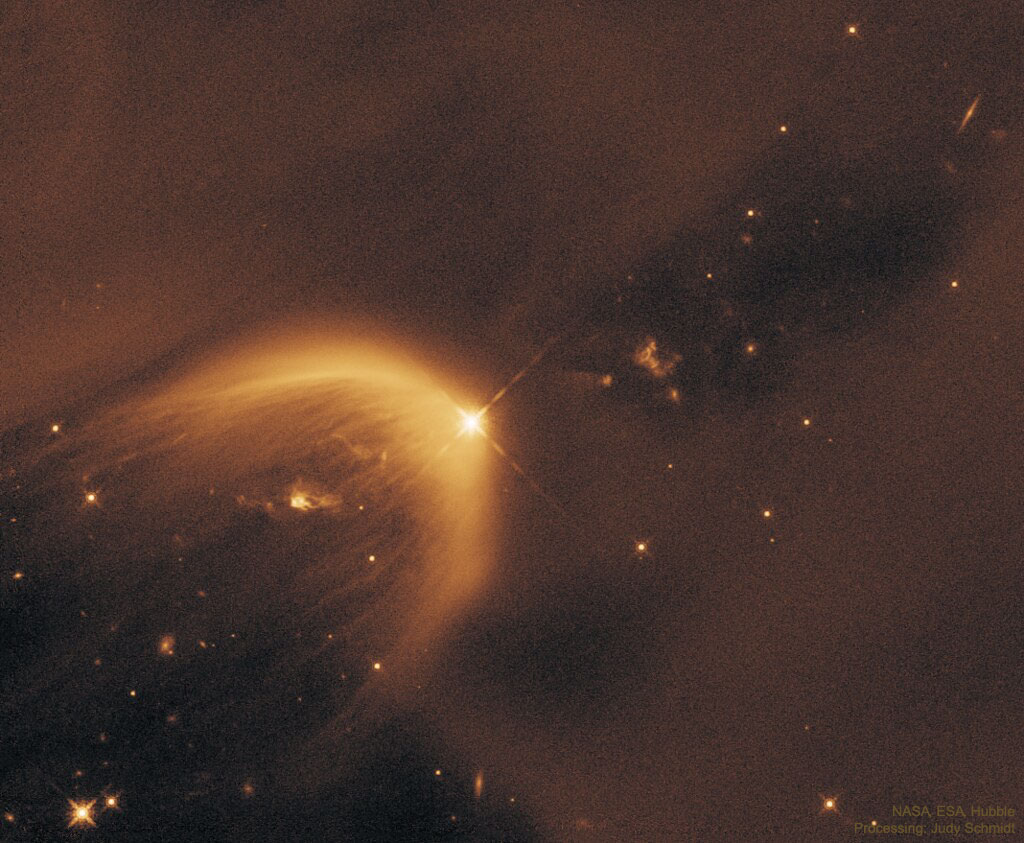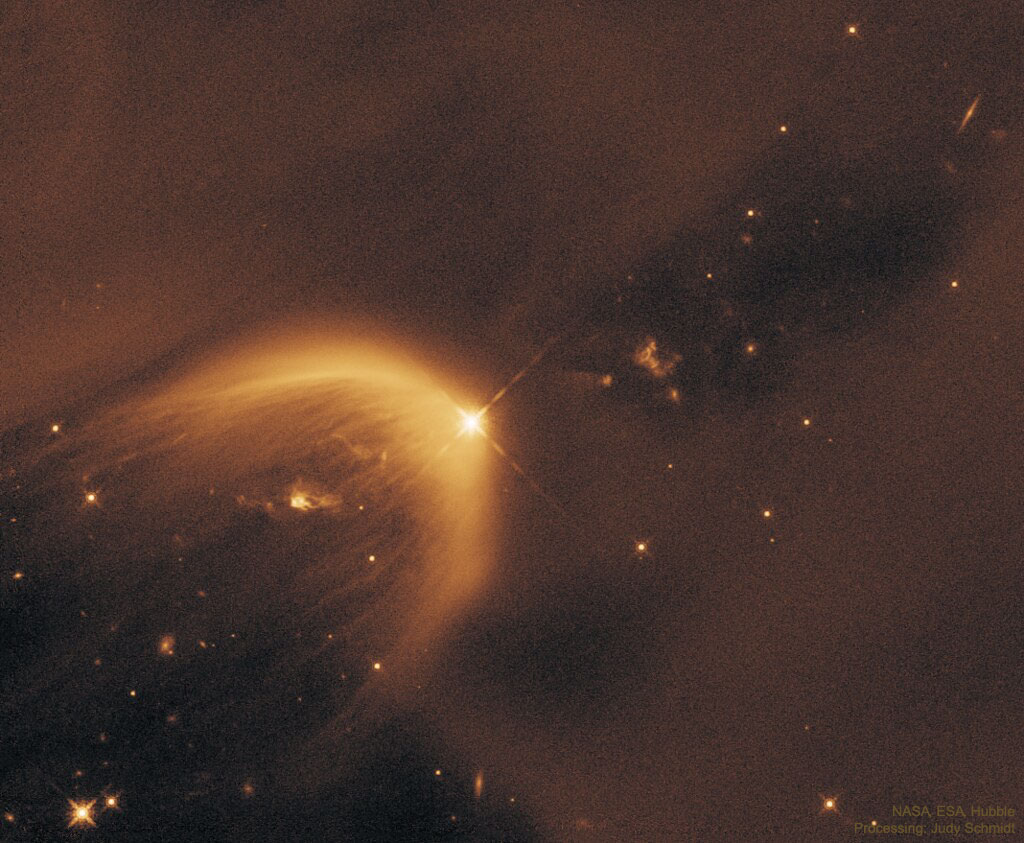
What is the cause of this unusual parabolic structure? This illuminated cavity, known as LDN 1471, was created by a newly forming star, seen as the bright source at the peak of the parabola. This protostar is experiencing a stellar outflow which is then interacting with the surrounding material in the Perseus Molecular Cloud, causing it to brighten. We see only one side of the cavity -- the other side is hidden by dark dust. The parabolic shape is caused by the widening of the stellar-wind blown cavity over time. Two additional structures can also be seen either side of the protostar; these are known as Herbig-Haro objects, again caused by the interaction of the outflow with the surrounding material. What causes the striations on the cavity walls, though, remains unknown. The featured image was taken by NASA and ESA’s Hubble Space Telescope after an original detection by the Spitzer Space Telescope. Explore Your Universe: Random APOD Generator
¿Cuál es la causa de esta estructura parabólica inusual? Esta cavidad iluminada, conocida como LDN 1471, fue creada por una estrella en formación, visible como la fuente brillante en la cima de la parábola. Esta protoestrella experimenta un flujo estelar que interactúa con el material circundante en la Nube Molecular de Perseo, causando que se ilumine. Solo vemos un lado de la cavidad — el otro lado está oculto por polvo oscuro. La forma parabólica se debe al ensanchamiento de la cavidad moldeada por el viento estelar con el tiempo. Se pueden observar dos estructuras adicionales a ambos lados de la protoestrella; estas son conocidas como objetos Herbig-Haro, también causados por la interacción del flujo con el material circundante. Sin embargo, la causa de las estrías en las paredes de la cavidad sigue siendo desconocida. La imagen destacada fue capturada por el Telescopio Espacial Hubble de NASA y ESA, tras una detección inicial realizada por el Telescopio Espacial Spitzer.