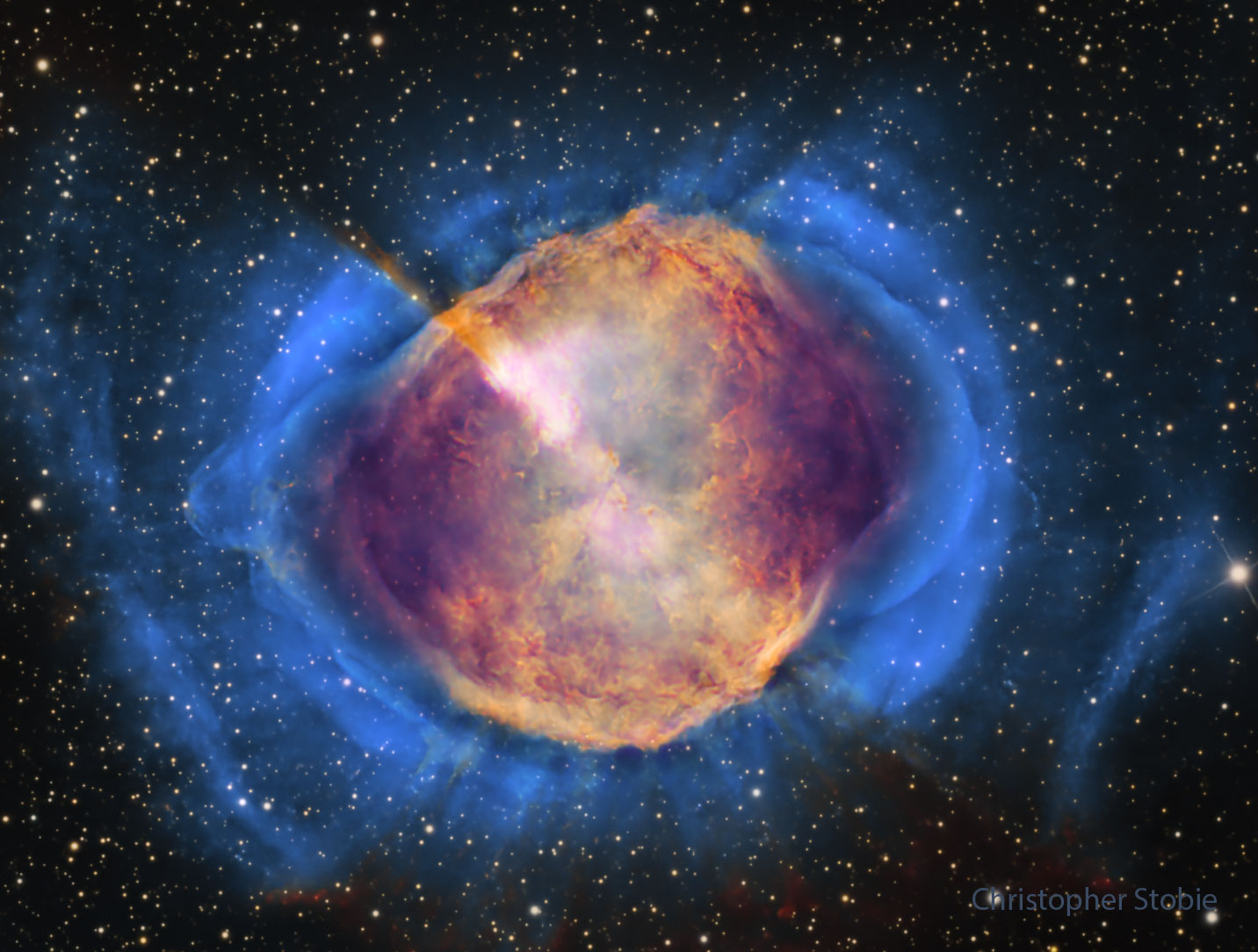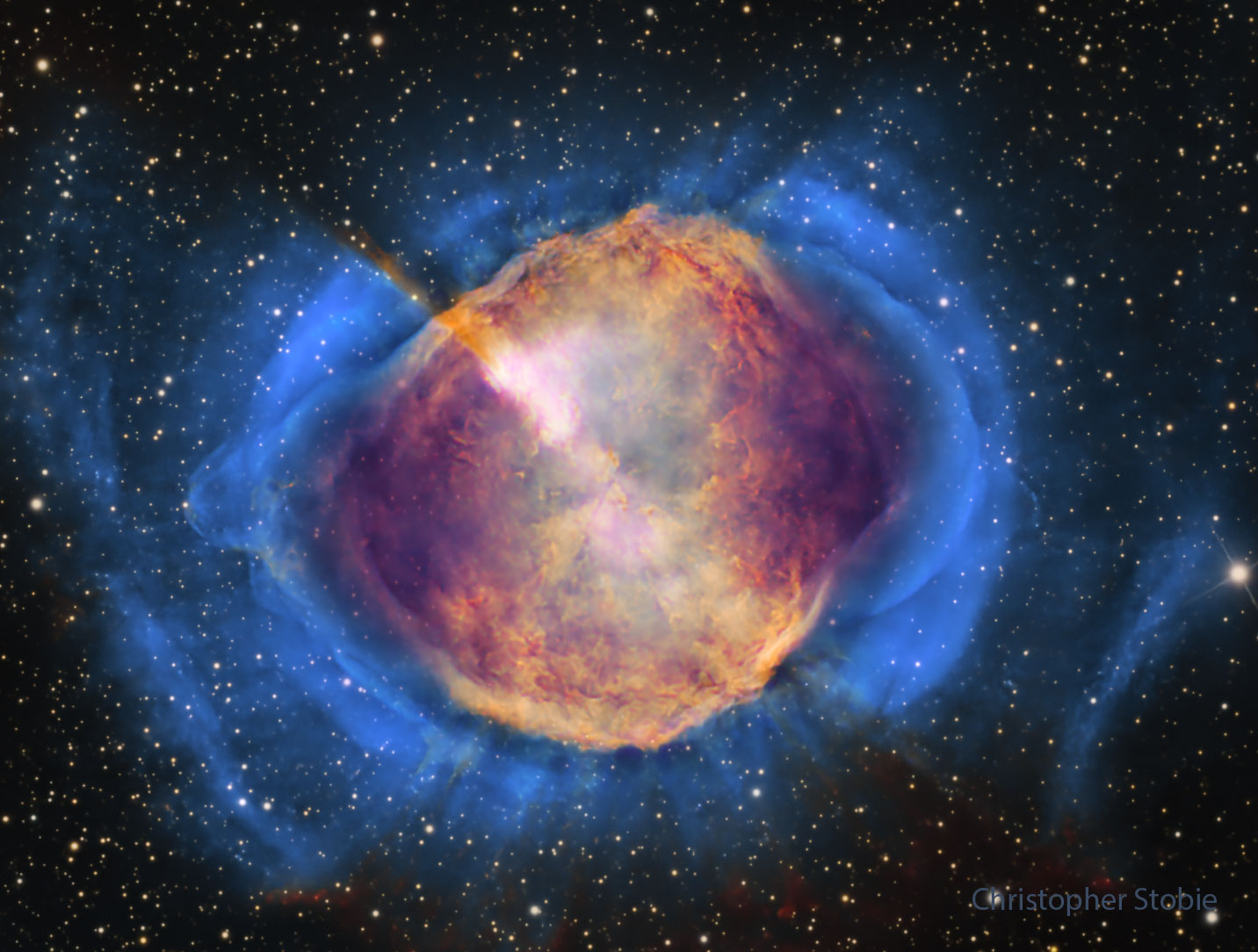
Is this what will become of our Sun? Quite possibly. The first hint of our Sun's future was discovered inadvertently in 1764. At that time, Charles Messier was compiling a list of diffuse objects not to be confused with comets. The 27th object on Messier's list, now known as M27 or the Dumbbell Nebula, is a planetary nebula, one of the brightest planetary nebulas on the sky and visible with binoculars toward the constellation of the Fox (Vulpecula). It takes light about 1000 years to reach us from M27, featured here in colors emitted by sulfur (red), hydrogen (green) and oxygen (blue). We now know that in about 6 billion years, our Sun will shed its outer gases into a planetary nebula like M27, while its remaining center will become an X-ray hot white dwarf star. Understanding the physics and significance of M27 was well beyond 18th century science, though. Even today, many things remain mysterious about planetary nebulas, including how their intricate shapes are created. APOD Year in Review: Night Sky Network Presentation for 2024
¿Es esto lo que será de nuestro Sol? Probablemente sí. La primera pista sobre el futuro del Sol fue descubierta accidentalmente en 1764. En ese momento, Charles Messier estaba compilando una lista de objetos difusos que no debían confundirse con cometas. El 27º objeto en la lista de Messier, ahora conocido como M27 o la Nebulosa del Doble, es una nebulosa planetaria, una de las nebulosas planetarias más brillantes del cielo y visible con binoculares hacia la constelación del Zorro (Vulpecula). A la luz le toma aproximadamente 1000 años llegar hasta nosotros desde M27, cuya imagen aquí se muestra en colores emitidos por el azufre (rojo), el hidrógeno (verde) y el oxígeno (azul). Ahora sabemos que en unos 6 mil millones de años, nuestro Sol expulsará sus gases externos en una nebulosa planetaria como M27, mientras que su núcleo restante se convertirá en una estrella enana blanca caliente en rayos X. Comprender la física y la importancia de M27 estaba claramente más allá de la ciencia del siglo XVIII. Incluso hoy en día, muchas cosas siguen siendo misteriosas sobre las nebulosas planetarias, incluyendo cómo se crean sus formas intrincadas.