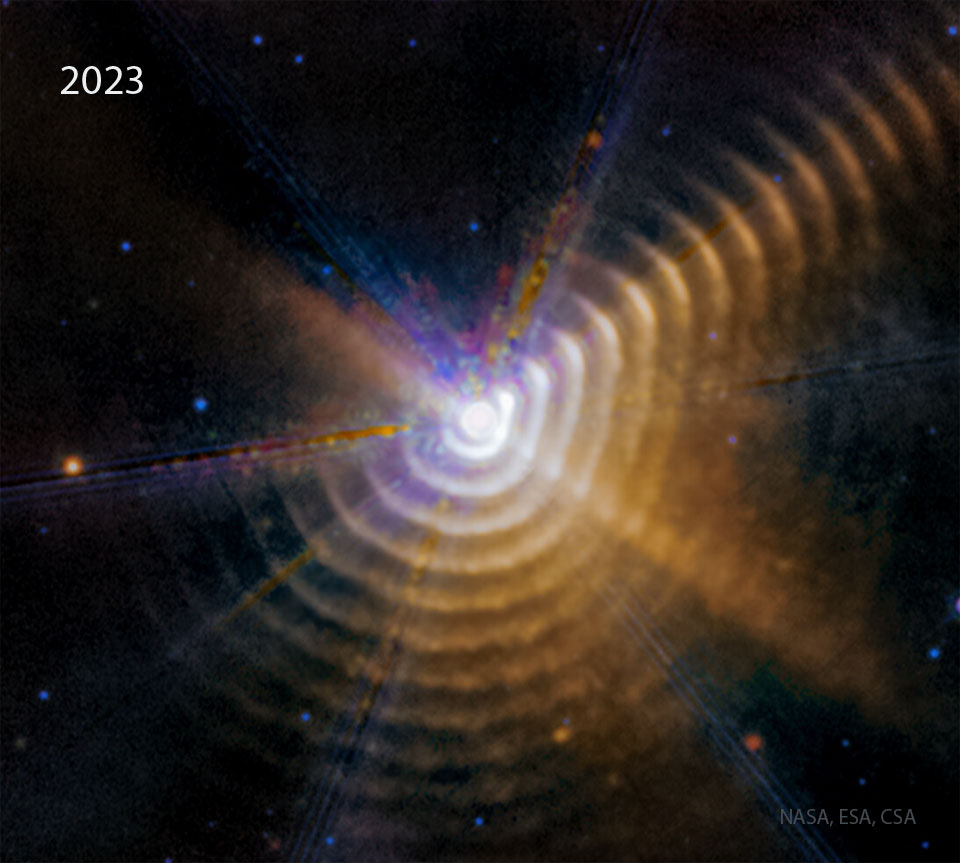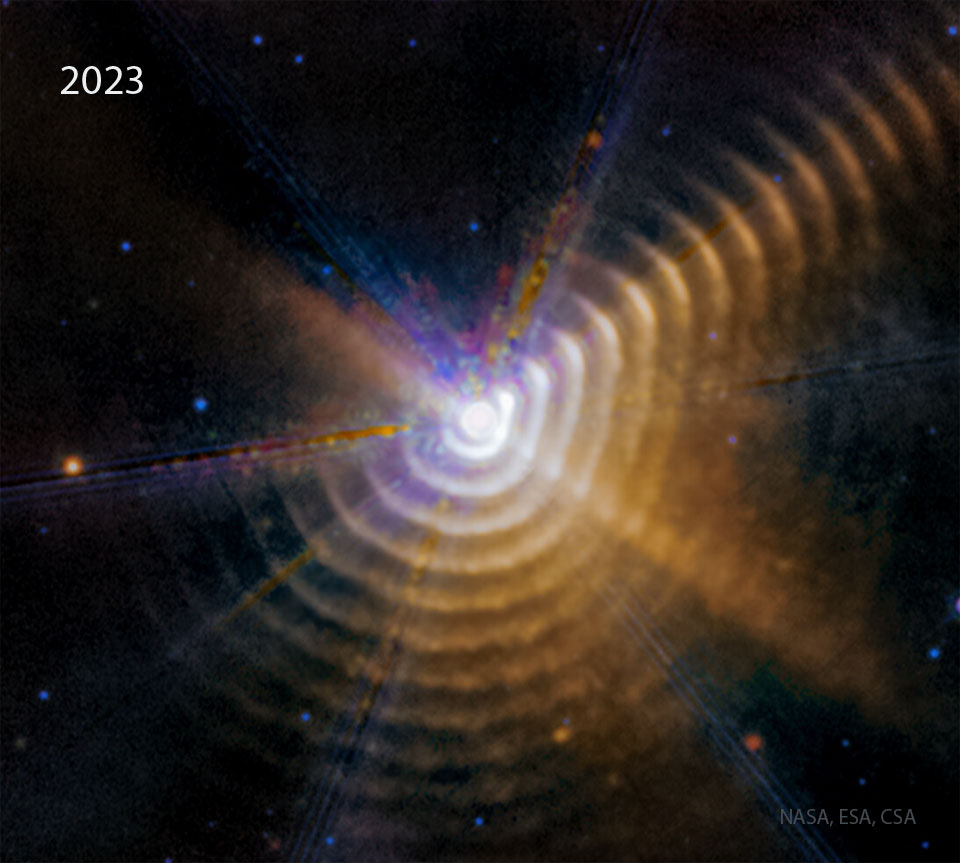
What are those strange rings? Rich in dust, the rings are likely 3D shells -- but how they were created remains a topic of research. Where they were created is well known: in a binary star system that lies about 6,000 light years away toward the constellation of the Swan (Cygnus) -- a system dominated by the Wolf-Rayet star WR 140. Wolf-Rayet stars are massive, bright, and known for their tumultuous winds. They are also known for creating and dispersing heavy elements such as carbon, which is a building block of interstellar dust. The other star in the binary is also bright and massive -- but not as active. The two great stars joust in an oblong orbit as they approach each other about every eight years. When at closest approach, the X-ray emission from the system increases, as, apparently, does the dust expelled into space -- creating another shell. The featured infrared image by the Webb Space Telescope resolves greater details and more dust shells than ever before. Images taken over consecutive years show the shells moving outward.
¿Qué son esos anillos extraños? Ricos en polvo, los anillos probablemente son capas tridimensionales, pero cómo se formaron sigue siendo un tema de investigación. Dónde se formaron es bien conocido: en un sistema binario de estrellas que se encuentra a unos 6000 años luz de distancia hacia la constelación del Cisne (Cisne), un sistema dominado por la estrella Wolf-Rayet WR 140. Las estrellas Wolf-Rayet son masivas, brillantes y conocidas por sus vientos tumultuosos. También son conocidas por crear y dispersar elementos pesados como el carbono, que es un bloque de construcción del polvo interestelar. La otra estrella en el sistema binario también es brillante y masiva, pero no tan activa. Las dos grandes estrellas se enfrentan en una órbita elíptica, acercándose entre sí aproximadamente cada ocho años. Cuando están en su punto más cercano, la emisión de rayos X del sistema aumenta, así como, aparentemente, el polvo expulsado al espacio, formando otra capa. La imagen infrarroja destacada del Telescopio Espacial Webb resuelve detalles más grandes y más capas de polvo que nunca antes. Las imágenes tomadas en años consecutivos muestran las capas moviéndose hacia afuera.