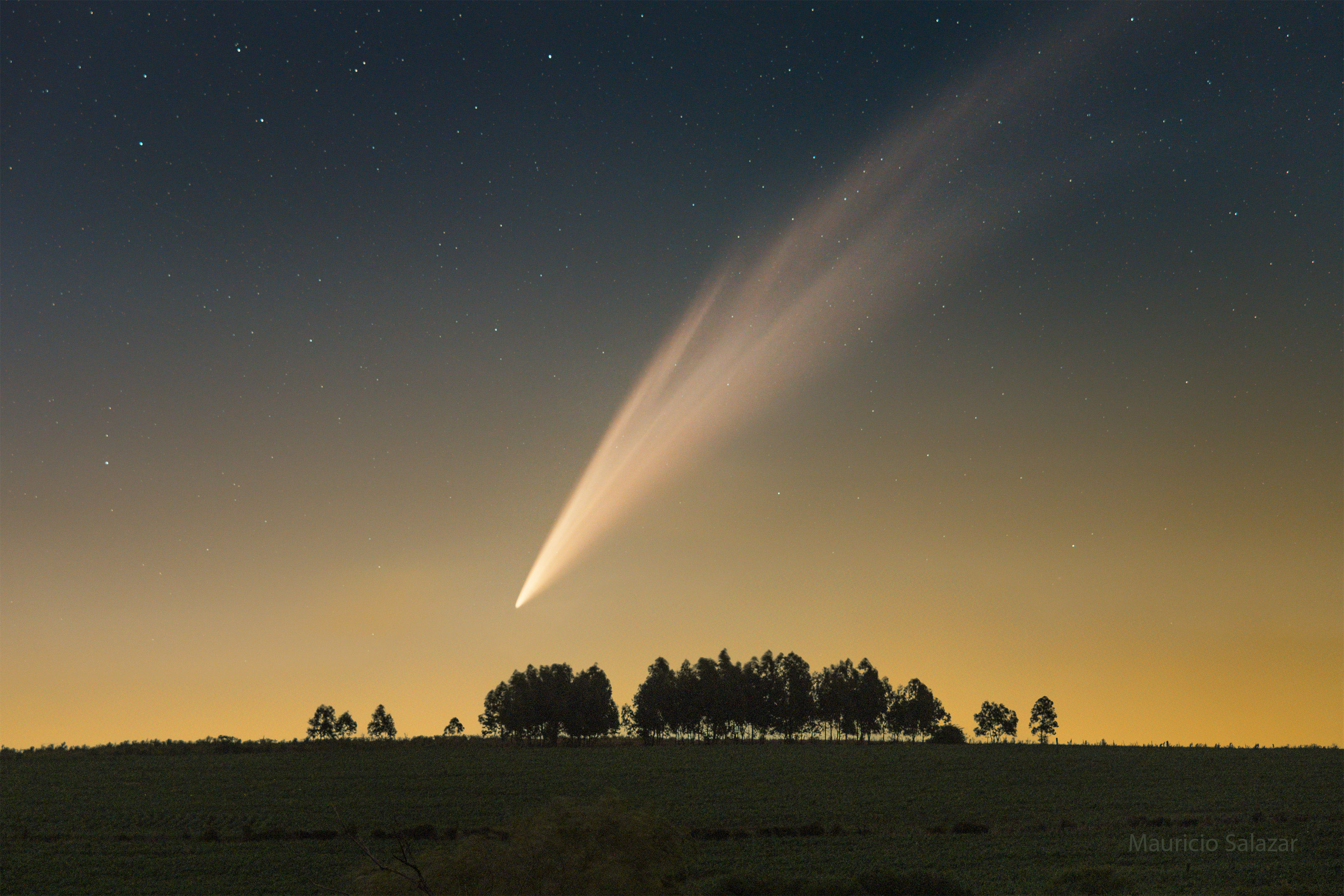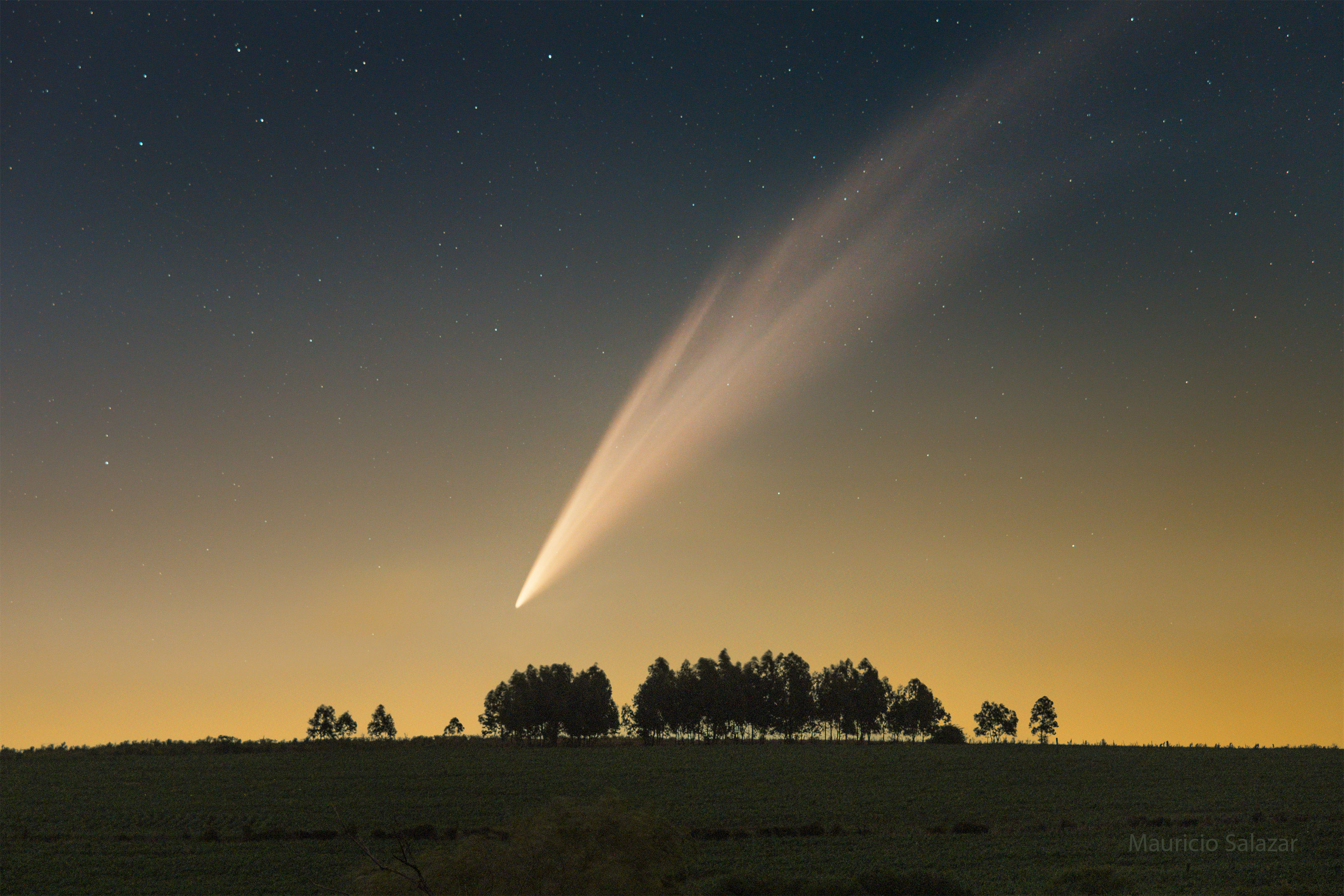
Comets can be huge. When far from the Sun, a comet's size usually refers to its hard nucleus of ice and rock, which typically spans a few kilometers -- smaller than even a small moon. When nearing the Sun, however, this nucleus can eject dust and gas and leave a thin tail that can spread to an enormous length -- even greater than the distance between the Earth and the Sun. Pictured, C/2024 G3 (ATLAS) sports a tail of sunlight-reflecting dust and glowing gas that spans several times the apparent size of a full moon, appearing even larger on long duration camera images than to the unaided eye. The featured image shows impressive Comet ATLAS over trees and a grass field in Sierras de Mahoma, San Jose, Uruguay about a week ago. After being prominent in the sunset skies of Earth's southern hemisphere, Comet G3 ATLAS is now fading as it moves away from the Sun, making its impressive tails increasingly hard to see. Gallery: Comet ATLAS (G3)
Los cometas pueden ser muy grandes. Cuando están lejos del Sol, el tamaño de un cometa generalmente se refiere a su núcleo duro de hielo y roca, que típicamente abarca unos pocos kilómetros — más pequeño que incluso una luna pequeña. Sin embargo, al acercarse al Sol, este núcleo puede expulsar polvo y gas, dejando una cola delgada que puede extenderse a una longitud enorme — incluso mayor que la distancia entre la Tierra y el Sol. En la imagen, C/2024 G3 (ATLAS) muestra una cola de polvo que refleja la luz solar y gas brillante que abarca varias veces el tamaño aparente de una luna llena, apareciendo aún más grande en imágenes de larga exposición que a simple vista. La imagen destacada muestra el impresionante cometa ATLAS sobre árboles y un campo de hierba en las Sierras de Mahoma, San José, Uruguay, hace aproximadamente una semana. Después de haber sido destacado en los cielos al atardecer del hemisferio sur de la Tierra, el cometa G3 ATLAS ahora está desvaneciéndose a medida que se aleja del Sol, haciendo que sus colas impresionantes sean cada vez más difíciles de ver.