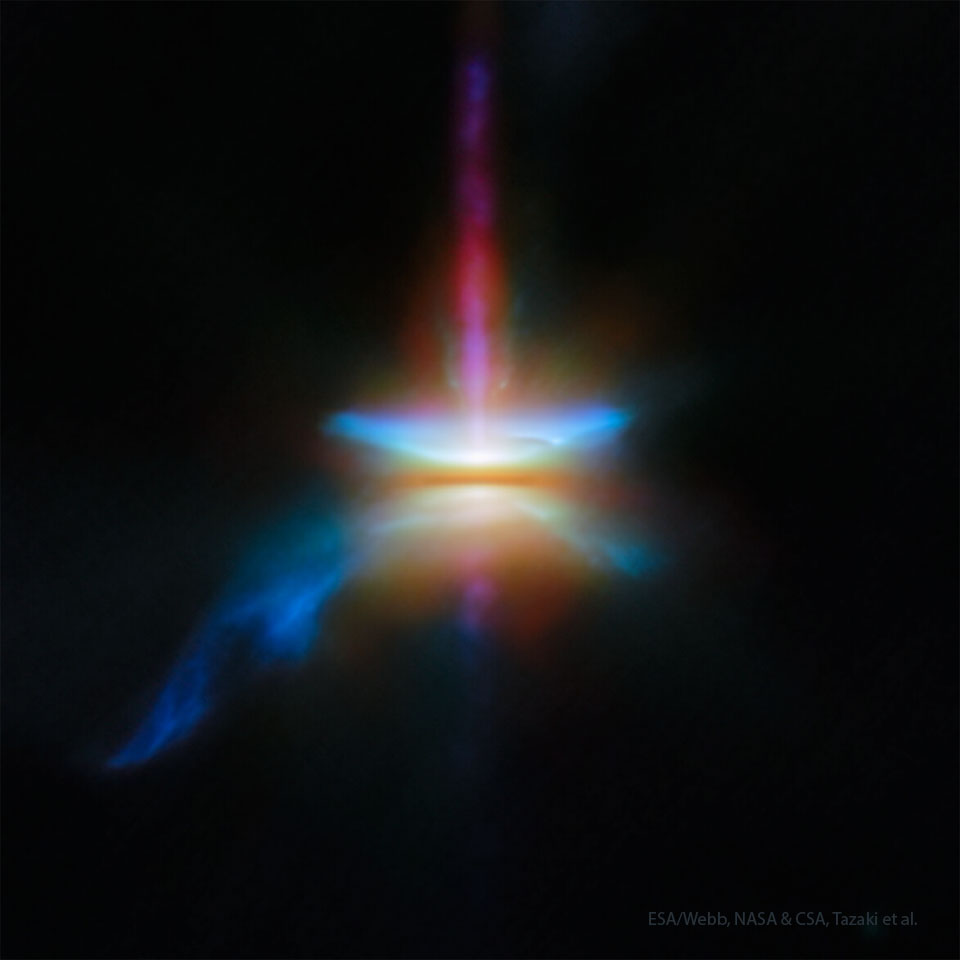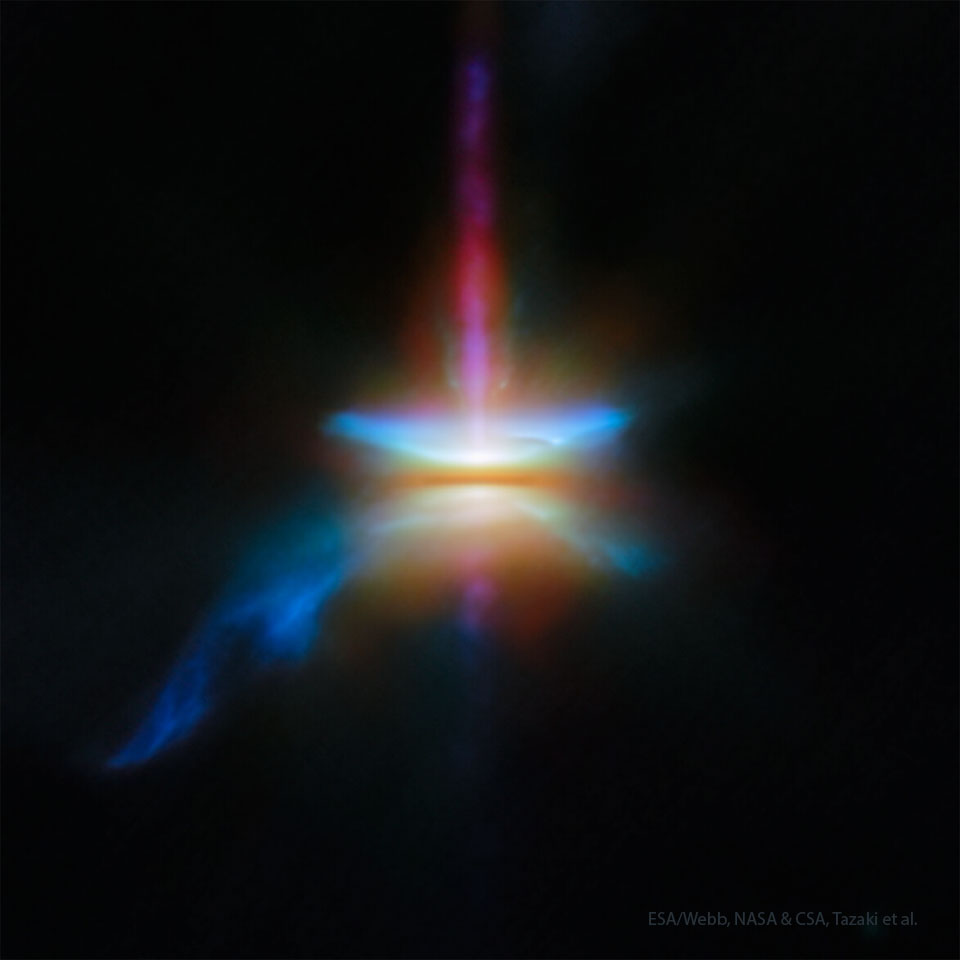
How do stars and planets form? New clues have been found in the protoplanetary system Herbig-Haro 30 by the James Webb Space Telescope in concert with Hubble and the Earth-bound ALMA. The observations show, among other things, that large dust grains are more concentrated into a central disk where they can form planets. The featured image from Webb shows many attributes of the active HH-30 system. Jets of particles are being expelled vertically, shown in red, while a dark dust-rich disk is seen across the center, blocking the light from the star or stars still forming there. Blue-reflecting dust is seen in a parabolic arc above and below the central disk, although why a tail appears on the lower left is currently unknown. Studying how planets form in HH 30 can help astronomers better understand how planets in our own Solar System once formed, including our Earth.
¿Cómo se forman las estrellas y los planetas? Nuevas pistas han sido encontradas en el sistema protoplanetario Herbig-Haro 30 por el Telescopio Espacial James Webb en conjunto con Hubble y el ALMA terrestre. Las observaciones muestran, entre otras cosas, que granos de polvo grandes están más concentrados en un disco central donde pueden formarse planetas. La imagen destacada de Webb muestra muchas características del sistema activo HH-30. Chorros de partículas están siendo expulsados verticalmente, mostrados en rojo, mientras que un disco rico en polvo oscuro se ve a través del centro, bloqueando la luz de la estrella o estrellas que aún se están formando allí. Polvo que refleja la luz azul se observa en un arco parabólico por encima y por debajo del disco central, aunque por qué aparece una cola en la esquina inferior izquierda actualmente es desconocido. Estudiar cómo se forman los planetas en HH 30 puede ayudar a los astrónomos a comprender mejor cómo se formaron los planetas en nuestro propio Sistema Solar, incluido nuestro planeta Tierra.