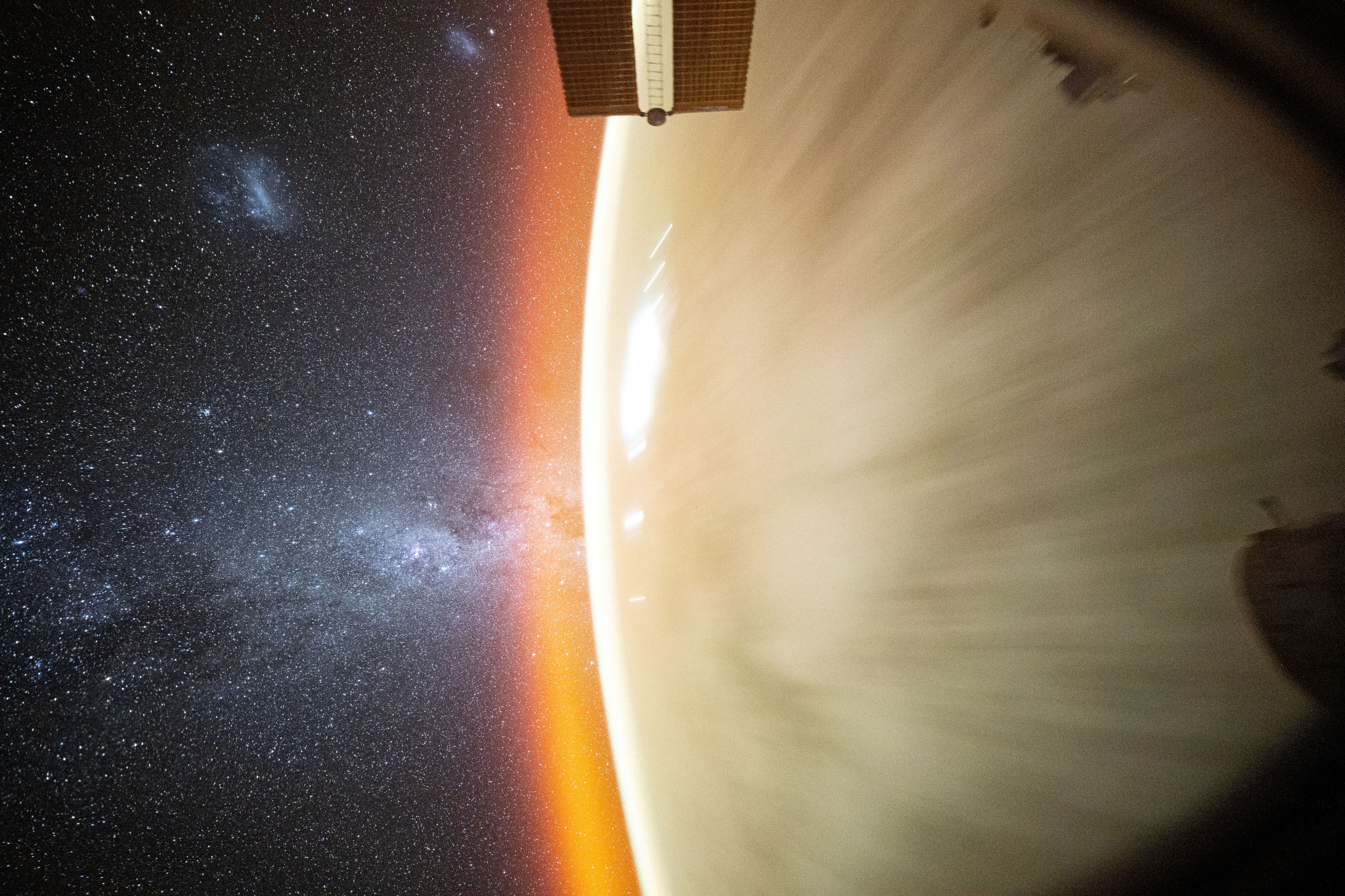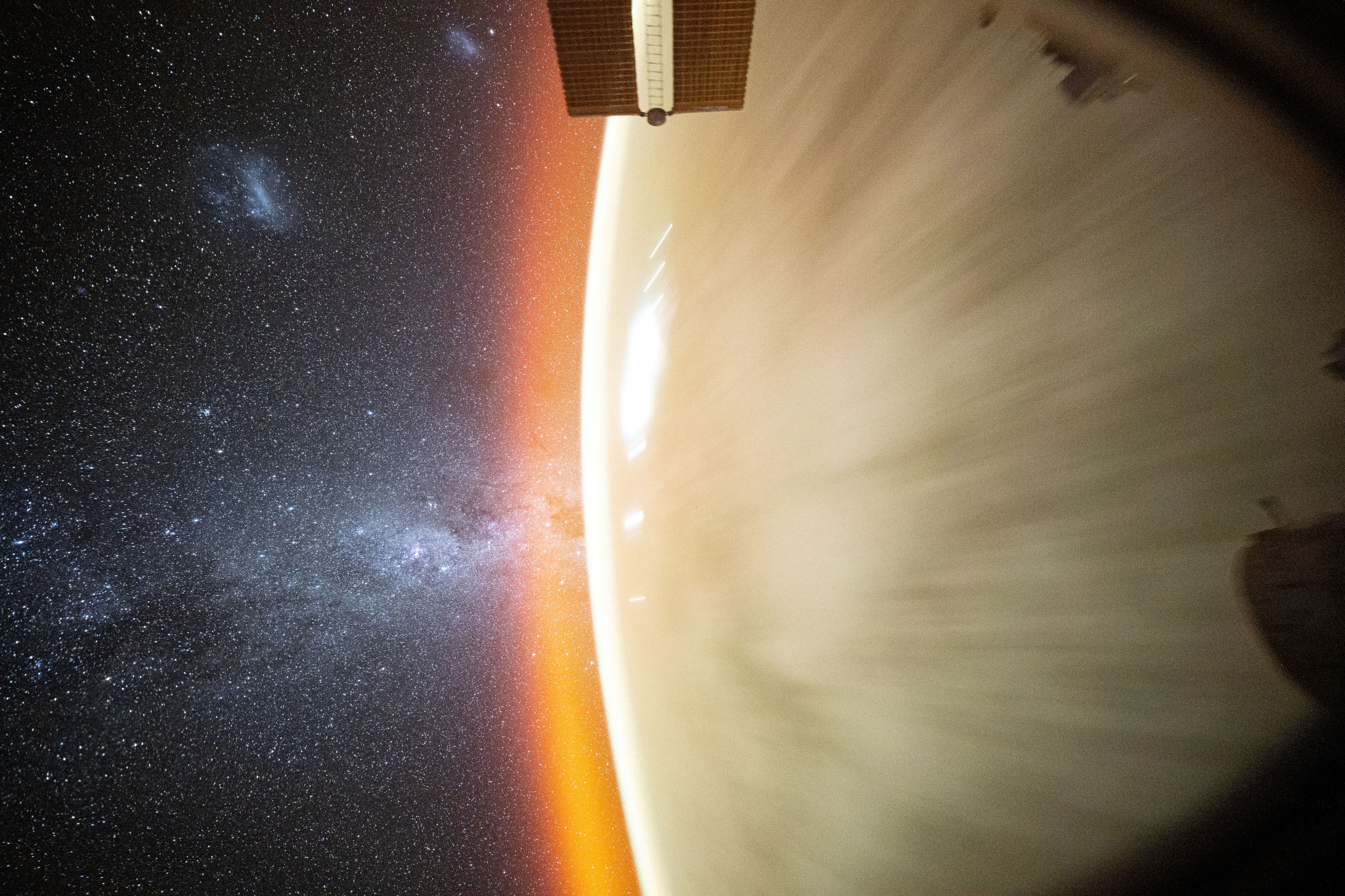
The plane of our Milky Way galaxy extends beyond the limb of planet Earth in this space age exposure captured by astronaut Don Pettit. His camera, with low light and long duration settings, was pointed out the window of a Dragon crew spacecraft docked with the International Space Station on January 29. The orbital outpost was at an altitude of about 400 kilometers above the Pacific Ocean at the time. Motion blurs the Earth below, while the gorgeous view from low Earth orbit includes the Milky Way's prominent satellite galaxies, known as the Large and Small Magellanic Clouds, near the upper left in the frame. Fans of southern skies can also spot the Southern Cross. The four brightest stars of the famous southern constellation Crux are near picture center, just beyond the edge of the bright horizon and shining through Earth's orange tinted atmospheric glow.
Crédito: NASA, Don Pettit El plano de nuestra galaxia, la Vía Láctea, se extiende más allá del horizonte terrestre en esta exposición capturada por el astronauta Don Pettit en la era espacial. Su cámara, configurada con ajustes de baja luz y duración prolongada, estaba orientada hacia la ventana de una nave Dragon tripulada acoplada a la Estación Espacial Internacional el 29 de enero. La base orbital se encontraba a una altitud de aproximadamente 400 kilómetros sobre el océano Pacífico en ese momento. El movimiento desenfoca la Tierra debajo, mientras que la hermosa vista desde órbita baja incluye las galaxias satélite prominentes de la Vía Láctea, conocidas como las Nubes de Magallanes Mayor y Menor, cerca de la esquina superior izquierda del marco. Los amantes del cielo austral también pueden identificar la Cruz del Sur. Las cuatro estrellas más brillantes de la famosa constelación austral Crux se encuentran cerca del centro de la imagen, justo más allá del borde del horizonte brillante y brillando a través del resplandor atmosférico terrestre teñido de naranja.