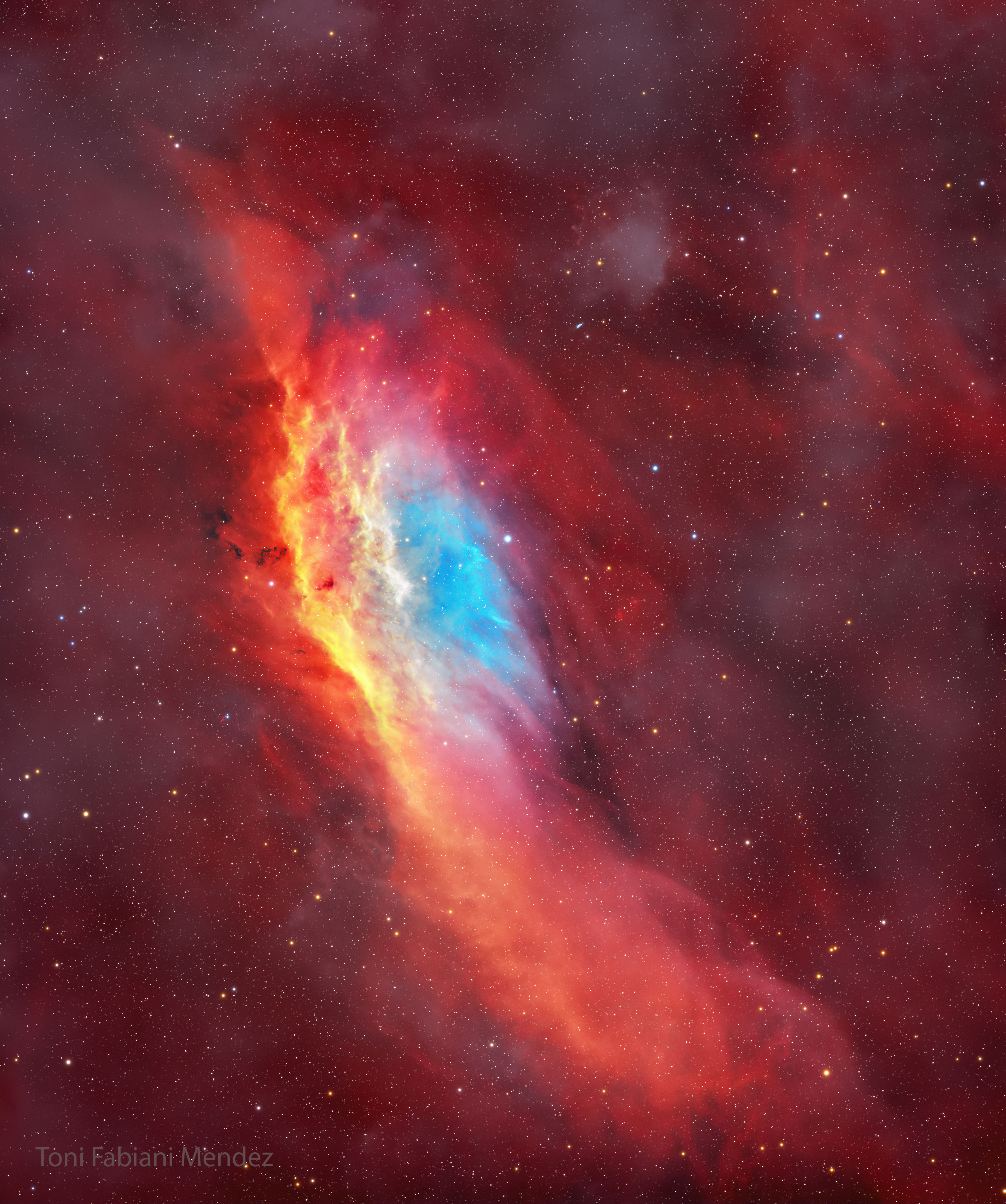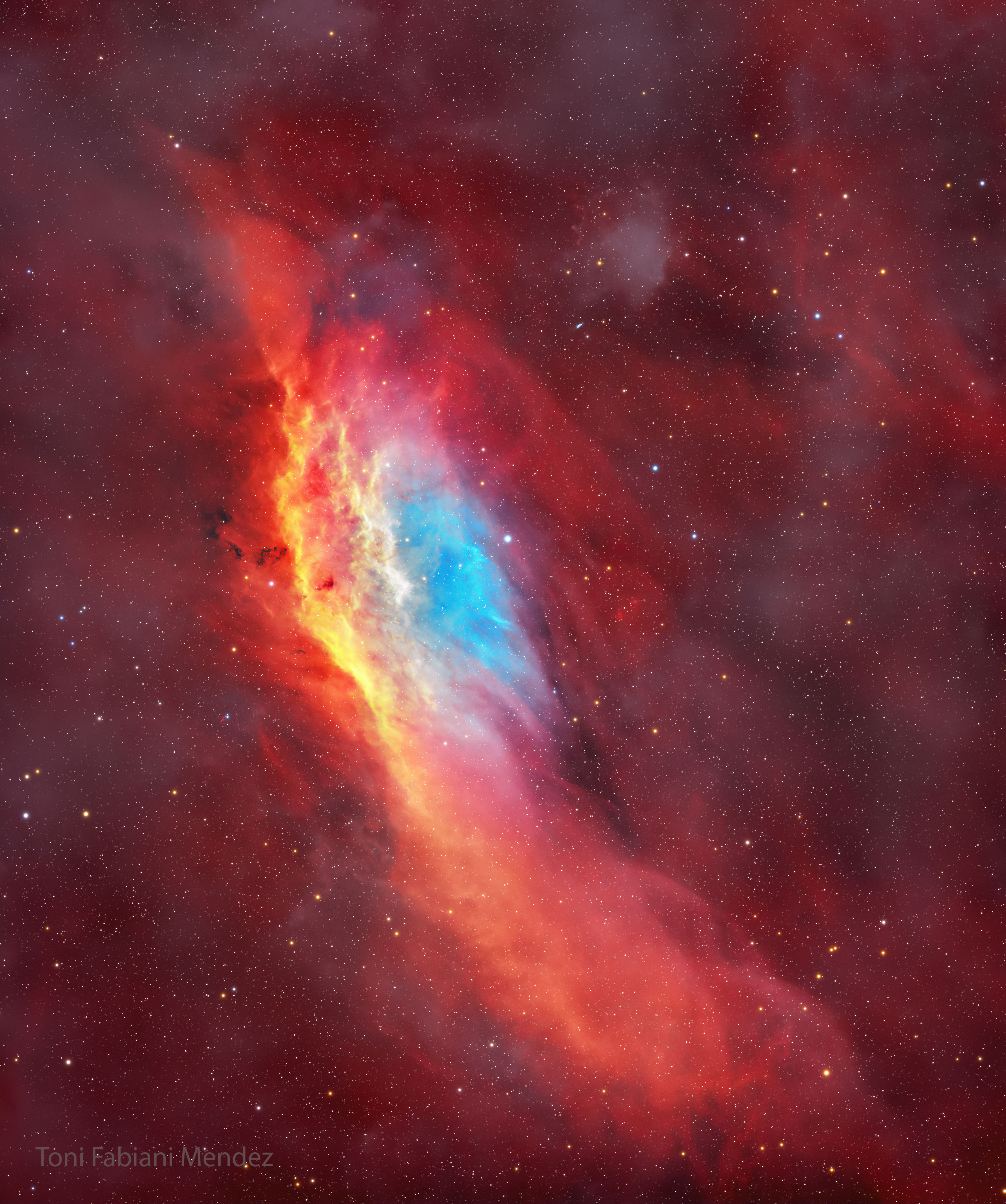
Could Queen Calafia's mythical island exist in space? Perhaps not, but by chance the outline of this molecular space cloud echoes the outline of the state of California, USA. Our Sun has its home within the Milky Way's Orion Arm, only about 1,000 light-years from the California Nebula. Also known as NGC 1499, the classic emission nebula is around 100 light-years long. On the featured image, the most prominent glow of the California Nebula is the red light characteristic of hydrogen atoms recombining with long lost electrons, stripped away (ionized) by energetic starlight. The star most likely providing the energetic starlight that ionizes much of the nebular gas is the bright, hot, bluish Xi Persei just to the right of the nebula. A regular target for astrophotographers, the California Nebula can be spotted with a wide-field telescope under a dark sky toward the constellation of Perseus, not far from the Pleiades. Explore Your Universe: Random APOD Generator
¿Podría existir en el espacio la isla mítica de la reina Calafia? Quizás no, pero por casualidad el contorno de esta nube molecular espacial refleja el contorno del estado de California, EE. UU. Nuestro Sol tiene su hogar dentro del Brazo de Orión de la Vía Láctea, a solo unos 1000 años luz de la Nebulosa de California. También conocida como NGC 1499, la nebulosa de emisión clásica tiene alrededor de 100 años luz de longitud. En la imagen destacada, el brillo más destacado de la Nebulosa de California es la luz roja característica de los átomos de hidrógeno que se recombinan con electrones perdidos, arrancados (ionizados) por la luz estelar energética. La estrella que probablemente proporciona la luz energética que ioniza gran parte del gas nebuloso es la brillante, caliente y azulada Xi Persei, ubicada justo a la derecha de la nebulosa. Un objetivo habitual para los fotógrafos astronómicos, la Nebulosa de California puede ser observada con un telescopio de campo amplio bajo un cielo oscuro hacia la constelación de Perseo, no muy lejos de las Pléyades.