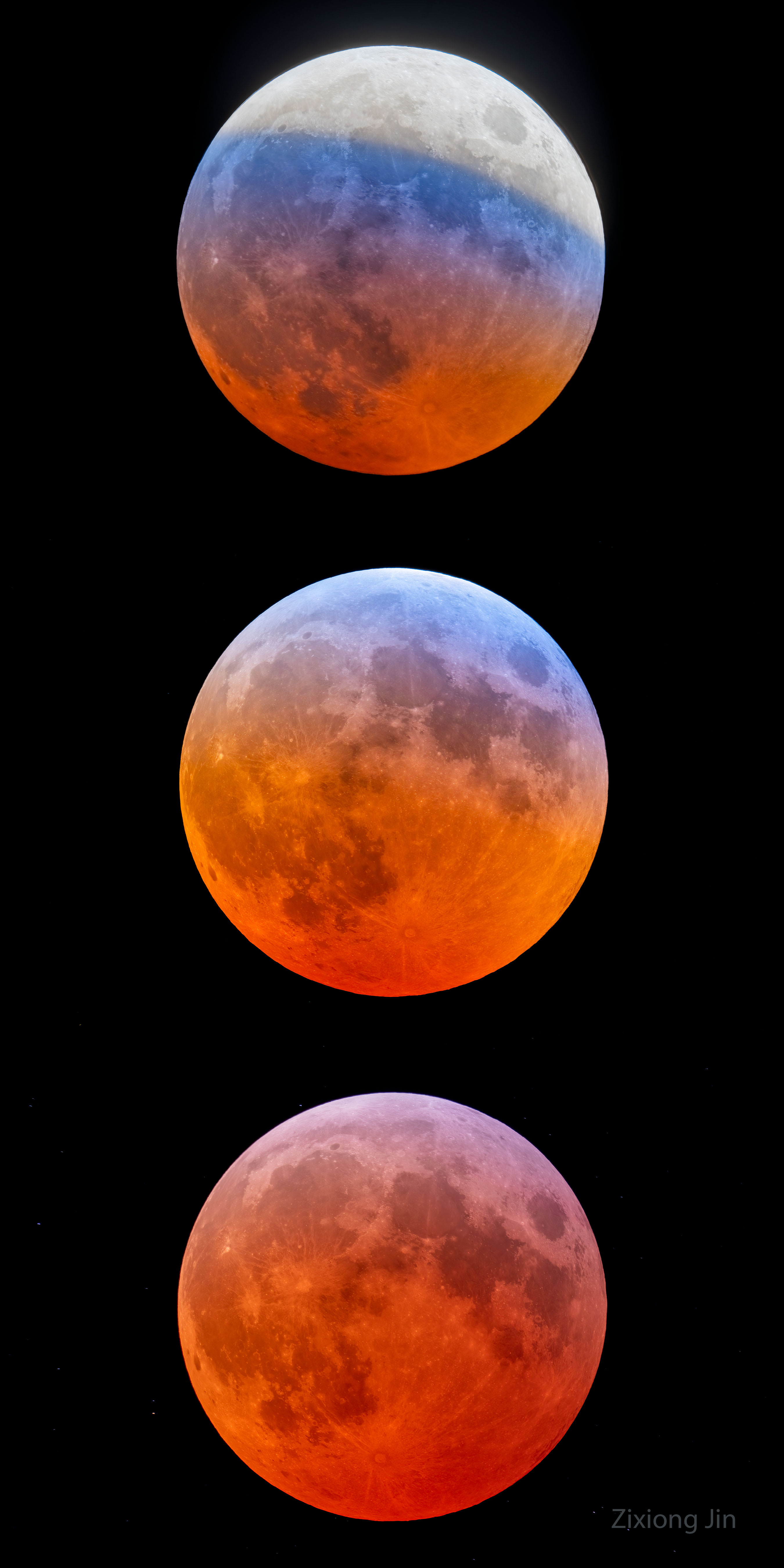
What causes a blue band to cross the Moon during a lunar eclipse? The blue band is real but usually quite hard to see. The featured HDR image of last week's lunar eclipse, however -- taken from Norman, Oklahoma (USA) -- has been digitally processed to exaggerate the colors. The gray color on the upper right of the top lunar image is the Moon's natural color, directly illuminated by sunlight. The lower parts of the Moon on all three images are not directly lit by the Sun since it is being eclipsed -- it is in the Earth's shadow. It is faintly lit, though, by sunlight that has passed deep through Earth's atmosphere. This part of the Moon is red -- and called a blood Moon -- for the same reason that Earth's sunsets are red: because air scatters away more blue light than red. The unusual purple-blue band visible on the upper right of the top and middle images is different -- its color is augmented by sunlight that has passed high through Earth's atmosphere, where red light is better absorbed by ozone than blue. Celestial Surprise: What picture did APOD feature on your birthday? (post 1995)
¿Qué causa una banda azul que cruza la Luna durante un eclipse lunar? La banda azul es real, pero normalmente es bastante difícil de ver. La imagen HDR destacada del eclipse lunar de la semana pasada, tomada desde Norman, Oklahoma (EE.UU.), ha sido procesada digitalmente para exagerar los colores. El color gris en la parte superior derecha de la imagen lunar superior es el color natural de la Luna, directamente iluminada por la luz solar. Las partes inferiores de la Luna en todas las tres imágenes no están directamente iluminadas por el Sol, ya que está en eclipse — está en la sombra de la Tierra. Sin embargo, está débilmente iluminada por la luz solar que ha atravesado profundamente la atmósfera terrestre. Esta parte de la Luna es roja — y se llama Luna de Sangre — por la misma razón por la que los atardeceres terrestres son rojos: porque el aire dispersa más luz azul que luz roja. La banda inusual de color púrpura-azul visible en la parte superior derecha de las imágenes superior y central es diferente — su color se ve aumentado por la luz solar que ha atravesado altamente la atmósfera terrestre, donde la luz roja es absorbida mejor por el ozono que la luz azul.