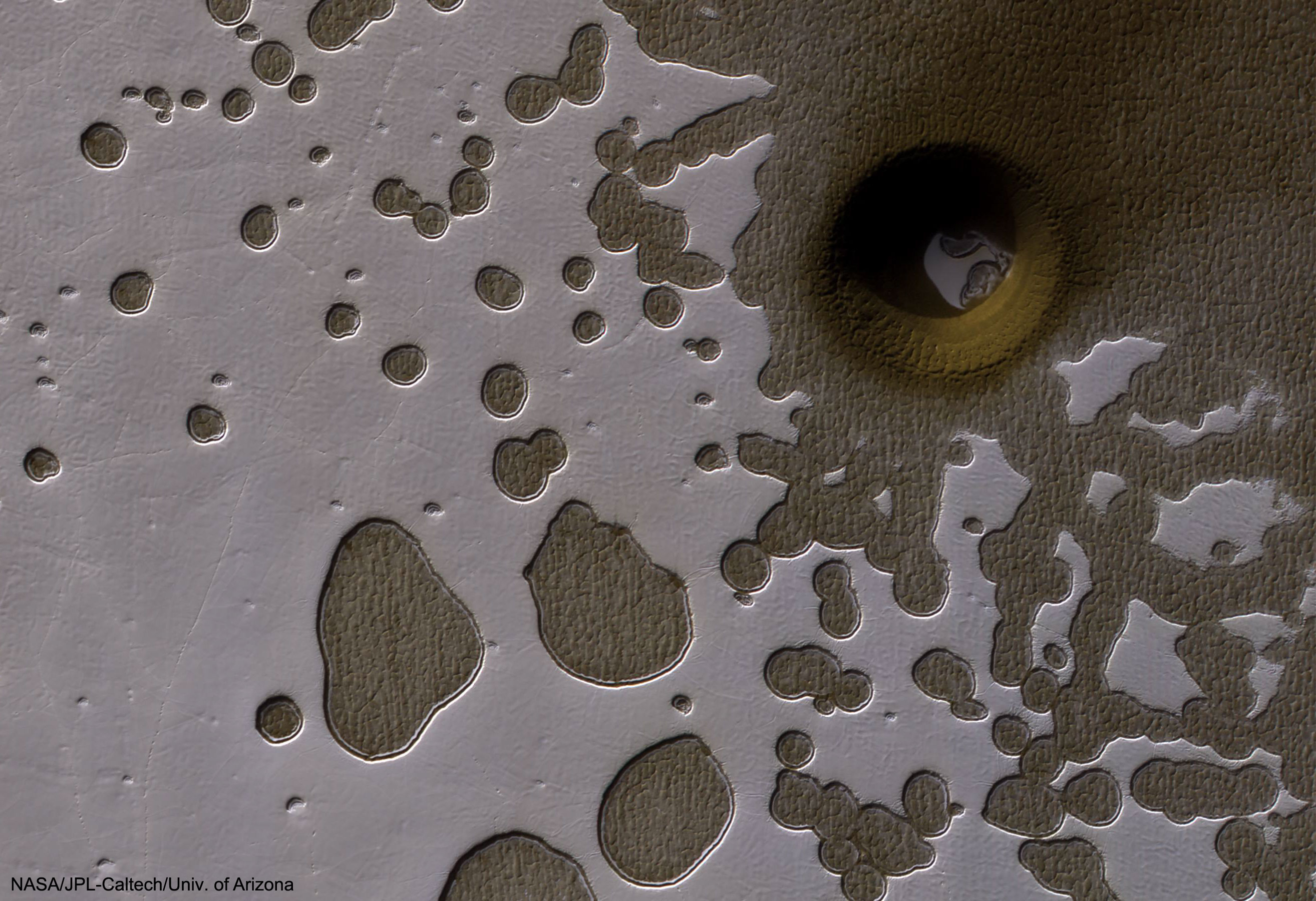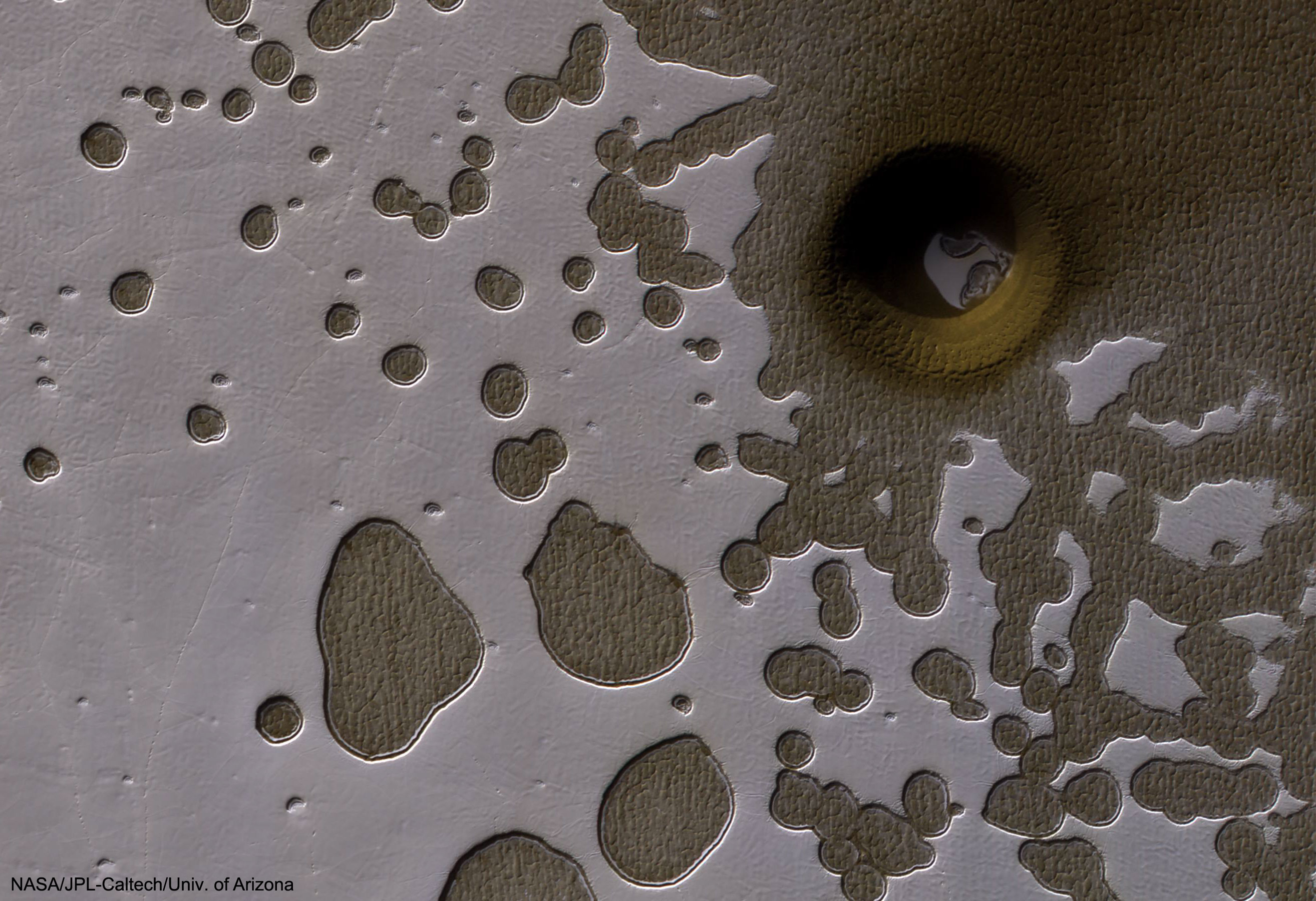
What created this unusual hole in Mars? Actually, there are numerous holes pictured in this Swiss cheese-like landscape, with all-but-one of them showing a dusty, dark, Martian terrain beneath evaporating, light, carbon dioxide ice. The most unusual hole is on the upper right, spans about 100 meters, and seems to punch through to a lower level. Why this hole exists and why it is surrounded by a circular crater remains a topic of speculation, although a leading hypothesis is that it was created by a meteor impact. Holes such as this are of particular interest because they might be portals to lower levels that extend into expansive underground caves. If so, these naturally occurring tunnels are relatively protected from the harsh surface of Mars, making them relatively good candidates to contain Martian life. These pits are therefore also prime targets for possible future spacecraft, robots, and even human interplanetary explorers.
¿Qué creó este agujero inusual en Marte? De hecho, hay numerosos agujeros en este paisaje que recuerda al queso suizo, con casi todos ellos mostrando un terreno polvoriento y oscuro de Marte bajo una capa de hielo ligero de dióxido de carbono que se evapora. El agujero más inusual se encuentra en la parte superior derecha, tiene aproximadamente 100 metros de diámetro y parece atravesar hasta un nivel inferior. La existencia de este agujero y el hecho de que esté rodeado por un cráter circular sigue siendo un tema de especulación, aunque una hipótesis principal sugiere que fue creado por un impacto de meteorito. Agujeros como este son de particular interés porque podrían ser portales hacia niveles inferiores que se extienden hacia cuevas subterráneas extensas. Si es así, estos túneles naturales estarían relativamente protegidos de la dura superficie de Marte, lo que los convierte en candidatos relativamente buenos para albergar vida marciana. Por ello, estos pozos también son objetivos prioritarios para posibles futuros vehículos espaciales, robots e incluso exploradores interplanetarios humanos.