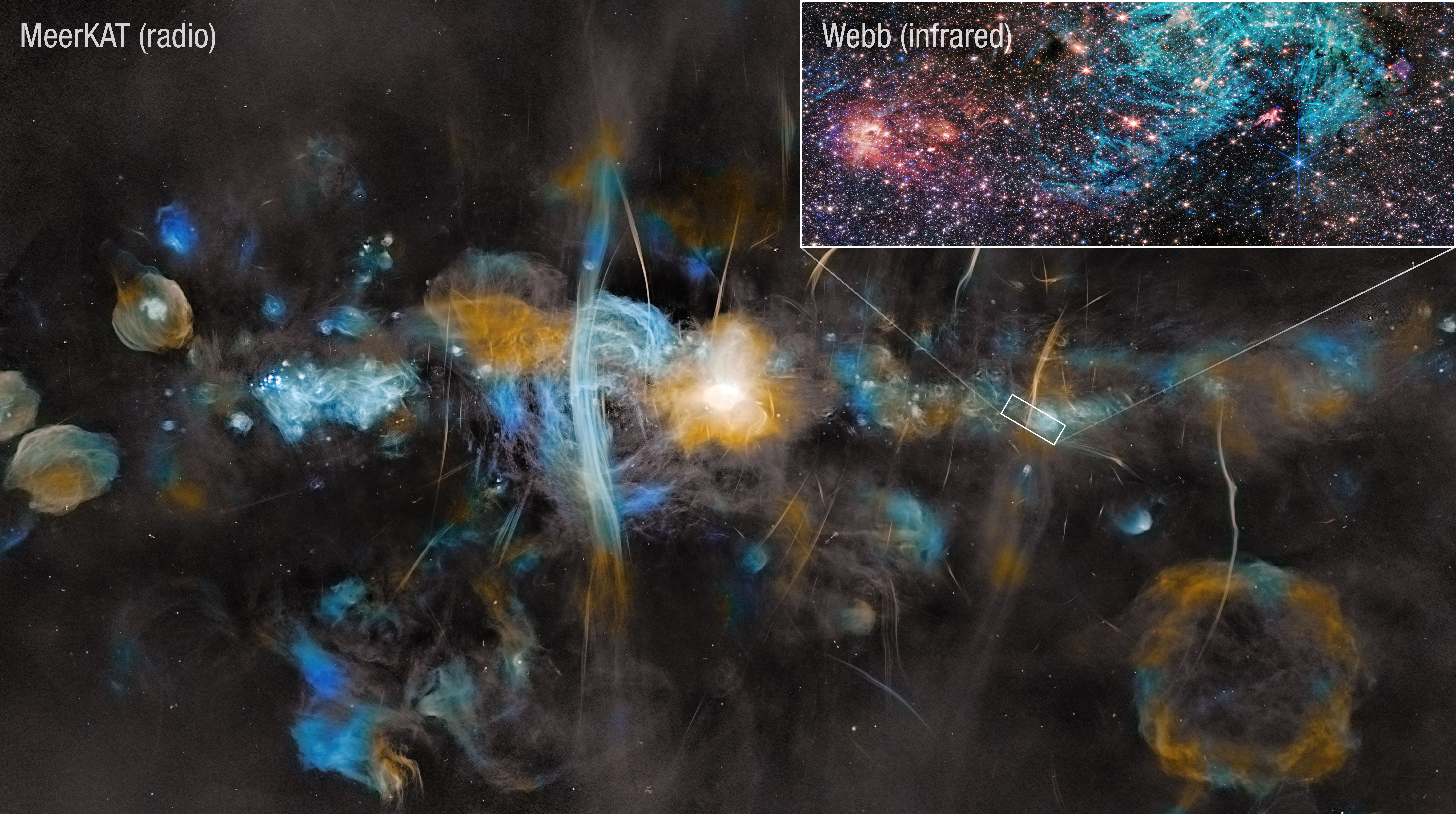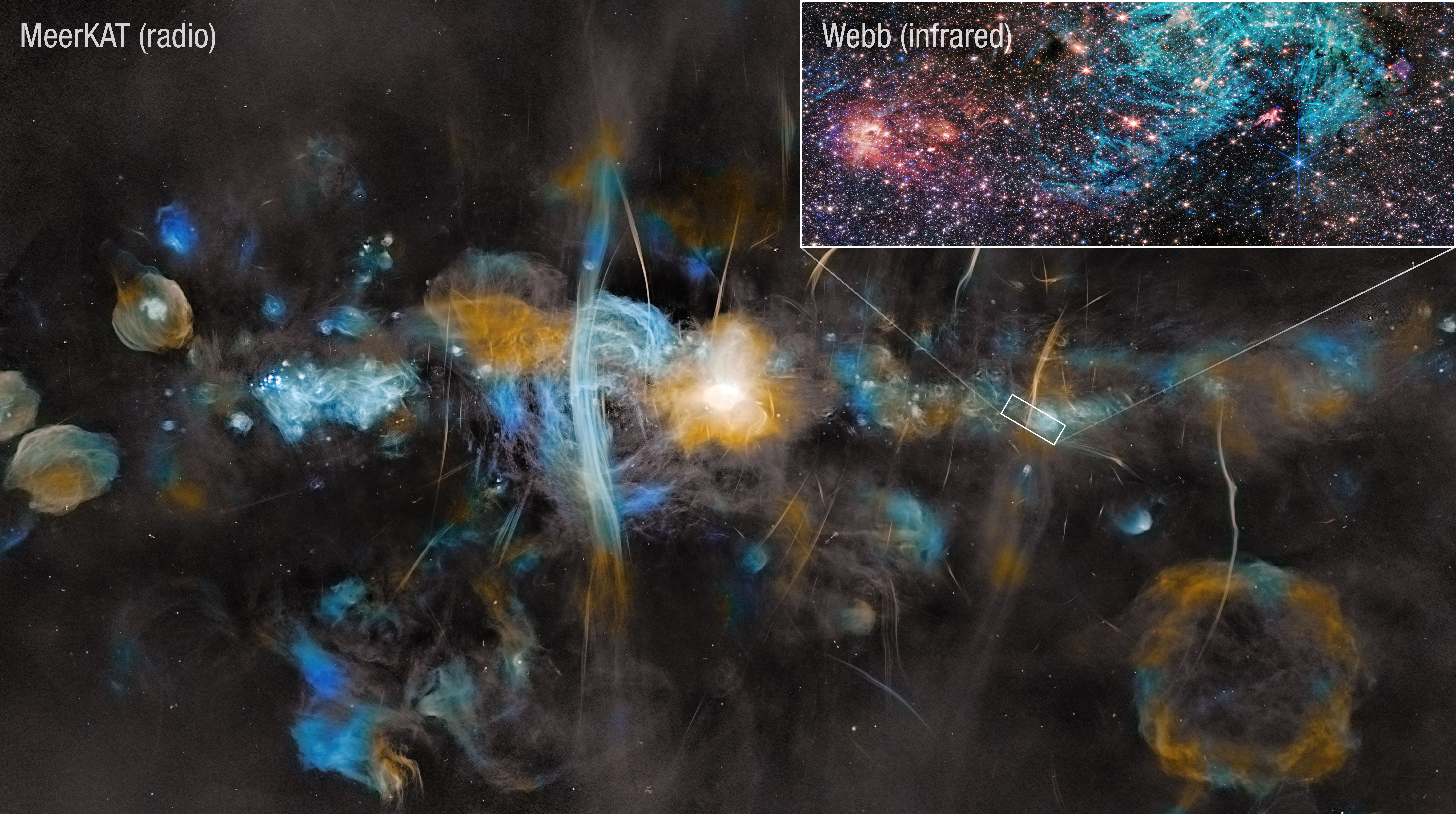
What's happening at the center of our galaxy? It's hard to tell with optical telescopes since visible light is blocked by intervening interstellar dust. In other bands of light, though, such as radio, the galactic center can be imaged and shows itself to be quite an interesting and active place. The featured picture shows an image of our Milky Way's center by the MeerKAT array of 64 radio dishes in South Africa. Spanning four times the angular size of the Moon (2 degrees), the image is impressively vast, deep, and detailed. Many known sources are shown in clear detail, including many with a prefix of Sgr, since the galactic center is in the direction of the constellation Sagittarius. In our galaxy's center lies Sgr A, found here in the image center, which houses the Milky Way's central supermassive black hole. Other sources in the image are not as well understood, including the Arc, just to the left of Sgr A, and numerous filamentary threads. The inset image shows a small patch recently imaged in infrared light with the James Webb Space Telescope to investigate the effects of magnetic fields on star formation. Open Science: Browse 3,600+ codes in the Astrophysics Source Code Library
¿Qué está sucediendo en el centro de nuestra galaxia? Es difícil determinarlo con telescopios ópticos, ya que la luz visible es bloqueada por el polvo interestelar intermedio. Sin embargo, en otras bandas de luz, como las ondas de radio, el centro galáctico puede ser observado y revela ser un lugar bastante interesante y activo. La imagen destacada muestra una imagen del centro de nuestra Vía Láctea obtenida por el array MeerKAT, compuesto por 64 antenas de radio en Sudáfrica. Con un tamaño angular cuatro veces mayor al de la Luna (2 grados), la imagen es notablemente vasta, profunda y detallada. Muchas fuentes conocidas aparecen claramente detalladas, incluyendo muchas con el prefijo Sgr, ya que el centro galáctico se encuentra en la dirección de la constelación de Sagitario. En el centro de nuestra galaxia se encuentra Sgr A, ubicado aquí en el centro de la imagen, que alberga el agujero negro supermasivo central de la Vía Láctea. Otras fuentes en la imagen no están tan bien comprendidas, incluyendo el Arco, ubicado justo a la izquierda de Sgr A, y numerosos hilos filamentosos. La imagen insertada muestra un pequeño parche recientemente observado en luz infrarroja con el telescopio espacial James Webb, para investigar los efectos de los campos magnéticos en la formación estelar.