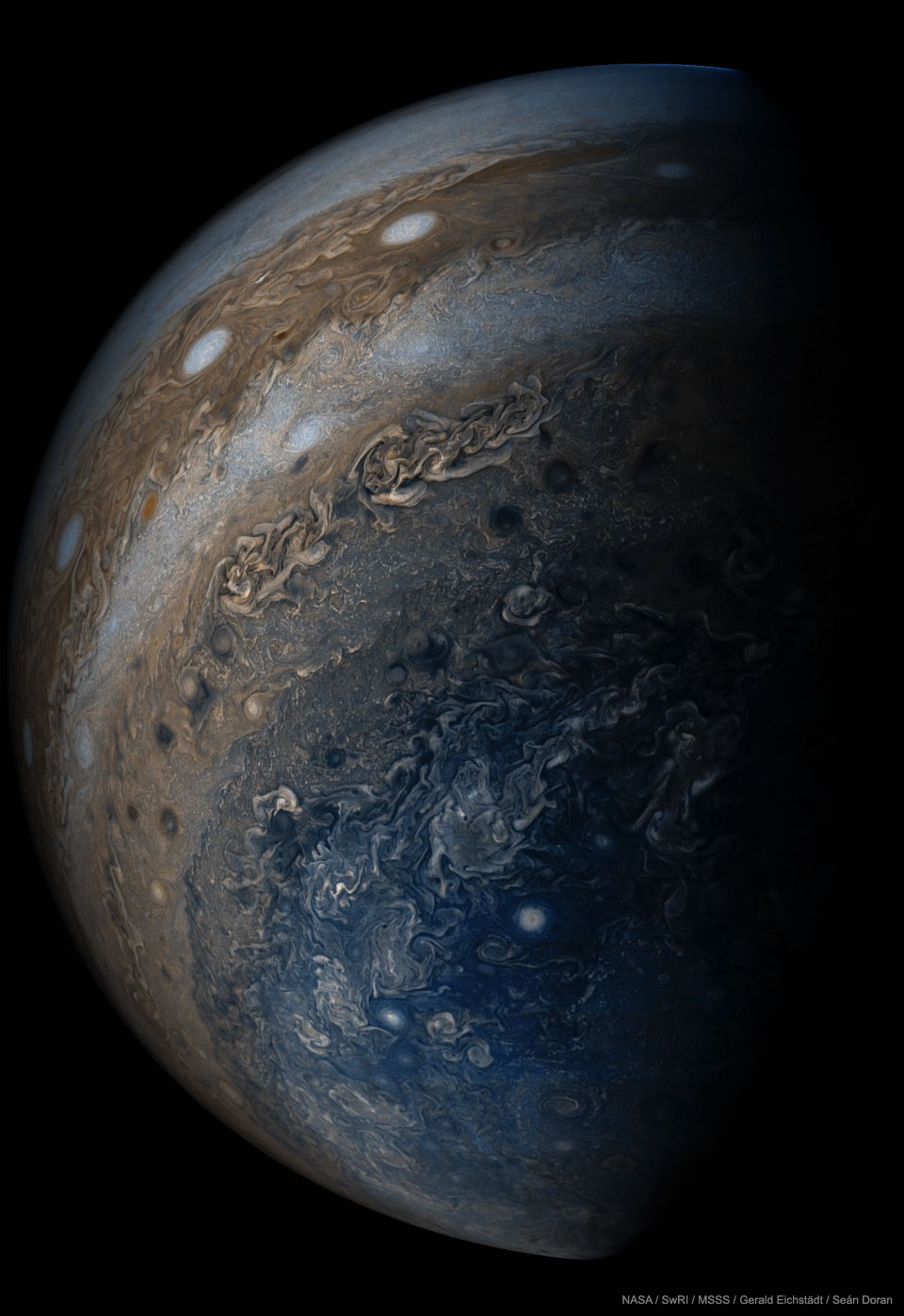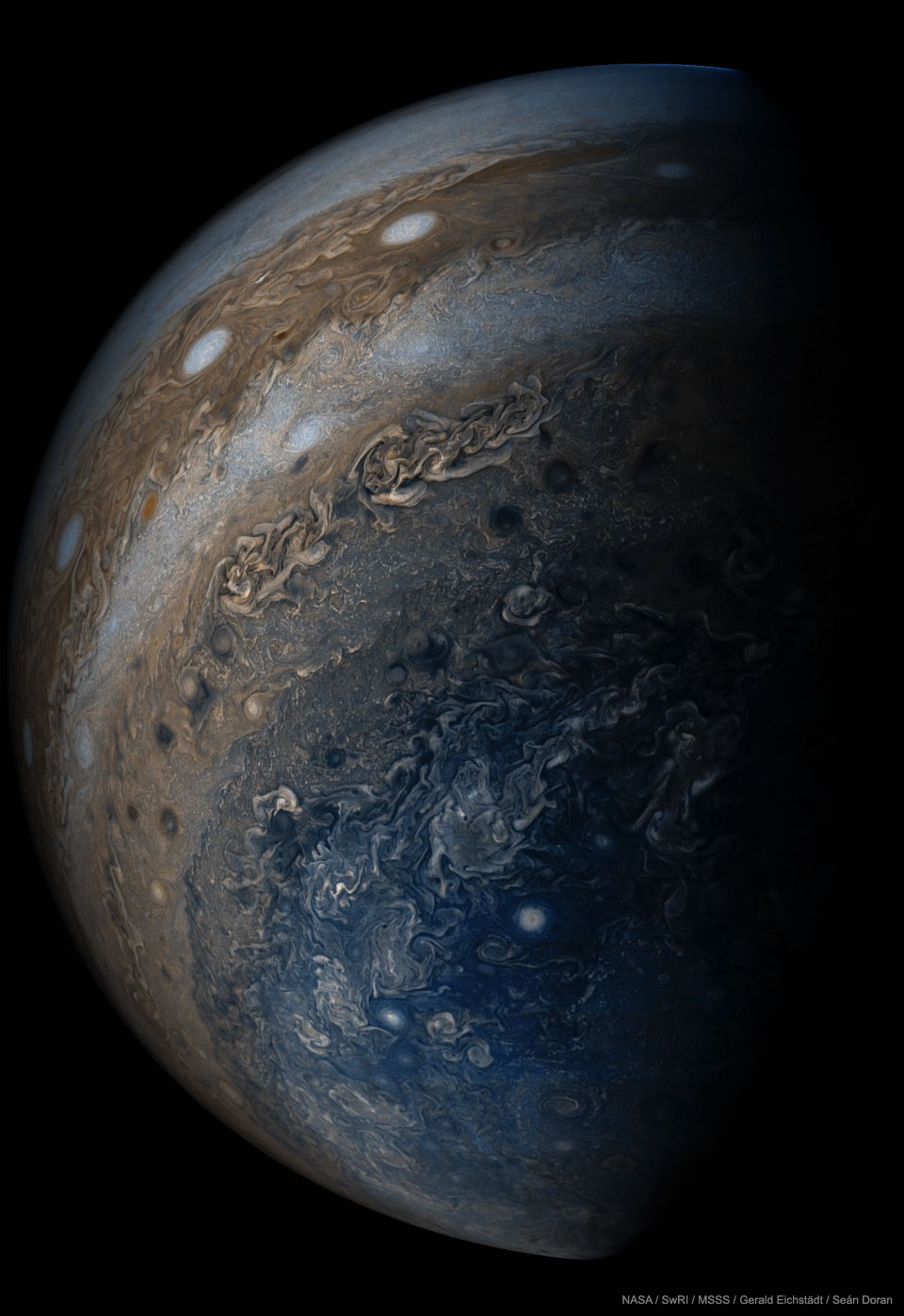
Jupiter is stranger than we knew. NASA's Juno spacecraft has now completed over 70 swoops past Jupiter as it moves around its highly elliptical orbit. Pictured from 2017, Jupiter is seen from below where, surprisingly, the horizontal bands that cover most of the planet disappear into swirls and complex patterns. A line of white oval clouds is visible nearer to the equator. Impressive results from Juno show that Jupiter's weather phenomena can extend deep below its cloud tops, that Jupiter's center has a core that is unexpectedly large and soft, and that Jupiter's magnetic field varies greatly with location. Although Juno is scheduled to keep orbiting Jupiter further into 2025, at some time the robotic spacecraft will be maneuvered to plunge into the giant planet. Jigsaw Jumble: Astronomy Puzzle of the Day
Júpiter es más extraño de lo que creíamos. La nave espacial Juno de la NASA ha completado ya más de 70 acercamientos a Júpiter mientras se mueve en su órbita altamente elíptica. En esta imagen tomada en 2017, se ve a Júpiter desde abajo, donde, sorprendentemente, las bandas horizontales que cubren gran parte del planeta desaparecen en remolinos y patrones complejos. Una línea de nubes ovales blancas es visible más cerca del ecuador. Los resultados impresionantes de Juno muestran que los fenómenos meteorológicos de Júpiter pueden extenderse profundamente bajo sus nubes, que el centro de Júpiter tiene un núcleo inesperadamente grande y blando, y que el campo magnético de Júpiter varía considerablemente según la ubicación. Aunque Juno está programada para seguir orbitando a Júpiter hasta más allá de 2025, en algún momento la nave espacial robótica será maniobrada para que se precipite hacia el gigante planeta.