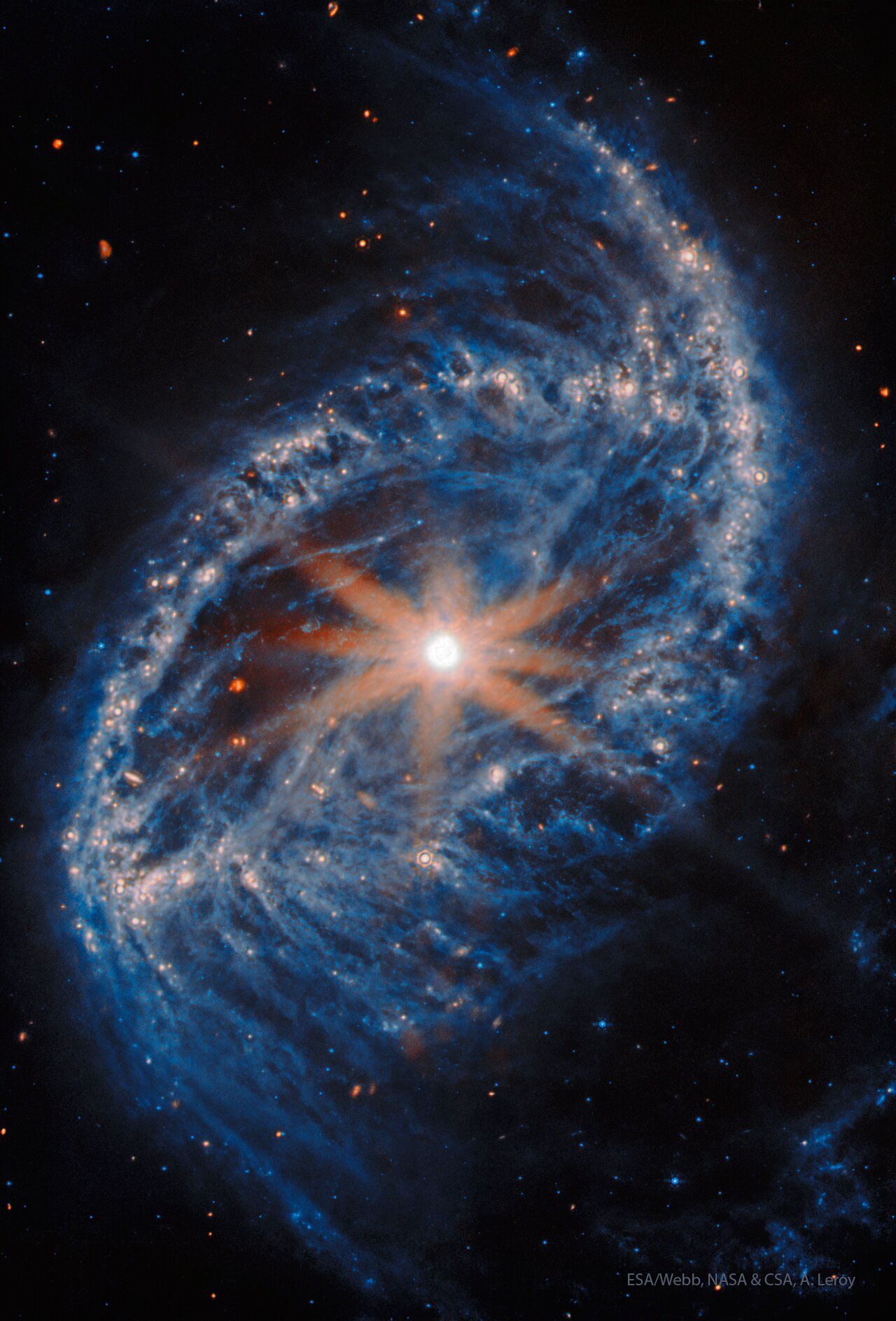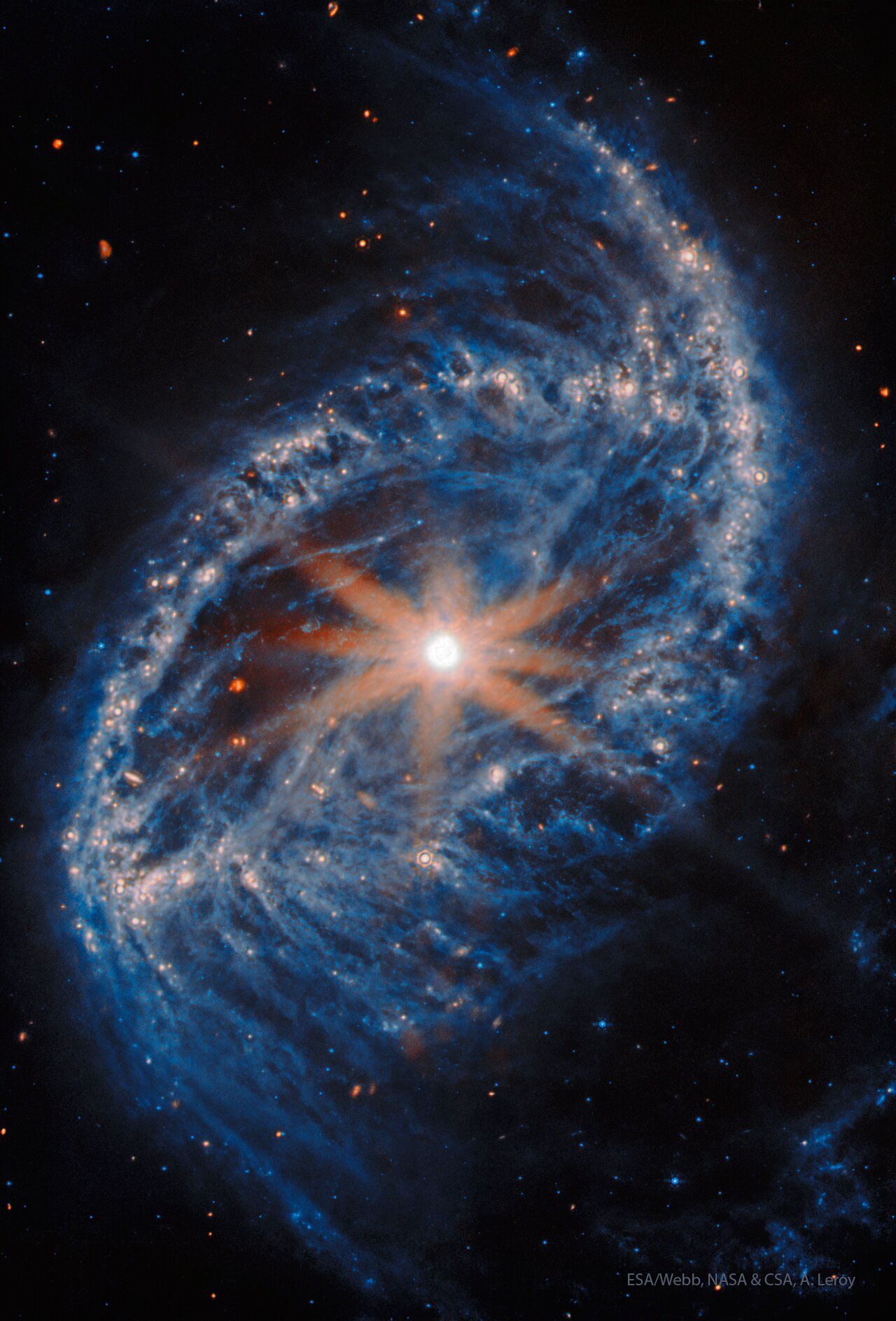
What’s happening in the center of spiral galaxy NGC 2566? First, the eight rays that appear to be coming out of the center in the featured infrared image are not real — they are diffraction spikes caused by the mechanical structure of the Webb space telescope itself. The center of NGC 2566 is bright but not considered unusual, which means that it likely contains a supermassive black hole, although currently not very active. At only 76 million light years away, the light we see from NGC 2566 today left when dinosaurs roamed the Earth. The picturesque galaxy is close enough so that Earthly telescopes, including Webb and Hubble, can resolve the turbulent clouds of gas and dust where stars can form and so allows study of stellar evolution. NGC 2566, similar in size to our Milky Way Galaxy, is notable for its bright central bar and its prominent outer spiral arms.
¿Qué está sucediendo en el centro de la galaxia espiral NGC 2566? Primero, las ocho rayas que parecen salir del centro en la imagen infrarroja presentada no son reales — son picos de difracción causados por la estructura mecánica del propio telescopio espacial Webb. El centro de NGC 2566 es brillante, pero no se considera inusual, lo que significa que probablemente contenga un agujero negro supermasivo, aunque actualmente no muy activo. A solo 76 millones de años luz de distancia, la luz que vemos de NGC 2566 hoy salió cuando los dinosaurios paseaban por la Tierra. La galaxia pintoresca está lo suficientemente cerca como para que los telescopios terrestres, incluidos Webb y Hubble, puedan resolver las nubes turbulentas de gas y polvo donde se forman las estrellas, lo que permite estudiar la evolución estelar. NGC 2566, similar en tamaño a nuestra galaxia Vía Láctea, es notable por su barra central brillante y sus brazos espirales externos prominentes.