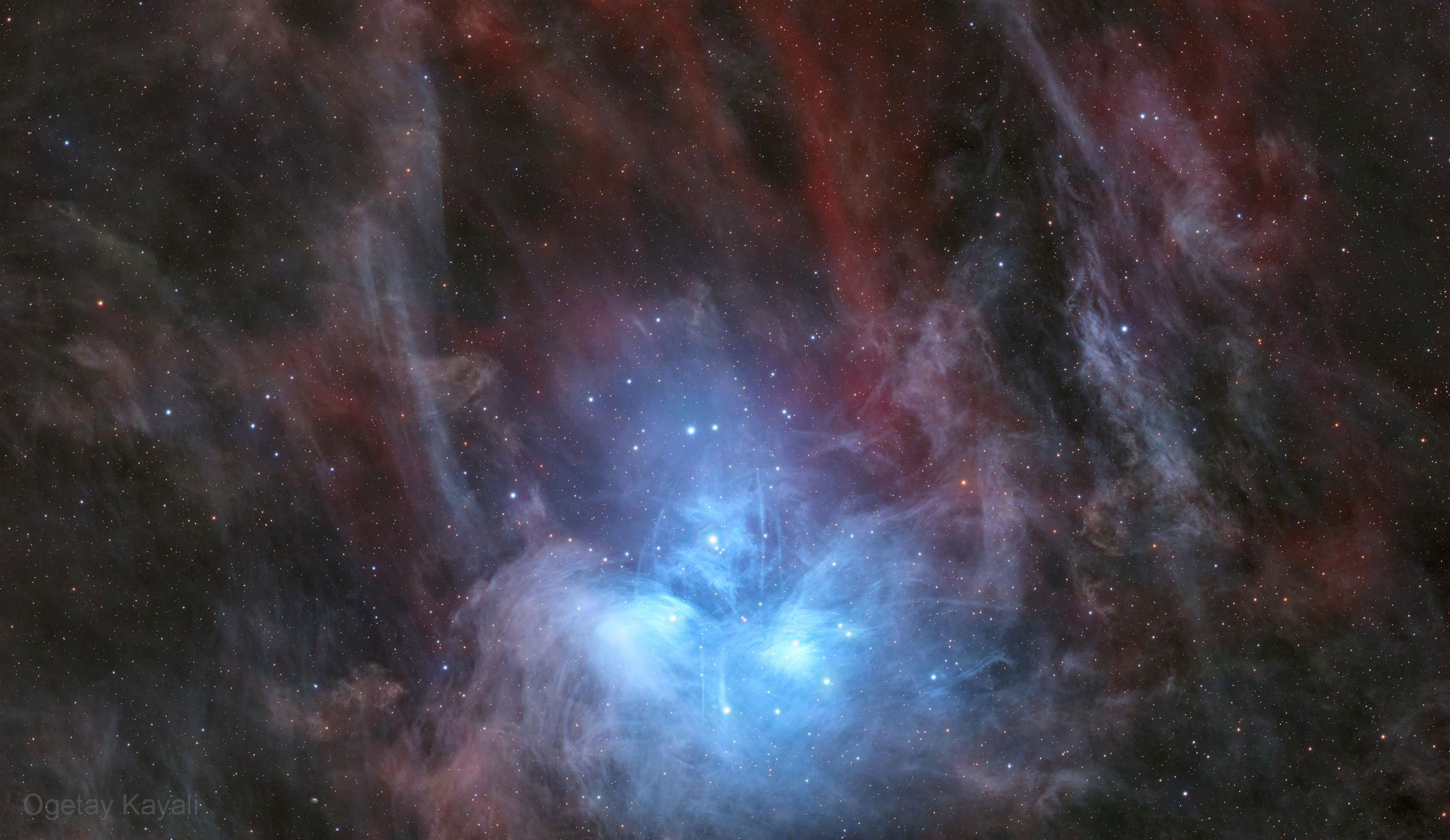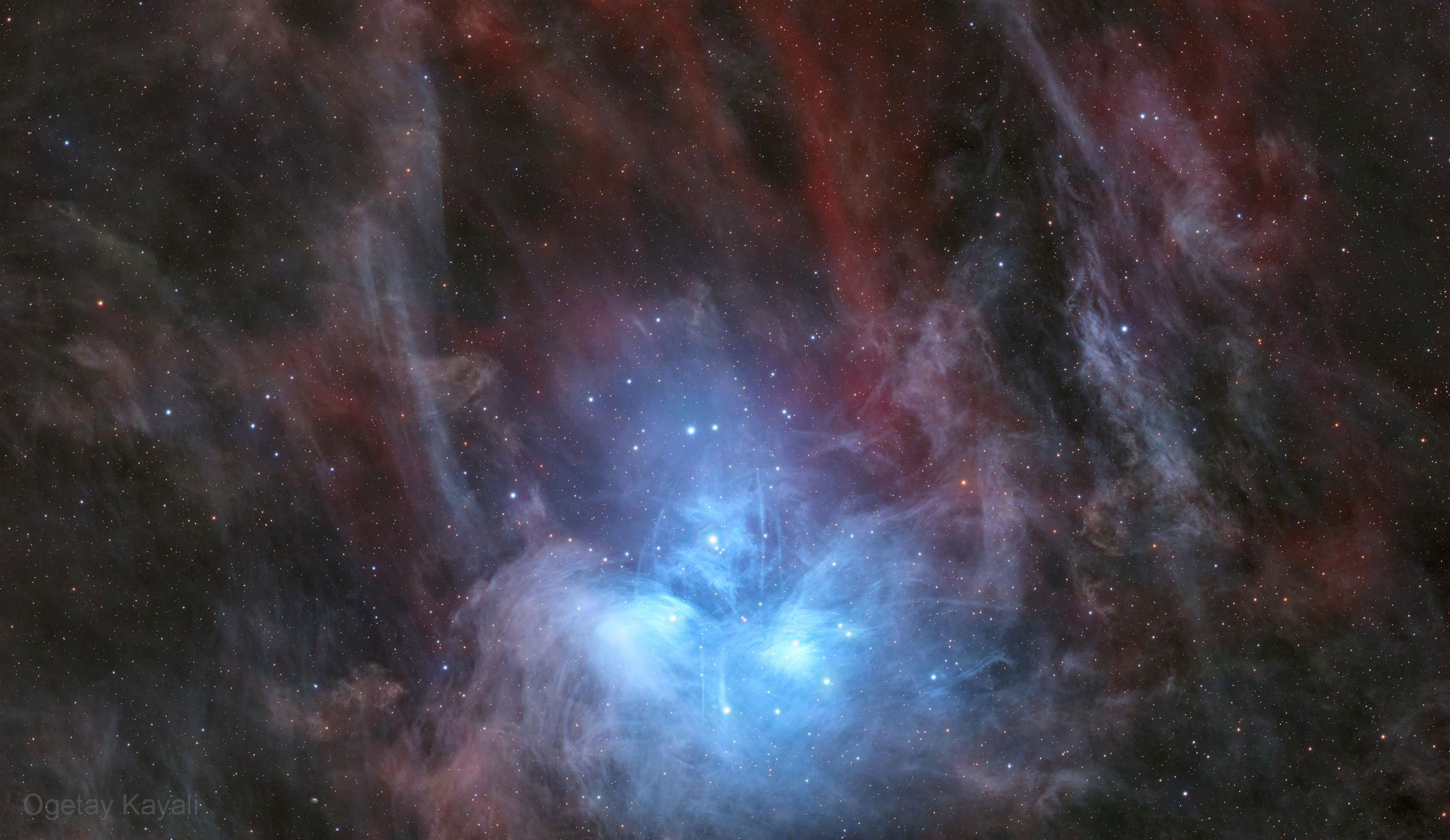
If you have looked at the sky and seen a group of stars about the size of the full Moon, that's the Pleiades (M45). Perhaps the most famous star cluster in the sky, its brightest stars can be seen even from the light-polluted cities. But your unaided eye can also see its nebulosity -- the gas and dust surrounding it -- under dark skies. However, telescopes can catch even more. The bright blue stars of the Pleiades, also known as the Seven Sisters, light up their surrounding dust, causing it to appear a diffuse blue that can only be seen under long exposures. But that's not all. The cosmic dust appears to stretch upward like ethereal arms. And the entire structure is surrounded by a reddish glow from the most abundant element in the universe: hydrogen. The featured image is composed of nearly 25 hours of exposure and was captured last year from Starfront Observatory, in Texas, USA Explore Your Universe: Random APOD Generator
Si has mirado el cielo y has visto un grupo de estrellas del tamaño de la Luna llena, esas son las Pléyades (M45). Quizás el cúmulo estelar más famoso del cielo, sus estrellas más brillantes se pueden ver incluso desde ciudades con contaminación lumínica. Pero tu ojo desnudo también puede apreciar su nebulosidad — el gas y el polvo que lo rodean — bajo cielos oscuros. Sin embargo, los telescopios pueden captar aún más. Las brillantes estrellas azules de las Pléyades, también conocidas como las Siete Hermanas, iluminan el polvo que las rodea, causando que aparezca como un azul difuso que solo se puede ver bajo exposiciones largas. Pero eso no es todo. El polvo cósmico parece estirarse hacia arriba como brazos etéreos. Y toda la estructura está rodeada por un brillo rojizo del elemento más abundante del universo: el hidrógeno. La imagen destacada está compuesta por casi 25 horas de exposición y fue capturada el año pasado desde el Observatorio Starfront, en Texas, Estados Unidos.