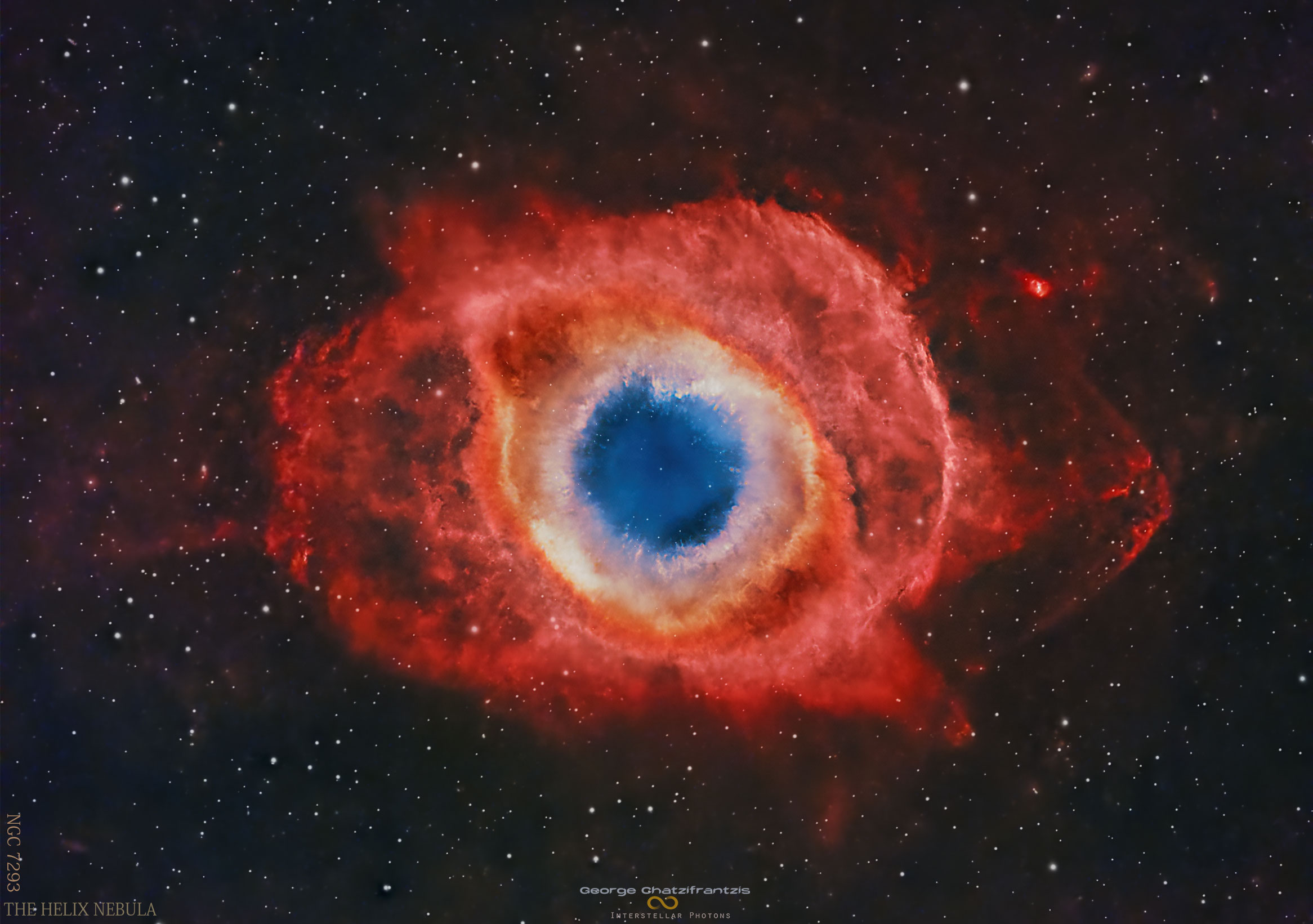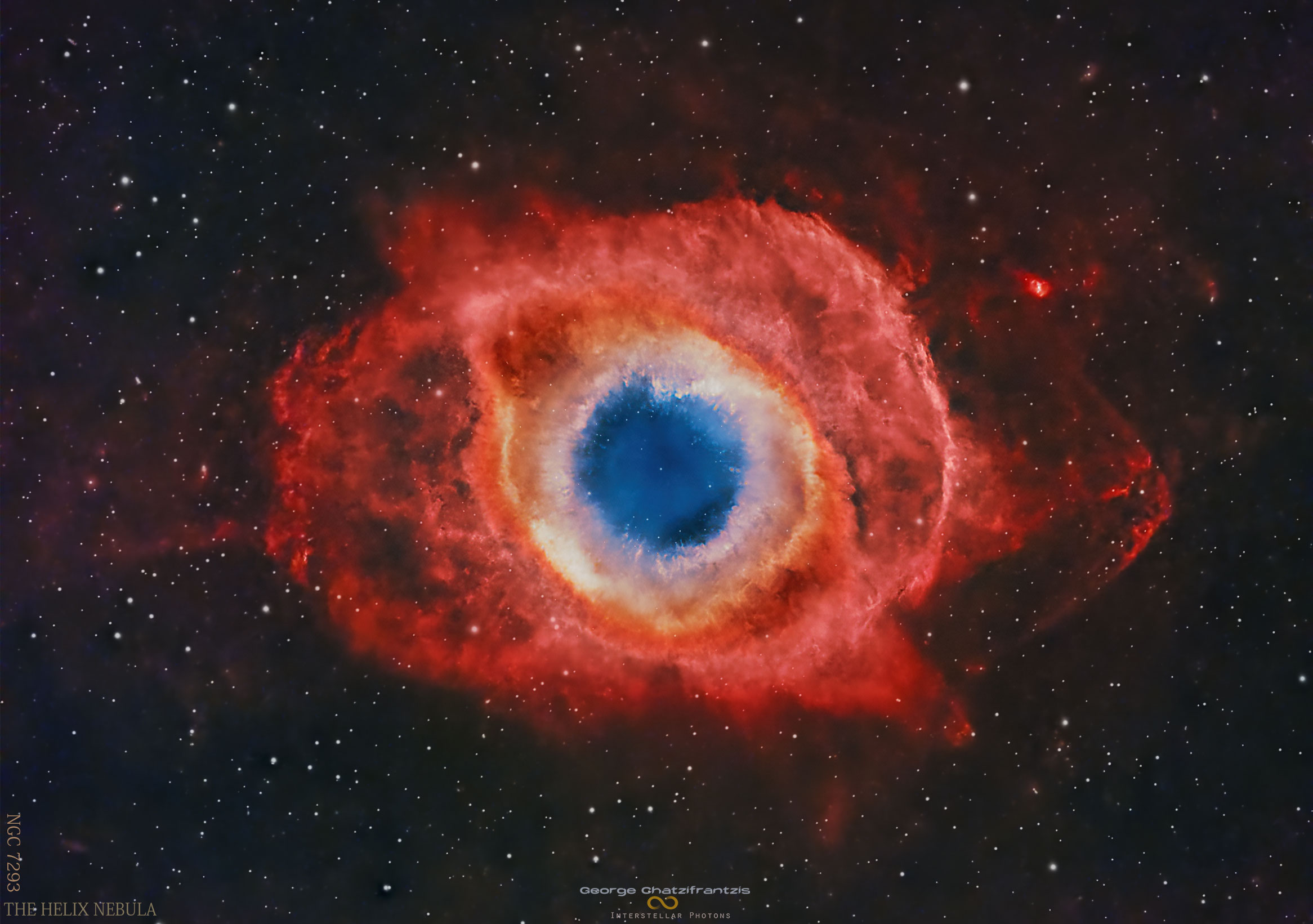
Is the Helix Nebula looking at you? No, not in any biological sense, but it does look quite like an eye. The Helix Nebula is so named because it also appears that you are looking down the axis of a helix. In actuality, it is now understood to have a surprisingly complex geometry, including radial filaments and extended outer loops. The Helix Nebula (aka NGC 7293) is one of brightest and closest examples of a planetary nebula, a gas cloud created at the end of the life of a Sun-like star. The remnant central stellar core, destined to become a white dwarf star, glows in light so energetic it causes the previously expelled gas to fluoresce. The featured picture, taken in red, green, and blue but highlighted by light emitted primarily by hydrogen was created from 12 hours of exposure through a personal telescope located in Greece. A close-up of the inner edge of the Helix Nebula shows complex gas knots the origin of which are still being researched. Portal Universe: Random APOD Generator
¿La Nebulosa Helix te está mirando? No, no en ningún sentido biológico, pero sí se parece bastante a un ojo. La Nebulosa Helix recibe su nombre porque también parece que estás mirando por el eje de una hélice. En realidad, ahora se sabe que tiene una geometría sorprendentemente compleja, que incluye filamentos radiales y bucles externos extendidos. La Nebulosa Helix (también conocida como NGC 7293) es uno de los ejemplos más brillantes y cercanos de una nebulosa planetaria, una nube de gas creada al final de la vida de una estrella similar al Sol. El núcleo estelar residual, destinado a convertirse en una enana blanca, emite luz tan energética que hace que el gas previamente expulsado fluoreszca. La imagen destacada, tomada en rojo, verde y azul, pero resaltada por la luz emitida principalmente por hidrógeno, fue creada a partir de 12 horas de exposición a través de un telescopio personal ubicado en Grecia. Un acercamiento al borde interior de la Nebulosa Helix muestra nudos complejos de gas cuyo origen aún se está investigando.