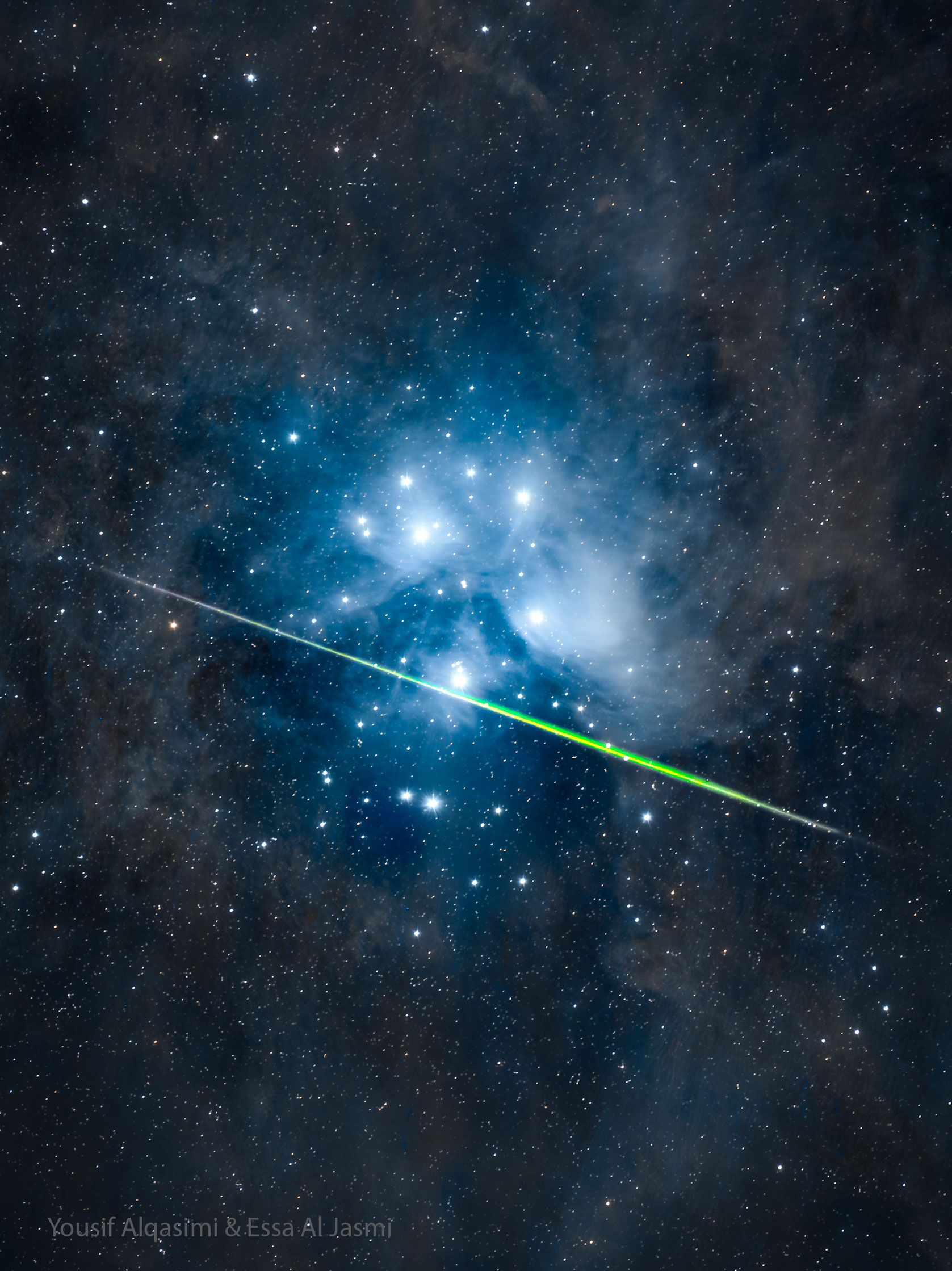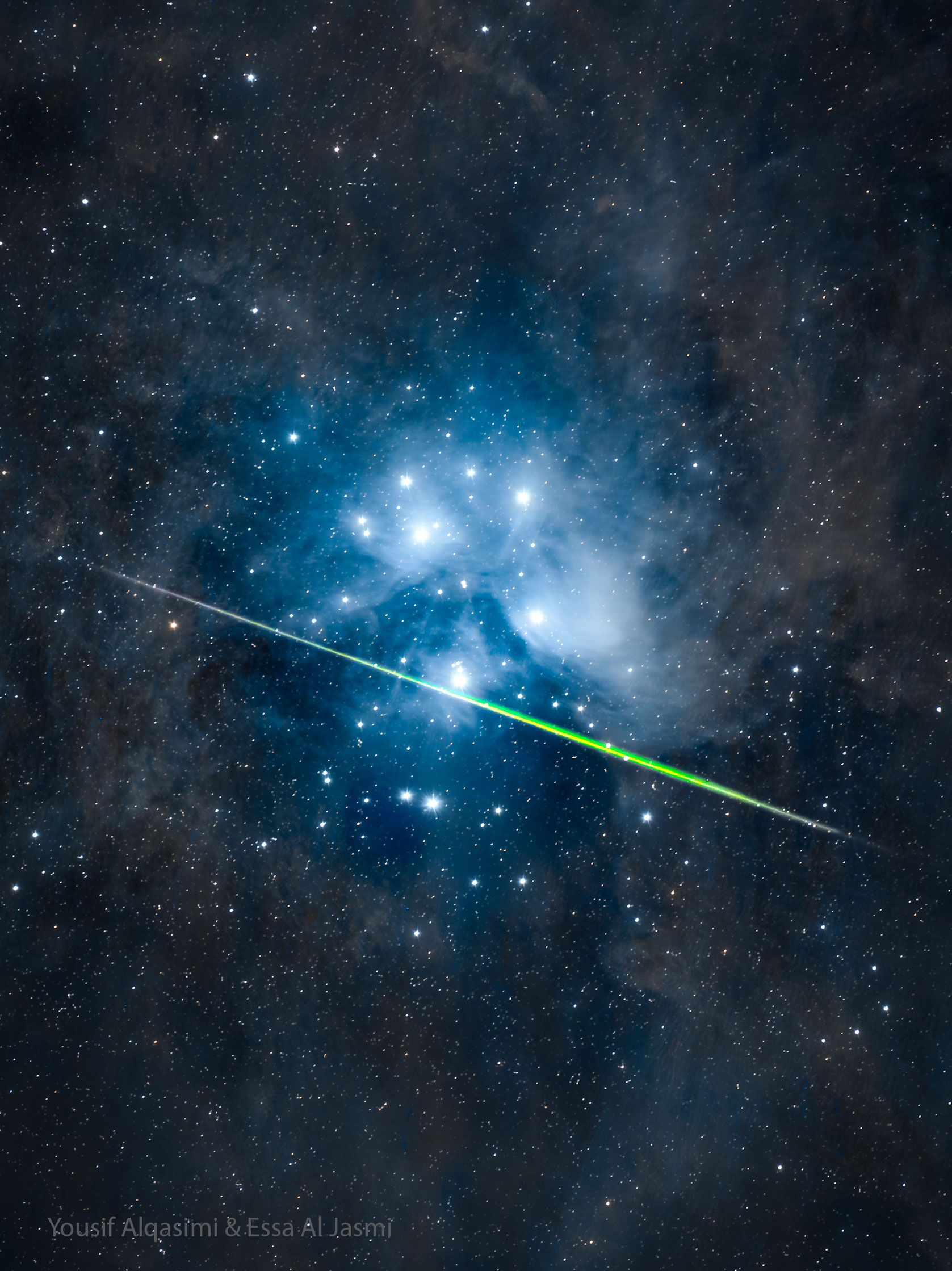
Sometimes even the sky surprises you. To see more stars and faint nebulosity in the Pleiades star cluster (M45), long exposures are made. Many times, less interesting items appear on the exposures that were not intended -- but later edited out. These include stuck pixels, cosmic ray hits, frames with bright clouds or Earth's Moon, airplane trails, lens flares, faint satellite trails, and even insect trails. Sometimes, though, something really interesting is caught by chance. That was just the case a few weeks ago in al-Ula, Saudi Arabia when a bright meteor streaked across during an hour-long exposure of the Pleiades. Along with the famous bright blue stars, less famous and less bright blue stars, and blue-reflecting dust surrounding the star cluster, the fast rock fragment created a distinctive green glow, likely due to vaporized metals. Jigsaw Universe: Astronomy Puzzle of the Day
A veces, incluso el cielo te sorprende. Para ver más estrellas y nebulosidad tenue en el cúmulo estelar de las Pléyades (M45), se realizan exposiciones largas. Muchas veces, aparecen elementos menos interesantes en las exposiciones que no eran intencionales, pero que posteriormente se editan. Estos incluyen píxeles atascados, impactos de rayos cósmicos, fotogramas con nubes brillantes o con la Luna terrestre, rastros de aviones, reflejos en la lente, rastros tenues de satélites, e incluso rastros de insectos. Sin embargo, a veces se captura algo realmente interesante por casualidad. Ese fue precisamente el caso hace unas semanas en al-Ula, Arabia Saudita, cuando un meteorito brillante cruzó durante una exposición de una hora de las Pléyades. Junto con las famosas estrellas azules brillantes, las estrellas azules menos famosas y menos brillantes, y el polvo azul que refleja la luz que rodea al cúmulo estelar, el fragmento rocoso rápido creó un brillo distintivo de color verde, probablemente debido a metales vaporizados.