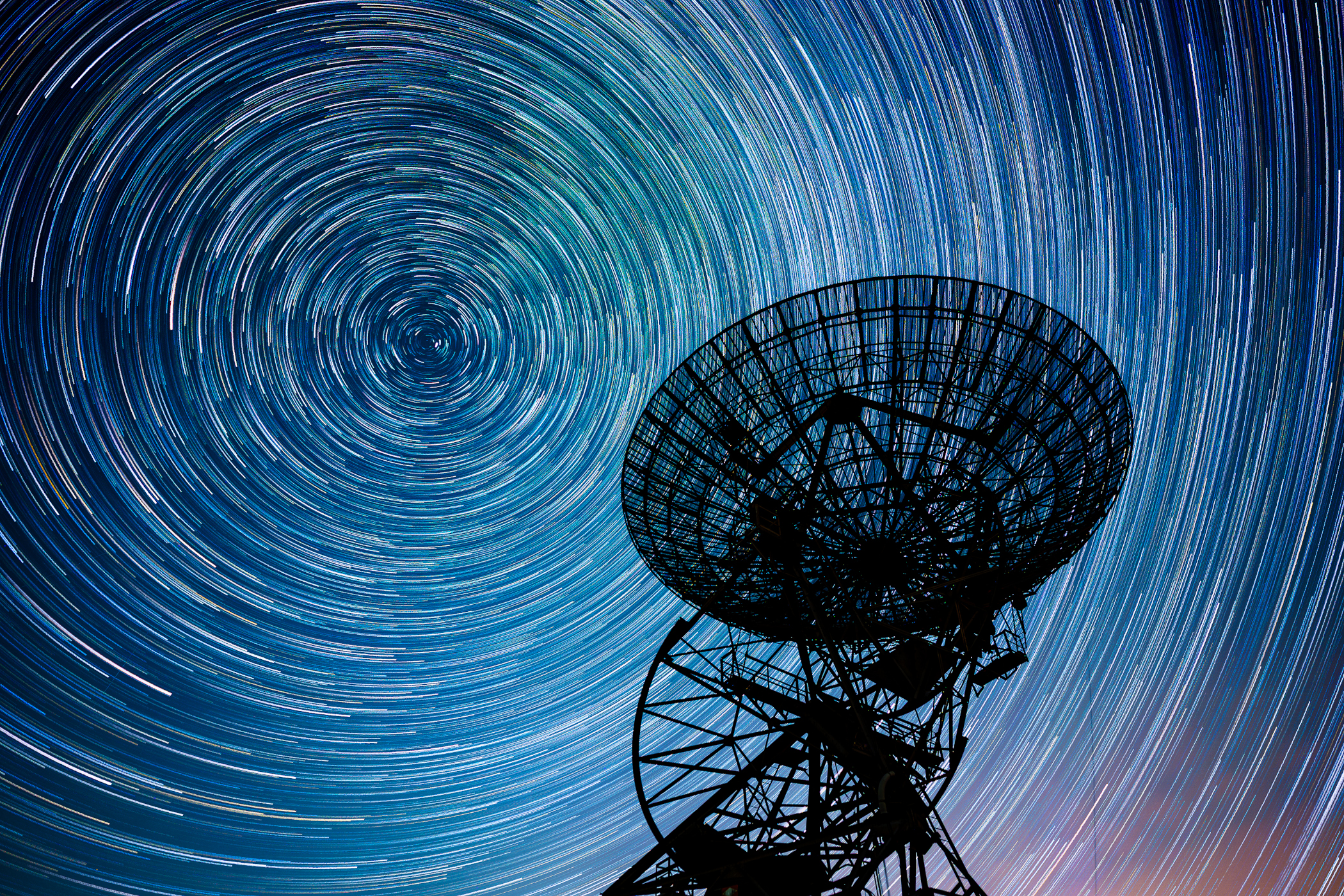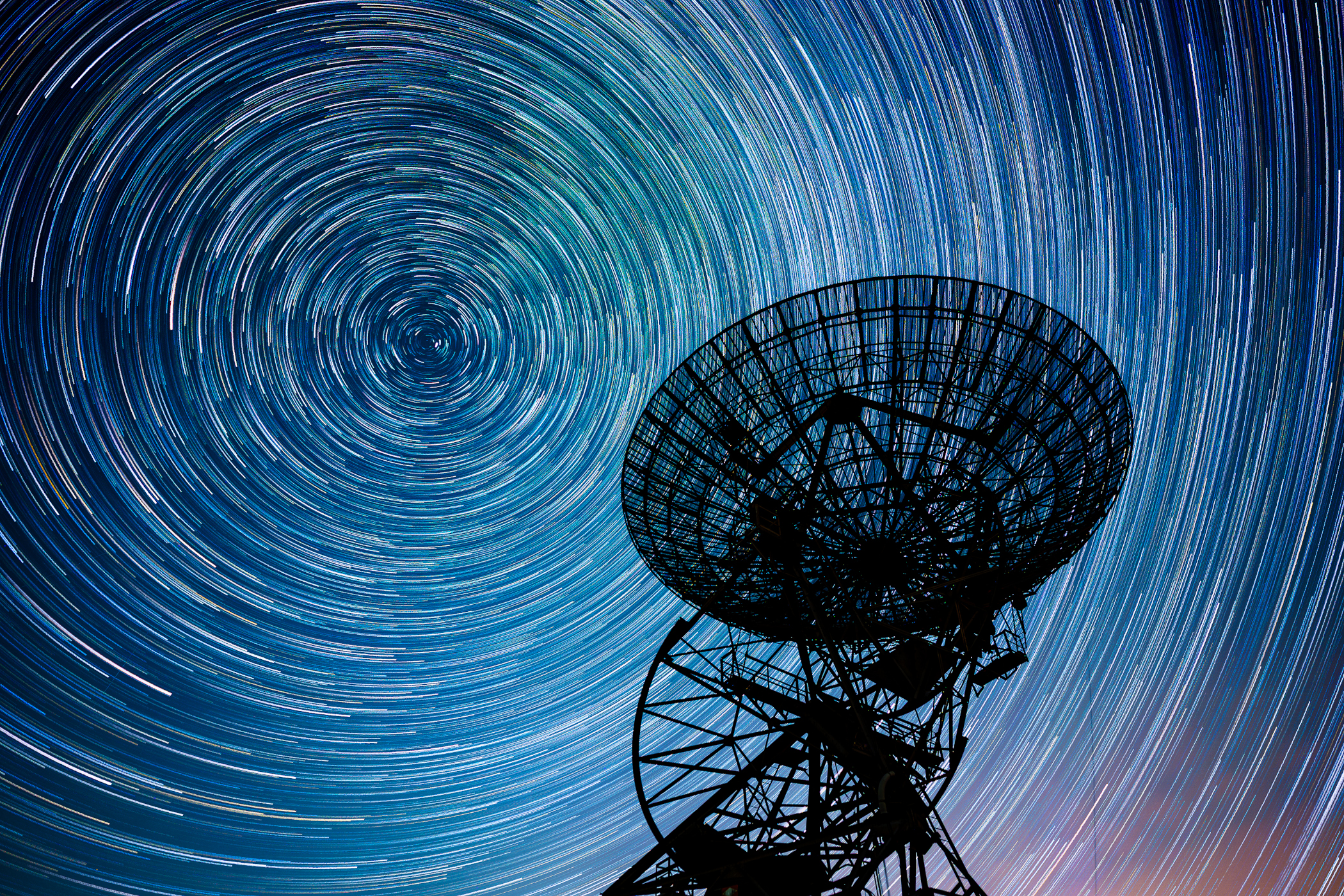
The steerable 60 foot diameter dish antenna of the One-Mile Telescope at Mullard Radio Astronomy Observatory, Cambridge, UK, is pointing skyward in this evocative night-skyscape. To capture the dramatic scene, consecutive 30 second exposures were recorded over a period of 90 minutes. Combined, the exposures reveal a background of gracefully arcing star trails that reflect planet Earth's daily rotation on its axis. The North Celestial Pole, the extension of Earth's axis of rotation into space, points near Polaris, the North Star. That's the bright star that creates the short trail near the center of the concentric arcs. But the historic One-Mile Telescope array also relied on planet Earth's rotation to operate. Exploring the universe at radio wavelengths, it was the first radio telescope to use Earth-rotation aperture synthesis. That technique uses the rotation of the Earth to change the relative orientation of the telescope array and celestial radio sources to create high resolution radio maps of the sky.
La antena parabólica de 60 pies de diámetro y orientación ajustable del telescopio One-Mile en el Observatorio de Astronomía de Radio Mullard, en Cambridge, Reino Unido, apunta hacia el cielo en esta evocadora escena nocturna. Para capturar esta escena impactante, se tomaron exposiciones consecutivas de 30 segundos durante un período de 90 minutos. Al combinar estas exposiciones, se revela un fondo de rastros de estrellas que arquean grácilmente, reflejando la rotación diaria de la Tierra sobre su eje. El Polo Celeste Norte, la extensión del eje de rotación terrestre al espacio, se encuentra cerca de Polaris, la Estrella Polar. Esta es la estrella brillante que crea el rastro corto cerca del centro de los arcos concéntricos. Pero también el histórico arreglo One-Mile Telescope dependía de la rotación de la Tierra para operar. Explorando el universo en longitudes de onda de radio, fue el primer telescopio de radio en utilizar la síntesis de apertura por rotación terrestre. Esta técnica aprovecha la rotación de la Tierra para cambiar la orientación relativa del arreglo de telescopios y las fuentes de radio celestes, creando mapas de radio de alta resolución del cielo.