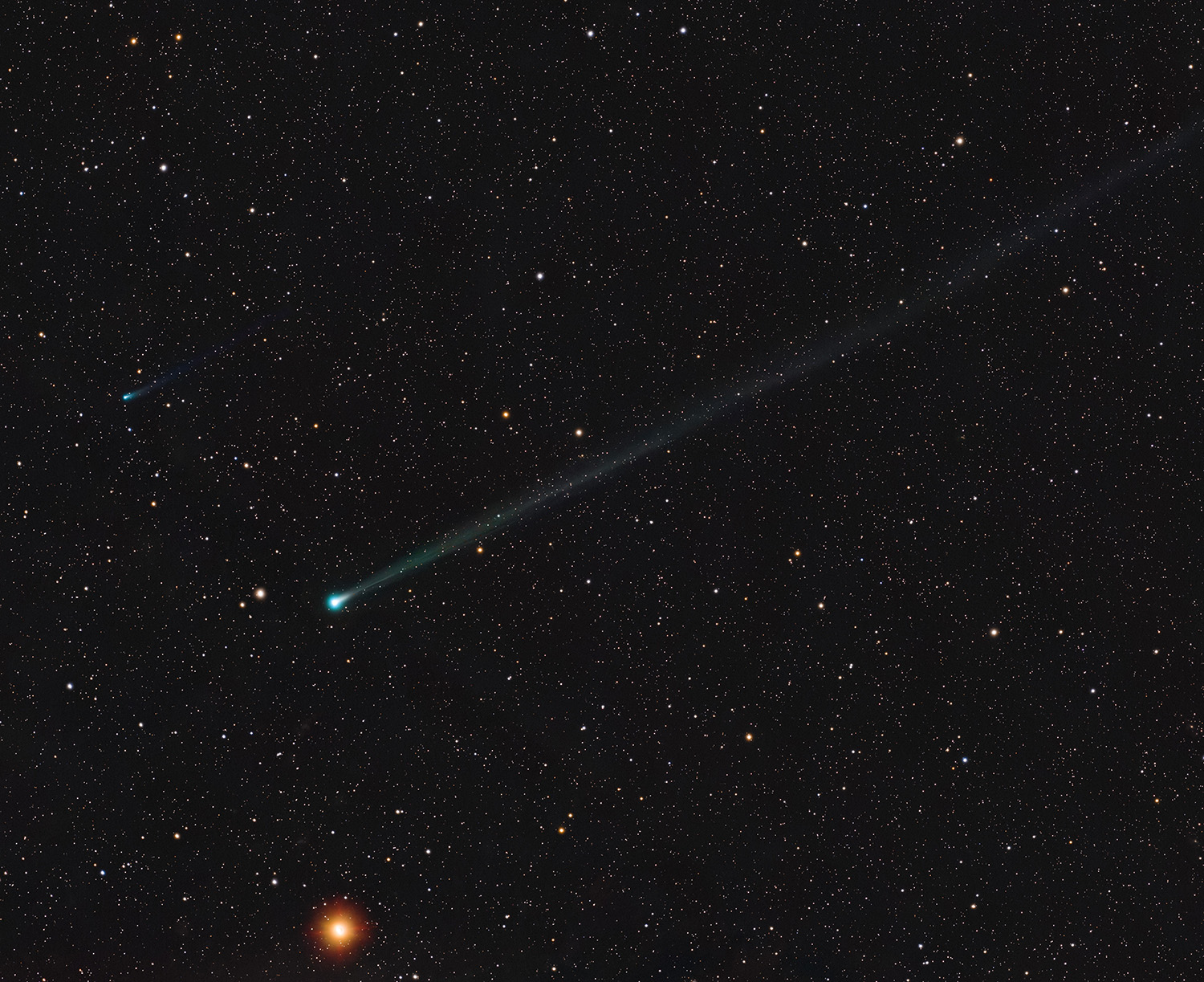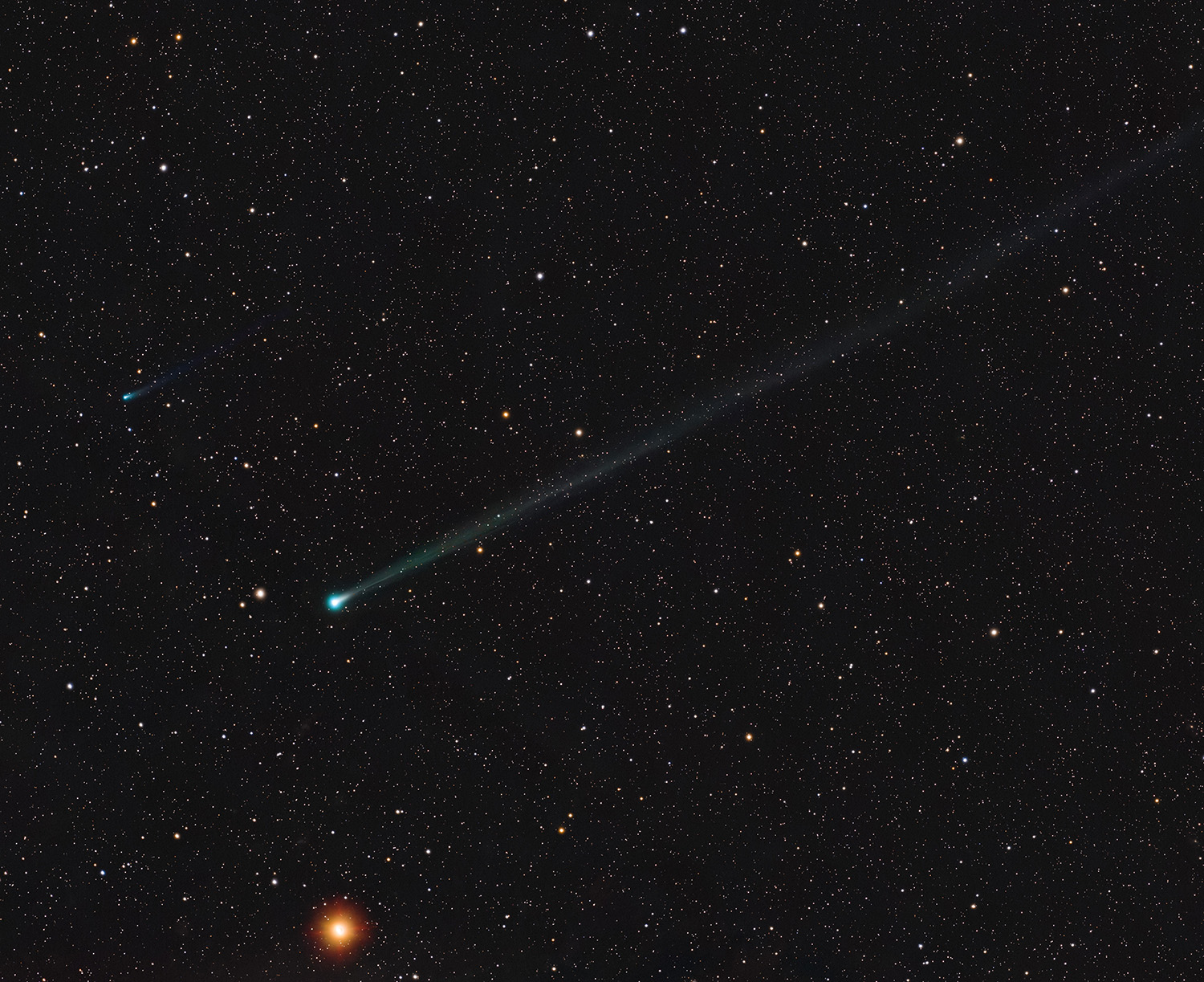
A new visitor to the inner Solar System, comet C/2025 R2 (SWAN) sports a long ion tail extending diagonally across this almost 7 degree wide telescopic field of view recorded on September 21. A fainter fellow comet also making its inner Solar System debut, C/2025 K1 (ATLAS), can be spotted above and left of SWAN's greenish coma, just visible against the background sea of stars in the constellation Virgo. Both new comets were only discovered in 2025 and are joined in this celestial frame by ruddy planet Mars (bottom), a more familiar wanderer in planet Earth's night skies. The comets may appear to be in a race, nearly neck and neck in their voyage through the inner Solar System and around the Sun. But this comet SWAN has already reached its perihelion or closest approach to the Sun on September 12 and is now outbound along its orbit. This comet ATLAS is still inbound though, and will make its perihelion passage on October 8.
Un nuevo visitante del sistema solar interior, el cometa C/2025 R2 (SWAN), muestra una larga cola de iones que se extiende diagonalmente a través de este campo de visión telescópico de casi 7 grados de ancho, registrado el 21 de septiembre. Un cometa más tenue que también está haciendo su debut en el sistema solar interior, el C/2025 K1 (ATLAS), puede verse arriba y a la izquierda de la coma verde de SWAN, apenas visible contra el fondo de estrellas en la constelación de Virgo. Ambos cometas nuevos solo fueron descubiertos en 2025 y se unen en esta imagen al planeta Marte (abajo), un peregrino más familiar en los cielos nocturnos de la Tierra. Los cometas pueden parecer estar en una carrera, casi empatados en su viaje a través del sistema solar interior y alrededor del Sol. Pero este cometa SWAN ya alcanzó su perihelio o punto más cercano al Sol el 12 de septiembre y ahora se aleja a lo largo de su órbita. Este cometa ATLAS aún está en camino hacia el Sol, y realizará su paso por el perihelio el 8 de octubre.